

Republican President Donald Trump ran on an “America First” platform yet now seems on the verge of a U.S.-led regime change war in Venezuela.
Republican Congressman Thomas Massie (Ky.) has questions about this.
During the government shutdown last month, Massie asked a practical, very America first question, “How is it that we have money for regime change in Venezuela but not money to pay air traffic controllers in our country?”
It was a good point. Trump, who once vowed to “expel the warmongers” in Washington, prefers to attack Massie on a regular basis. The Kentucky lawmaker is not alone.
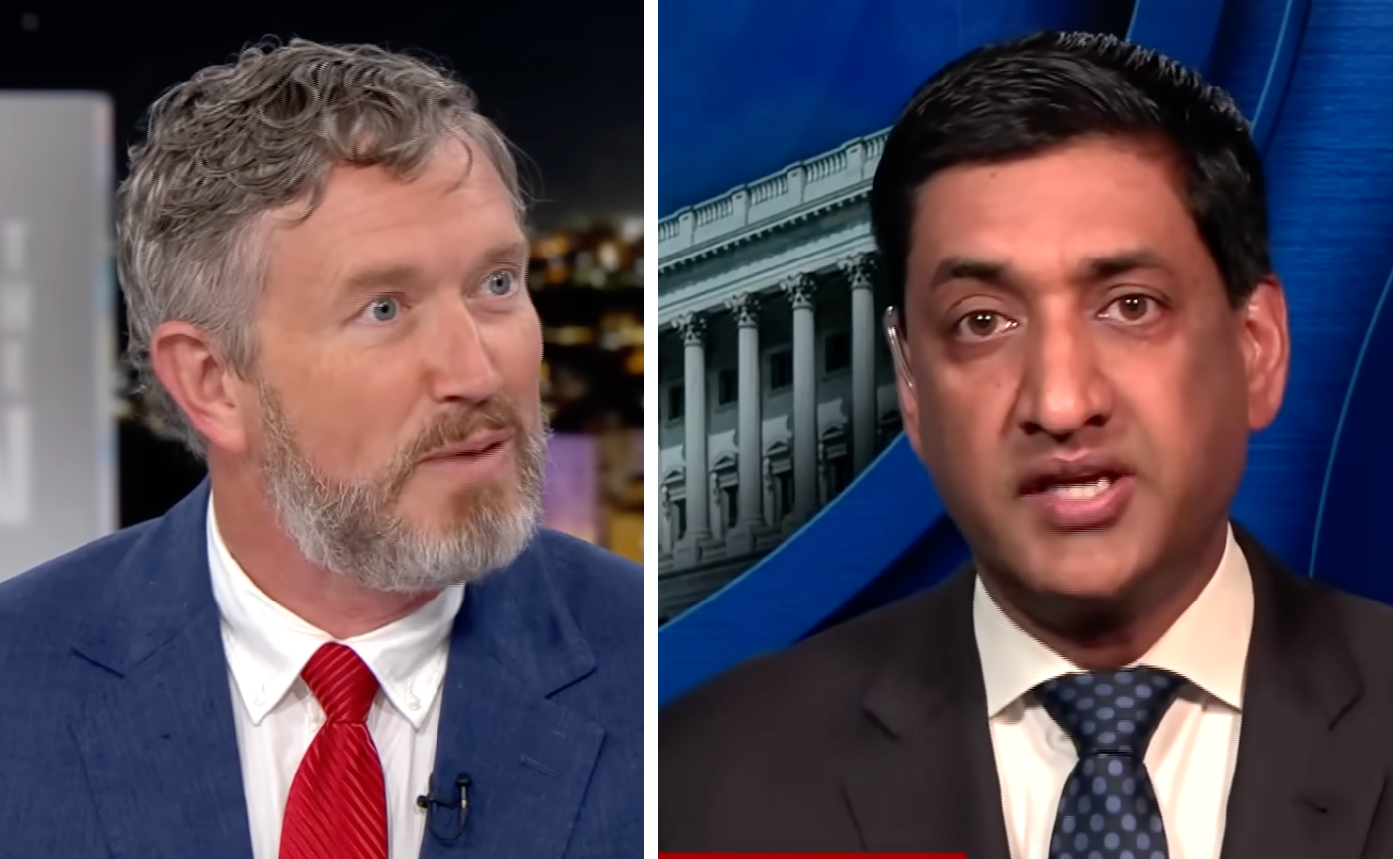
Massie appeared in June on CBS News’ Face the Nation with his friend and frequent ally, Democratic Congressman Ro Khanna (Calif.). Host Margaret Brennan said to her guests, “I know this is an unlikely pairing. You are on completely different ends of the political spectrum, but you both worked on this war powers resolution to prohibit U.S. forces from engaging in hostilities against Iran without authorization from Congress. [The] president just blew right past that.”
Their resolution failed but their coalition hasn’t in their attempt to check power. In fact, Massie just introduced another war powers bill on Monday with peers across the aisle — Rep. Jim McGovern (D-Mass.) and Rep. Jaoquin Castro (D-Texas) — to prevent Trump from launching a war on Venezuela.
Massie and Khanna have built something. Massie told Brennan, “I think I represent part of the coalition that elected President Trump. We were tired of endless wars in the Middle East, and tired of wars in Eastern Europe.”
Khanna added, “Thomas is absolutely right, and showing courage… He is, actually, representing a lot of the people in the MAGA base.”
Khanna the Democrat is not MAGA, but has made common cause with Republicans like Massie and others towards antiwar ends, seemingly forming their own, populist left-right coalition. Similar to Khanna, progressive Rep. Rashida Tlaib (D-Mich.) also supported the June resolution with Massie.
On foreign policy in general, you won’t find that much daylight between Khanna and Massie.
Both agree that the U.S. should not be funding Israel’s brutal war in Gaza, and each has commented on the moral depravity of that conflict. Massie has opposed giving any U.S. aid to Ukraine (he opposes all foreign aid) throughout the Russia-Ukraine war. Khanna has voted with his party to send U.S. aid to Ukraine, but has taken heat from Democrats for supporting Trump’s various peace proposals. Both opposed U.S. strikes in Yemen. Of course there was the cosponsored resolution to prevent a U.S. attack on Iran.
Their positions here often run counter to the majorities in their respective parties. Bipartisan foreign policy alliances in the past have often meant that the Democratic and Republican establishments have simply agreed to promote, not question, the current or next war. That's why they call it the War Party.
But Democrat Khanna is no Hillary Clinton, and Republican Massie is no John McCain. Khanna’s foreign policy positions align more closely with his party’s progressive wing than they do with centrists like Democratic House Minority Leader Hakeem Jeffries or former House Speaker Nancy Pelosi. Massie’s consistent “America First” non-interventionism is very much in the vein of libertarianism and original MAGA and is the polar opposite of Republican leaders like House Speaker Mike Johnson (La.) and Sen. Mitch McConnell (Ky.).
The thread that connects these two is an antiwar populism that both Khanna and Massie seem to understand and find value in. In a November 19 story titled, "Rep. Ro Khanna cracks the MAGA coalition over the Epstein files,” NBC News observed, “Khanna has a different vision of bipartisanship than other Democrats, including former Presidents Joe Biden and Barack Obama, who sought to find the most moderate Republicans and work with them on noncontroversial goals.”
In Washington, opposing wars is almost always controversial.
“By contrast, Khanna tends to look for GOP lawmakers to partner with on populist issues that both the left and the right can sell as a rebuke of an entrenched establishment,” the story noted.
Besides just partnering with Massie, Khanna has "worked with Republicans to advocate for reining in the government’s warrantless surveillance powers under FISA Section 702 and to prevent U.S. military intervention in Yemen."
None of this is lost on the Quincy Institute, which is presenting its annual award to both men Wednesday night, “in recognition of their work to reassert Congress’ constitutional authority over questions of war and peace.” QI is the publisher of Responsible Statecraft.
At a time when much of the Democratic Party’s identity is wrapped up in simply opposing Trump, Khanna has consciously taken a different approach: Focus on the issues at hand, as he did in pairing with Massie to open the Epstein files, and don’t get so hung up on the personalities.
Even if one of those personalities is the president. “Let's spend more time railing against a rigged system than just memeing against Trump,” Khanna shared on X recently.
“I have not gotten into Twitter wars with Marjorie Taylor Greene or Lauren Boebert. I have a real friendship with Thomas Massie,” Khanna told NBC. “They trusted me enough not to make it about Donald Trump.”
Massie said of his Democratic ally and their cross pollination, “Ro gave me the idea, whether he meant to or not. He’s able to put aside the partisan bomb throwing in order to work across the aisle, and he’s really good on TV.”
This type of pairing isn’t unprecedented. In the George W. Bush and Barack Obama eras, Republican Ron Paul and Democrat Dennis Kucinich were often the most outspoken antiwar duo in Congress, representing the hard right and hard left of their respective parties.
Before the Epstein files vote, Khanna said on the House floor, “The Epstein class is going to go. And the reason they’re gonna go is the progressive left and the MAGA right and everyone in between is finally waking up against this rotten system.”
Endless wars have long been at the heart of that corrupt system.
The concept of an antiwar left-right alliance is not new. But it is good to see it regenerating in the tag teaming of these two lawmakers.- Left-right backlash against war with Venezuela is growing ›
- New House, Senate attempts to preempt war with Venezuela ›
- Can 'America only' Massie survive today’s AIPAC mobbing? | Responsible Statecraft ›
- Massie tells RS why he went after Hegseth and not Trump ›