

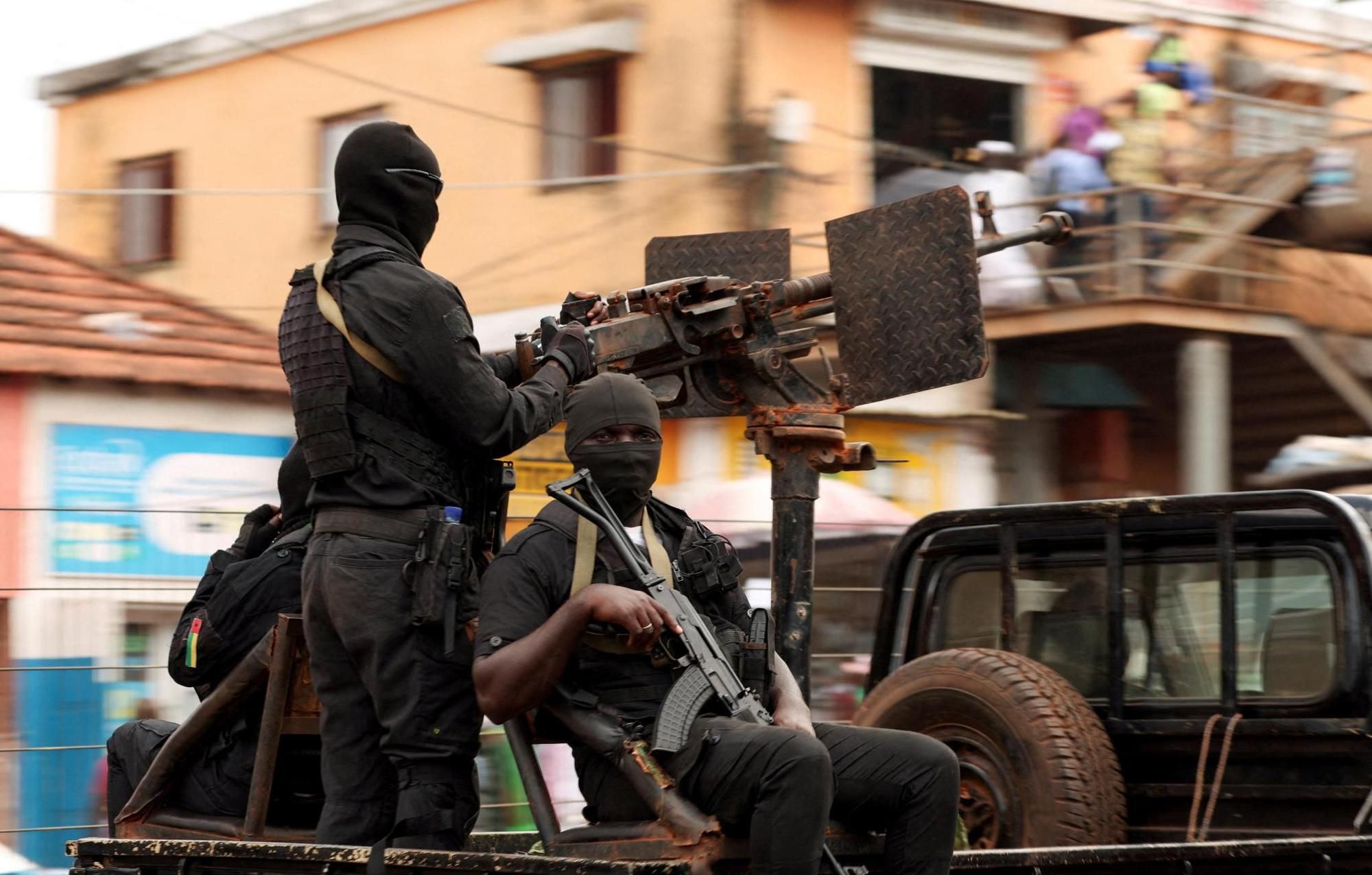
On November 26, soldiers of the Presidential Guard took power in yet another West African country. This time, it was Guinea-Bissau — the tiny country on the Atlantic coast better known to the world as the region’s first “narco-state.”
That Wednesday, Guinea-Bissau’s president, Umaro Sissoco Embaló, was deposed a few hours before the scheduled official announcement of the results of a long-delayed presidential election in which he was hoping to secure a second term. The putschists immediately suspended constitutional order and annulled the poll – sparking speculation of a sham coup orchestrated by the incumbent to avoid handing over power to the opposition. Days earlier, both Embaló and his main challenger, Fernando Dias Da Costa, had claimed victory, raising tensions in the country of roughly 2.3 million.
Since its independence in 1974, the former Portuguese colony has endured nine coups, making it one of West Africa’s most fragile states. As a “narco-state” that acts as a key transit point for the cocaine trade between the northern tier of South America and Europe, it is arguably of considerable relevance to the Trump administration’s priority of destroying international drug cartels.
The latest coup is the second successful military takeover this year in Africa’s rapidly expanding coup belt. But unlike the regional trend, where recent coups were often inspired by sovereigntist and nationalist concerns, Guinea-Bissau’s November 26 coup appears to have different motivations. In their first broadcast, the putschists claimed they struck to stop an alleged plot by “some national politicians with the participation of a well-known drug lord and domestic and foreign nationals” to destabilize the country.
It is not the first time that figures associated with the illicit cocaine trade have been accused of interfering in Guinea-Bissau’s politics. According to the Geneva-based Global Initiative Against Transnational Organized Crime (GI-TOC), “Politics and cocaine in Guinea-Bissau have gone hand in hand for decades. Upheavals in one cause ripples in the other.” In April 2012, the country’s chief of staff at the time, General Antonio Indjai, seized power in a coup reportedly influenced by the drug trade. Another coup in 2022, this time aimed at unseating Embaló, was also alleged to have ties with the drug cartels.
This situation reflects Guinea-Bissau’s role as a central cog in the international drug trafficking trade. Since the early 2000s, South American drug cartels, seeking a safer channel to reach Western European markets, while avoiding tighter U.S maritime controls in the Atlantic, have shifted focus to Guinea-Bissau’s Bijagós archipelago of 88 islands for the storage and transshipment of cocaine. At least two to three tons of cocaine, valued at roughly $246 million (a sum that exceeds the country’s annual budget), pass through Guinea-Bissau every month on their way to Europe. Although relatively cheap in West Africa, cocaine is in high demand in cities like Berlin, Paris and London where it can cost as much as $82,000 per kilo.
Colombian drug lords are a common sight in Bissau’s social scene, sporting luxury cars and mansions. Their lifestyle sharply contrasts with that of the rest of a country, which, with a GDP per capita of $494, is among the world’s poorest countries. According to a 2023 World Bank estimate, more than a quarter of Guinea-Bissau’s population live below the poverty line. The cocaine trade provides employment for many of the country’s disaffected youth. But it is the political and military elite that benefits most by providing cover for the flow of drugs through the country, ensuring that the risk of shipments being intercepted by the authorities remains within acceptable limits.
“As the drug money flows into Guinea-Bissau’s elite circles, it reinforces corruption, corrodes governance and weakens state institutions — factors that inevitably lead to instability,” Stephen Adewale, a professor of history at Nigeria’s Obafemi Awolowo University Ile Ife, told Responsible Statecraft.
A Deutsche Welle journalist on the ground in Guinea-Bissau has painted a lucid picture of the apparent role of drug money in the November 23 elections even before the coup. “In the capital Bissau, political factions drove convoys of expensive SUVs, professionally produced videos ran on LED screens, and rallies were staged with costly sound and light equipment — despite most candidates officially claiming to have limited funds.”
The United States established diplomatic relations with Guinea-Bissau in 1975 and promptly opened an embassy in its capital to facilitate a deeper engagement with the country whose independence was achieved by a left-wing insurgency that received support from the Soviet Union and its allies. When civil war broke out in 1998, however, Washington abandoned its in-country embassy and moved its diplomatic representation to neighboring Senegal.
Whether the American absence shaped the country’s descent into “narco-state” status can be debated, but Guinea-Bissau’s importance as the key transshipment point for cocaine between Colombia and the fast-growing market in Europe grew steadily over the years since. And the collateral effects of the trade and the corruption it fostered may have boosted insurgencies in both Latin America and in West Africa.
For example, following a sting operation conducted by the Drug Enforcement Administration (DEA) in 2013, Gen. Antonio Indjai, Guinea-Bissau’s senior military official at the time, was charged for conspiring to traffic drugs and procure military-grade weapons including surface-to-air missiles for Fuerzas Armadas Revolucionarios de Colombia (the “FARC”), a South American paramilitary group long designated by the United States as a Foreign Terrorist Organization. Although Indjai managed to slip away, some of his accomplices like the country’s Chief of Naval Staff, Na Tchuto, did time in the U.S for this.
Likewise in 2019, one of two large cocaine shipments seized in Guinea-Bissau was linked to a Malian who was using the proceeds from drug trafficking to finance the Al-Mourabitoun terrorist group, which is affiliated with Al-Qaeda.
“Increased drug flows to West Africa and the Sahel undermine peace and stability in the region,” according to Amado Philip de Andres, the head of the United Nations Office of Drugs and Crime (UNDOC) for West and Central Africa.
Last year, Andres co-authored a report that sheds light on how armed groups in the Sahel are profiting from the illicit drug trade to finance their operations. The report found that extremist armed groups are benefiting indirectly from drug trafficking through “the payment by traffickers of zakat, a form of wealth tax imposed by JNIM and ISGS in areas where they operate, or by taxing convoys that cross areas under their control.” Jama'a Nusrat ul-Islam wa al-Muslimin (JNIM) is the official branch of Al-Qaida in Mali while the Islamic State in the Greater Sahara (ISGS) operates across the borders of Mali, Benin, Niger and Burkina Faso.
Despite Guinea-Bissau’s importance to the illicit international drug trade and to radical Islamist groups in the Sahel and West Africa, Washington’s interest in the country has been sporadic at best. Except for 2019 and 2024, when U.S. bilateral aid spiked up to $19 million and $28 million, respectively, the average yearly amount of assistance from Washington over the past decade came to less than $1 million. While the Pentagon has sent small teams of forces to Guinea-Bissau for training purposes, the DEA has mainly provided only intelligence support.
In July this year, Embaló was one of the five African presidents who visited Trump in Washington to discuss opportunities for trade and cooperation. But the illicit drug trade continues with all its implications for political stability and regional security.
Several days after the coup, the country’s new helmsman, General Horta Inta-A, declared "zero tolerance in the fight against corruption and drug trafficking.” But since cocaine first entered the country in 2005, Guinea-Bissau has proved unable to rid itself of the illicit trade. Perhaps the new junta will surprise. The previous record invites skepticism.
What is clear, however, is that the international community needs to get behind any serious and credible domestic effort by the regime to tackle a drug problem whose consequences have dire effects for the region. Restoring a U.S. diplomatic presence in situ could be a good step in this direction.
- With Venezuela, Trump poised to make mistake of epic proportions ›
- In pardon of narco trafficker, Trump destroys his own case for war ›