

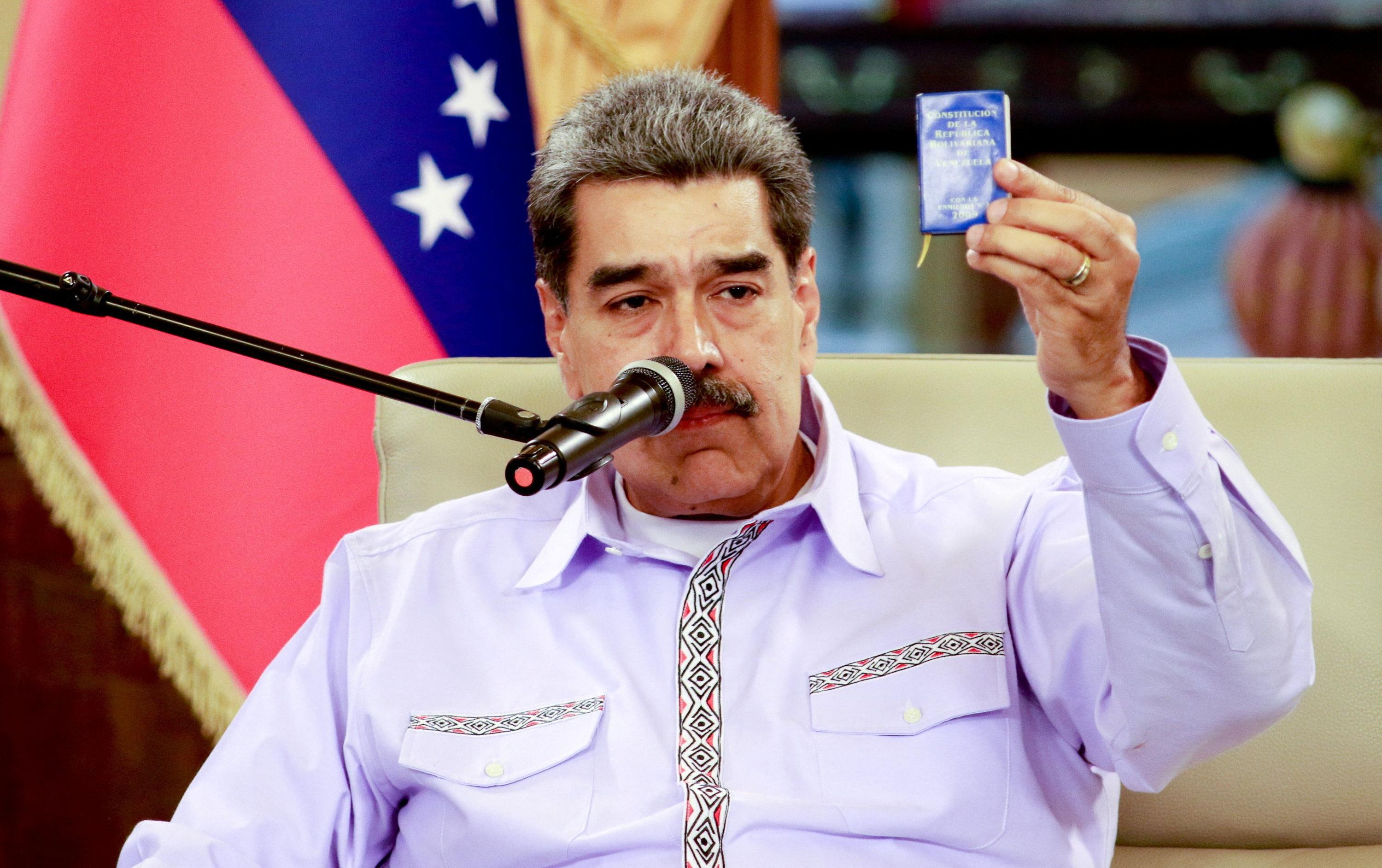
After another week of extra-judicial strikes on vessels in the Caribbean and Pacific, the U.S. is now reportedly preparing to hit military targets in Venezuela.
International condemnation of the strikes has been widespread. For example, Jean-Noël Barrot, French Minister of Foreign Affairs and Europe, accused the U.S. of ignoring international and maritime law in an interview on Thursday.
But the neoconservative lobby inside the Trump administration is unmoved.
Secretary of State Marco Rubio, the lead proponent of regime change in Venezuela, has pushed for these actions — allegedly as part of an effort to get tough on drug cartels, framing the Latin American nation through a “narco-terrorism” lens.
Washington’s “narco-terrorism” frame has pedigree; the DOJ indicted Maduro on narco-terrorism charges in 2020, but today’s drug threat picture looks different from that narrative.
Strategically, the label misaligns ends and means: it invites military solutions to problems that the DEA and Coast Guard still characterize primarily as law-enforcement interdiction.
It also simplifies a complex geopolitical picture, all the while increasing the risk of entangling the U.S. in an open-ended conflict in the Western Hemisphere.
The DEA’s 2024–2025 threat assessments identify fentanyl as the top U.S. drug danger, synthesized mainly in Mexico with precursors from China. Meanwhile, UNODC data show record coca cultivation and cocaine output centered in Colombia, with Venezuela functioning primarily as a transit route.
Yet, Washington’s “counternarcotics” rhetoric has already translated into military escalation, and with it come significant diplomatic, economic, and political risks.
Escalation might threaten U.S. energy interests, particularly Chevron’s limited license to import Venezuelan crude, a lifeline for U.S. Gulf Coast refineries that remain reliant on the country’s uniquely heavy oil.
Escalation could also bolster Maduro rather than undermine him. For a leader whose “anti-imperialist rhetoric” enhances domestic legitimacy, U.S. aggression is politically beneficial.
Caracas has already surged troops and naval deployments along key coastal routes and encouraged auxiliary mobilization, explicitly linking the moves to U.S. buildups in the Caribbean.
While there should be no doubt of the disruptive effects of U.S. escalation with Venezuela, one counterargument is that if Washington were to launch a land invasion, the Venezuelan Armed Forces (FANB) would be no match for U.S. military might. The U.S. military is the most advanced in the world — the FANB, in simple terms, is not. Its loyalty to Maduro is transactional, bought through select privileges rather than commitment to the cause. Public support for the regime is also brittle.
However, as the U.S. well knows, military superiority does not necessarily translate into political success, as Iraq and Afghanistan made painfully clear.
And even if the regime were to collapse, stabilizing a post-Maduro Venezuela would demand years of costly engagement, something neither the U.S. public nor its leadership appears to have the attention span or political will for.
A U.S.-led intervention — even a limited one — would have a destabilizing effect on Venezuela and the region. It risks spilling beyond Venezuela’s borders, drawing Colombia and even Pacific maritime routes into a widening theatre of operations. It could create humanitarian and security vacuums, driving a new wave of migration northward toward the U.S.
International refugee organizations now monitor over 6.8 million Venezuelan refugees and migrants across Latin America and the Caribbean, with continued onward movements. A disruption to Venezuela’s security situation could accelerate secondary flows northward, further straining regional reception systems already operating at full capacity.
Regionally, Mexico and Brazil have openly criticized U.S. boat strikes and deployments, and U.N. human-rights experts warned that the “war on narco-terrorists” violates the right to life, increasing legitimacy costs for unilateral actions. The recent spat between President Trump and Colombia’s president, Gustavo Petro, further complicates the regional calculus, since Venezuela’s closest neighbor is key to mitigating the spillover effects of an intervention.
Intelligence-sharing and joint policing rely on trust and legitimacy. Escalation would weaken both, undermining the very multilateral approach needed to fight transnational crime, such as drug trafficking, effectively.
The “narco-terrorism” frame isn’t new. Still, the use of Aegis warships and lethal interdictions underscores the risk that a rhetorical tool is now driving escalatory military behavior rather than cooperative policing.
A wiser approach for Washington is to prioritize intelligence sharing and law enforcement cooperation with allies — rather than rely on destroyer-launched kinetic strikes — and to align with the DEA’s operational strategy and the Coast Guard’s record of interdictions, without provoking backlash against militarization.
Lasting stability will come not from escalation, but from diplomacy, intelligence sharing, and collaboration with regional partners and institutions like Interpol to confront the causes, not merely the symptoms, of the problem.
The views and opinions expressed in this piece are solely those of the author, and not those of the University of North Texas at Dallas.
- Cartels are bad but they're not 'terrorists.' This is mission creep. ›
- Will Trump really attack Venezuela? ›
- A sneak peek at how Americans view Trump foreign policy so far | Responsible Statecraft ›
- US strikes are blowing up more than just boats in LatAm | Responsible Statecraft ›
- Elliott Abrams returns, promoting a Caracas cakewalk | Responsible Statecraft ›
- In pardon of narco trafficker, Trump destroys his own case for war | Responsible Statecraft ›
- Trump Venezuela oil obsession doesn't make sense ›
- Guinea-Bissau: The ‘narco-state’ the US virtually ignores | Responsible Statecraft ›
- Trump bombs Venezuela, captures Maduro | Responsible Statecraft ›
- Hubris: When the US military is feeling invincible, that's dangerous | Responsible Statecraft ›