

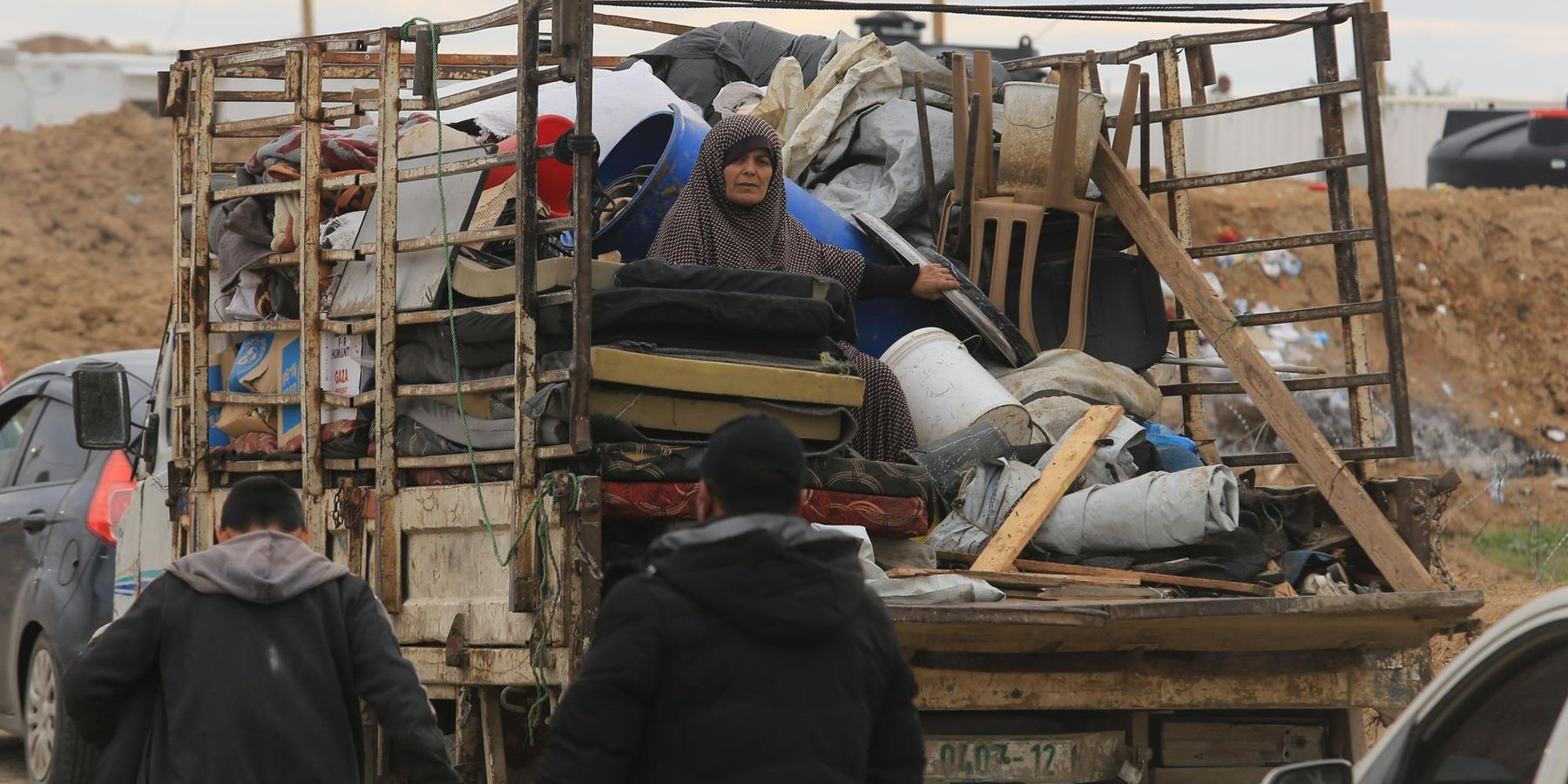
The Israeli noose around Gaza tightened December 30, with news that Jerusalem revoked the licenses of 37 aid groups that operate in the destroyed enclave, effective March 1.
Such a move suggests that the Israeli government means to drive Gaza’s reeling, destitute people out of the enclave, presumably to Somaliland, which Israel recognized on December 26 as an independent state, before anyone else did. It’s no secret that the ruling Israeli government wants to ethnically cleanse Gaza, and it now appears to be putting its ducks in a row.
At the very least, the suspension of aid organizations will lead to the collapse of the already foundering ceasefire, which Israeli Prime Minister Benjamin Netanyahu never appeared enthusiastic about in the first place.
The list of banned groups includes Oxfam, Doctors Without Borders (MSF), CARE, and Defense for Children International, with Israel singling out MSF as having staff that supposedly aided Hamas. According to Al Jazeera on December 30, the overall suspension occurred because these organizations failed “to meet [Israel’s] new rules for aid groups working in the war-ravaged Gaza Strip.” What are those new rules, one might ask. The new rules require demanding reporting requirements and compel groups to submit staff lists, including sensitive information about staff and their families — like passport and personal identification numbers.
“The message is clear: Humanitarian assistance is welcome. The exploitation of humanitarian frameworks for terrorism is not,” stated Diaspora Affairs Minister Amichai Chikli, without elaborating on what that exploitation would look like in the mind of the Israeli government.
Meanwhile, MSF announced on January 2 that, with the suspension of registration, Israel “is in breach of [its] obligations under international humanitarian law…If the descriptions of what our team sees with their own eyes in Gaza are unpalatable to some, the fault lies with those committing these atrocities, not with those who speak out about them.”
MSF denied other Israeli allegations. “MSF would never knowingly employ anyone involved in military activities.” The group also worries about the new Israeli registration requirement “to share personal information of our Palestinian staff with Israeli authorities. This is heightened by the fact that 15 MSF colleagues have been killed by Israeli forces since October 2023.
In any context — especially one where medical and humanitarian workers have been intimidated, arbitrarily detailed, attacked, killed in large numbers — demanding staff lists as a condition for access to territory is an outrageous overreach… made all the more dangerous by the absence of any clarity about how such sensitive data will be used, stored or shared,” MSF stated.
One affected group, the American Friends Service Committee, announced on December 30 that Israel’s new registration process “compromises humanitarian principles, independence and access to civic space. It also imposes prohibitively difficult reporting requirements…Disclosing operational information to a government credibly accused of genocide and apartheid endangers the lives of our staff and partners. Israel has already killed more than 500 aid workers since October of 2023. For these reasons, AFSC has made the difficult decision not to reapply for registration with the Israeli government.”
This is no doubt the intended effect of Israel’s license revocations in the first place.
According to the Catholic Register on January 5, “Statements from both the European Union and the United Nations have condemned [Israel’s] move…A joint statement by 10 foreign ministers was released on Dec. 30, in which they warned of a ‘catastrophic’ and ‘renewed deterioration of the humanitarian situation in Gaza.’” The article adds that one suspended group, Caritas, hopes to be able to continue its work in Gaza. The organizations suspended cannot, after March 1, “bring in aid from outside Gaza [but] they can still continue with their work using supplies obtained from within Gaza.”
This severing of Gaza’s food lifeline dates back to October 9, 2023, when Israel announced a “total blockade.” More recently Israel throttled aid and never allowed anywhere near the 600 aid trucks per day called for in Trump’s “ceasefire.”
“After October 7, 2023, Israel intensified its efforts to recast UNRWA not as a humanitarian agency operating under an international mandate but as a political problem to be neutralized,” wrote researcher and activist Ghada Majadli, who has served as the director of the Department of the Occupied Palestinian Territory at Physicians for Human Rights Israel, on January 2.
UNRWA, Majadli argues, was a test case. Israel alleged that some of the group’s employees had Hamas affiliations and effectively tarred them, crippling the organization and setting the stage for later bans in order to starve residents out of Gaza.
Israel’s strangulation of aid has caused 320,000 Gazan children under the age of five to face acute malnutrition in the coming months if adequate food fails to arrive, Middle East Eye reported just before the Christmas holiday. And how can adequate food reach these toddlers if the groups that supply it are banned as of March 1– groups that include Action Against Hunger, Campaign for the Children of Palestine, Medicos del Mundo, Mercy Corps, Relief International, War Child Holland, and others?
This is no haphazard prohibition; this is a generational assault. The 320,000 statistic only applies to acute malnutrition, leaving hundreds of thousands more in less crisis, but in crisis nonetheless.
How is the Trump administration reacting to Israel’s latest move, which may well jeopardize the ceasefire? When asked, a State Department spokesperson told us: “Since the ceasefire, the U.S. government has discussed with partners and the Israeli government multiple ways to address the de-registration of INGOs with a focus on balancing Israel’s legitimate security concerns about Hamas’ instrumentalization of aid with the need to ensure provision of assistance under the terms of the President’s peace plan. The CMCC is actively working with stakeholders, to continue to meet the humanitarian needs of the people of Gaza while ensuring Hamas cannot pose a continuing threat in the future.”
Those “multiple ways” of addressing the de-registration of aid groups are not specified, while exactly how Hamas is instrumentalizing non-existent aid remains a mystery.
Has the White House been caught off guard? Probably. But Washington’s response to Israeli refusal to let aid through to the Strip has been muted at best.
Trump claims to have brought peace to Gaza. He would be more credible should he demand that the people there not starve or be given tents that do not leak or blow away since their homes have been demolished. He might be given credit, then, for saving lives. If he really wants that Nobel prize, then getting food, shelter and medicine into Gaza might be a first step toward Stockholm.