

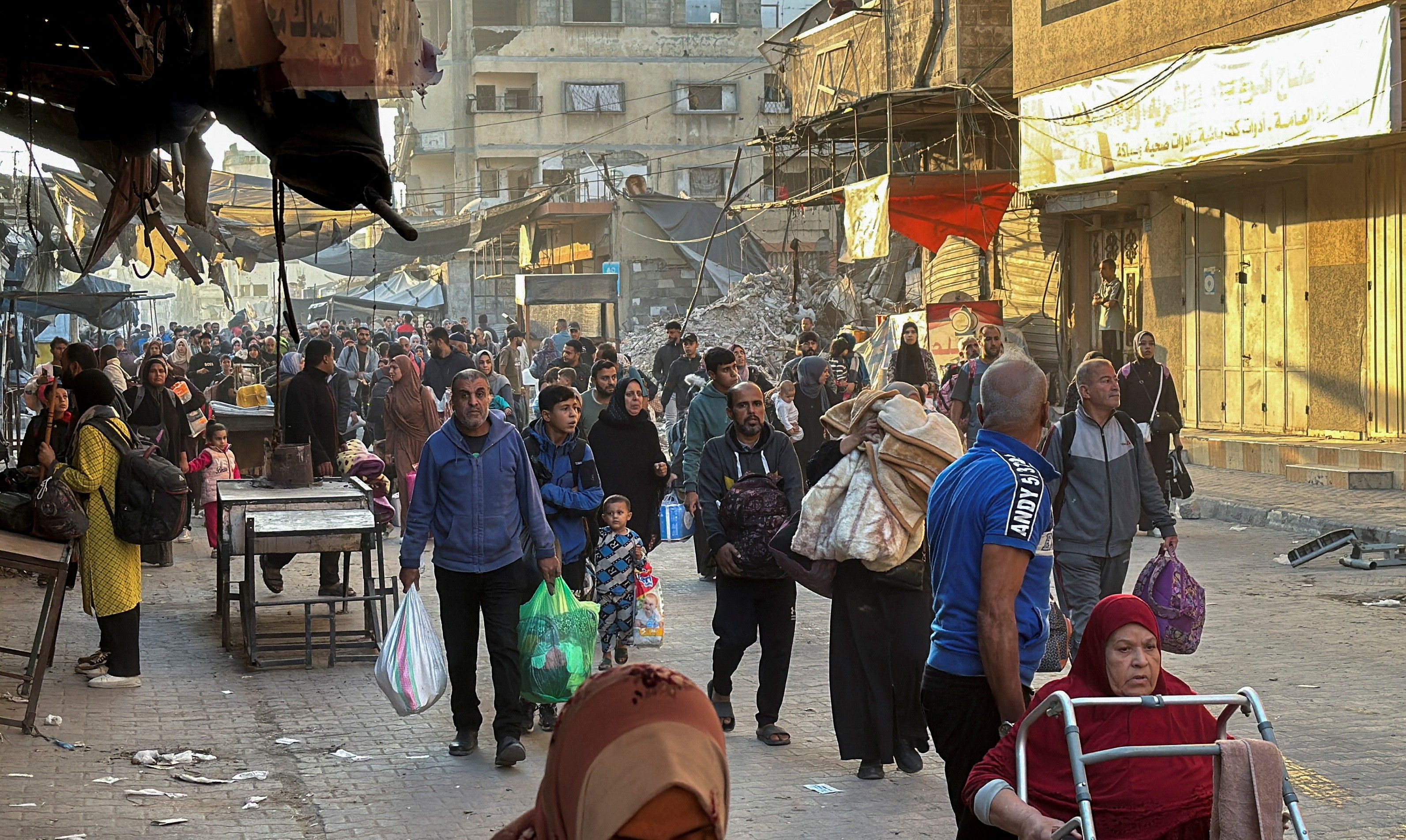
The ceasefire agreement in Gaza is hanging by a thread as both Israel and Hamas face allegations of violating the terms of the deal, which went into force on Monday.
Israel claims that Hamas has been dragging its feet on returning the remains of deceased hostages. So far, the Palestinian armed group has only managed to deliver the bodies of nine of the remaining 28 deceased hostages.
Hamas claims that it is moving as quickly as it can given the difficulties of finding bodies that may be buried under rubble or hidden deep in bombed-out tunnels. But that hasn’t stopped Israel from threatening to “resume fighting and act to achieve a total defeat of Hamas.”
Israel announced that it is scaling back its own compliance with the ceasefire in what it says is a response to violations by Hamas. Perhaps most consequentially, Israel is now dramatically reducing the amount of aid that it will allow to enter the strip, dropping the total number of permitted daily truckloads from 600 — the amount aid officials say is needed to help alleviate famine — to 300.
Israel claims that this reduced number of trucks will carry only humanitarian aid. But Al Jazeera reported Thursday that many of the shipments have contained commercial products, which are unaffordable for the vast majority of Gazans. Meanwhile, Israel has continued to carry out attacks within Gaza, killing at least nine Palestinians who allegedly got too close to Israeli military facilities in the strip.
U.S. officials have sought to play down these early challenges, with one senior adviser to President Donald Trump telling reporters that Hamas is honoring the deal, citing as evidence the return of all living hostages on Monday. But it remains unclear whether the U.S. will be able to keep up enough pressure on both sides to force a lasting peace.
Further complicating affairs have been images of Hamas cracking down on armed gangs that have grown in power — sometimes with explicit Israeli help — since the war began. In recent days, videos have circulated on social media showing Hamas carrying out field executions of gang members, sparking no small amount of unease among Western leaders.
The startling images highlight a key weakness of the deal: it initiated a partial Israeli withdrawal without first establishing some form of temporary government or peacekeeping force to manage the transition. Trump is now attempting to fill that gap by recruiting potential peacekeepers, with reports saying that Indonesia, Azerbaijan and Pakistan are interested in sending soldiers to support the effort.
But, even with a peacekeeping operation in place, significant questions remain about how to protect the deal. Hamas has agreed to hand over its heavy weapons, but only to an Arab or Palestinian governing body. And it has not accepted the idea of surrendering its light weapons, which could turn into a significant sticking point with Israel.
It’s not all bad news, of course. Egypt announced Tuesday that all sides had reached agreement on a board of 15 Palestinian technocrats who could manage the post-war transition in Gaza. And Egypt’s foreign minister said Hamas is “committed” to having “no role” in the transition. But the names of the technocrats are yet to be revealed, and the path to handing over power remains fraught at best.
The primary question now is whether Trump is willing to keep up the pressure on Israel in order to force it to accept a lasting peace — a situation that may well end with Hamas maintaining a certain degree of power in Gaza. One worrying sign on this front came Tuesday, when Trump threatened to restart the war if Hamas failed to turn over all of its weapons.
“They will disarm or we will disarm them,” he told reporters. “Got it?”
- Gaza plan: Looks Like peace, acts like occupation ›
- Trump Gaza Deal will work: If he keeps pressure on Israel ›
- Meet the Israeli-backed gangs that threaten to spoil Gaza ceasefire | Responsible Statecraft ›
- Is this Trump’s ‘Mission Accomplished’ moment? | Responsible Statecraft ›
- Israel shredding Gaza ceasefire while US distracted by Ukraine | Responsible Statecraft ›
- As expected, Netanyahu back demanding more war with Iran ›
- By suspending 37 aid orgs is Israel pushing toward a final expulsion? | Responsible Statecraft ›