

There is a laundry list of reasons for why the U.S. foreign policy establishment comes up short on so many occasions. A total and complete absence of accountability in the industry ensures that those who demonstrate poor judgment are protected from punishment and allowed to repeat it. In this harsh political climate, politicians have an incentive to double down on the status-quo rather than admit mistakes. And an aversion to the smallest reform in Washington, D.C. means that it’s easier to simply go along to get along—even if doing so compounds failure.
But so much of what goes wrong in U.S. foreign policy today can be traced back to a lack of good, old-fashioned common sense. For one reason or another, pragmatism has become an endangered species inside the Beltway and is often overshadowed by a gospel that the United States has the strength, power, fortitude, and perseverance to bend other countries—friend and foe alike—to its will. The political and policy class remains captivated by their own intellect and driven by assumptions that turn out to be hollow, shallow, and counterproductive.
Washington has a lot on its plate these days, from an Iranian government increasingly churning out ever more enriched uranium to a Russia highly skilled at playing a weak hand well. China’s growing assertiveness in the Asia-Pacific continues to raise hackles in the commentariat that the U.S. is only a few decades away from being overpowered by a new red menace. North Korean leader Kim Jong-un’s nuclear weapons program remains locked in his cold, dead hands. Back in the Western Hemisphere, Venezuela’s Nicolas Maduro is still in Caracas, toiling away despite the country’s near-total dysfunction, systemic electricity blackouts, rampant disorder, and a Washington-imposed economic embargo.
Some of these developments were unavoidable and likely would have happened regardless of U.S. policy. The world of 2019 is a whole lot different than the world of 1989 or 1992, when U.S. scholars and commentators were chirping about the “end of history” making way for a United States unencumbered by rivals or competitors. Beijing’s decades of double-digit economic growth and diversification was the inevitable prelude to a People’s Republic of China more than willing to throw its weight around in its own region. Ditto Moscow, which quickly after a short dalliance with the West in the 1990s became convinced that Washington was treating Russia like a father treats his less-successful son.
And yet global dynamics aside, it’s quite remarkable how problems the U.S. presently confronts have been made worse by its own hand. Iran’s nuclear program is perhaps the most obvious example of an own-goal, in which a powerful group of regime change advocates persuaded President Trump to throw an imperfect but effective nuclear agreement in the trash in favor of a maximum pressure strategy that has proved to be woefully deficient. Eighteen months later, all of the assumptions advocates of the maximum pressure strategy confidently predicted — that a desperate Ayatollah Ali Khamenei Seoul’s crawl back to the table on his hands and knees begging for relief — have been completely and utterly off-the-mark. Iran’s oil exports may be down by 80 percent and its economy may contract by 10 percent at the end of the year, but Tehran is no closer to signing a new deal on Washington’s terms. Just the opposite, in fact: Iran is meeting confrontation with confrontation, denouncing new talks as highly inappropriate as long as the White House is wedded to an uncompromising position.
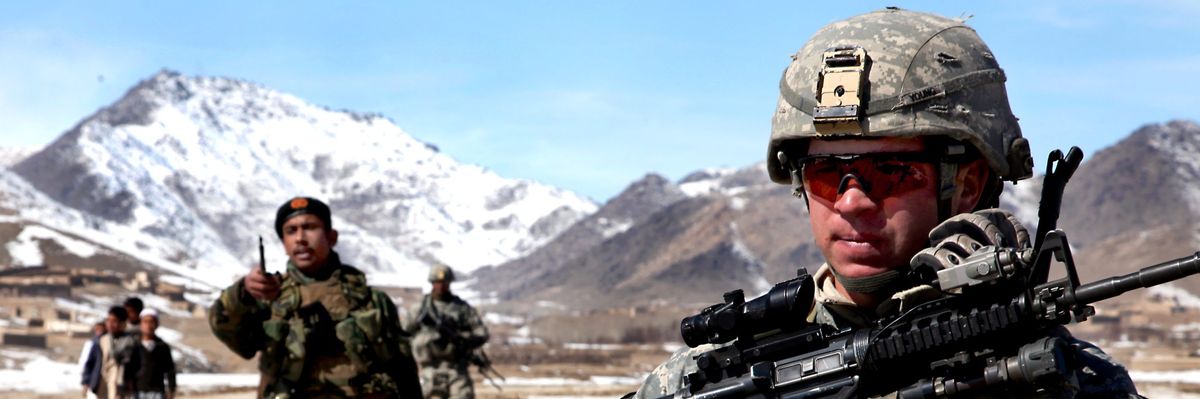
The war in Afghanistan, that 19-year horror movie that never seems to end, is the perfect metaphor for a bankrupt foreign policy elite whose arrogance is second to none. A rolling series of errors, wasteful spending, botched execution, wishful thinking, hubris, mismatched priorities, and misleading statements to the American public — revealed by the Washington Post this week in what has been dubbed the “Afghanistan Papers” — have fueled a war that goes on and on in an endless loop without a hint of resolution. Alternatives to the status-quo, like finally ending what has long been the longest U.S. military campaign in the nation’s 243-year history, is swatted away by the elite as unserious and dangerous. Those seeking a withdrawal are derisively labeled as wobbly, short-term thinkers or regarded with outright contempt. In the alternative universe that is the Beltway, it’s up to the American public to convince their leaders why the present course they themselves set is a disaster — the complete opposite of how a democracy is supposed to function.
In both the Iran and Afghanistan case studies, common-sense options are stifled. With respect to Iran, common-sense would dictate a return to JCPOA compliance by all of the parties involved and the acceptance of a pragmatic transaction that provides the U.S. and Iran with the opportunity to stabilize the relationship before it falls over the precipice. Included in such a deal, Tehran would agree to implement all of its nuclear restrictions as mandated in the JCPOA and cease acting like it owns the Persian Gulf; in exchange, Washington would provide the financial sanctions relief Iran is entitled to. The arrangement would be far from perfect, but far better than a reality that almost tripped both countries into a war last summer.
In Afghanistan, common-sense would require a 180-degree turn in policy and a policymaking and political elite in Washington willing to accept the painful realization that U.S. troops have done everything they could in this part of the world. It would also involve a monumental shift in perception about the war itself from one where the U.S. is the prime stakeholder to one where the Afghans have to come to terms with their differences and end it on their own.
U.S. foreign policy could use a healthy injection of pragmatism on Russia policy as well. Today, U.S.-Russia relations are politicized and held hostage to a zero-sum outlook, where dialogue—let alone compromise—on shared national security priorities is commonly dismissed as a lack of resolve or border-line appeasement. It’s precisely this type of mentality that has contributed to the Trump administration’s refusal to extend New START, a treaty that has not only capped the deployed nuclear arsenals of both countries but is the only guardrail standing in the way of the world’s two largest nuclear weapons powers unleashing a new arms race. Yet again, the common-sense solution — signing a simple 5-year extension and using that time to explore a more comprehensive arms control accord — is left on the shelf to rot.
The American people’s skepticism of the foreign policy establishment is fully understandable and more than justifiable given the results. The views that have held a monopoly in the Beltway have not served this country well. Nor have the architects of those views, all of whom are permitted to hide from any accountability in their Ivory Towers.
Thankfully, it’s not too late to turn things around. But in order for the ship to avoid crashing into the iceberg, our leaders need to begin looking at the world as it is rather than how they would like it to be. Burying our heads in the sand and clinging to unworkable policies like a 5-year old boy clings to a toy fire truck will only make it more difficult for the next generation of leaders to fix this country’s mistakes.