

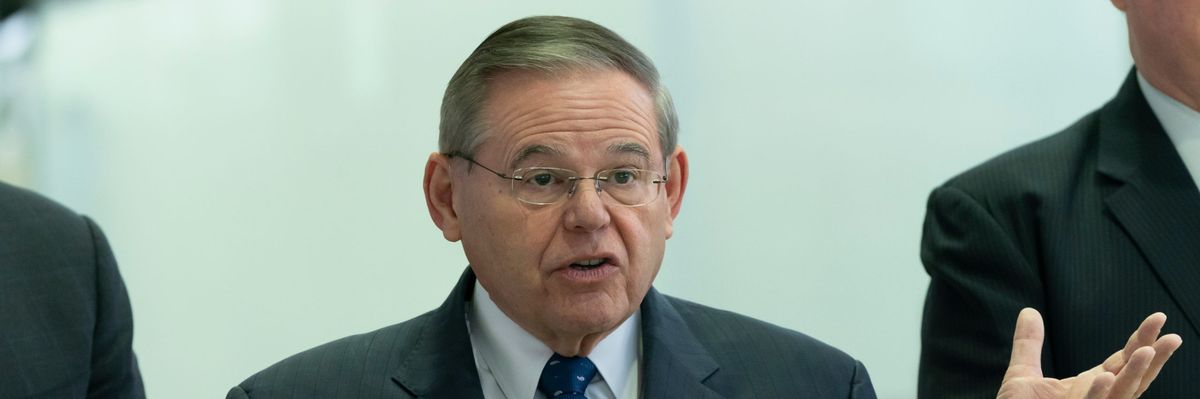
The top Democrat on the Senate Foreign Relations Committee had joined an AIPAC-backed effort to pressure President Joe Biden on diplomacy with Iran, sparking a backlash from pro-diplomacy advocates.
Senate Foreign Relations Committee Chair Robert Menendez (D–N.J.) and Sen. Lindsey Graham (R–S.C.) circulated a letter Monday urging President Biden to use “the full force of our diplomatic and economic tools…to come to an agreement that meaningfully constrains [Iran’s] destabilizing activity throughout the Middle East and its ballistic missile program.”
Menendez and Graham have both opposed the Joint Comprehensive Plan of Action, the 2015 nuclear deal with Iran that Biden has pledged to rejoin. Biden may already be taking a somewhat harder line on Iran in fear of Menendez’s wrath, Politico reported earlier this month.
The two senators are asking for more offices to sign onto their letter. It comes as 70 Democrats in the House of Representatives joined a Republican-led letter warning that the JCPOA has failed to stop “the full range of Iran’s threats" and calling for Biden to seek an “agreement or set of agreements” that secures more Iranian concessions.
“We have knowledge that AIPAC was behind this letter,” said Dylan Willliams, advocacy director at the left-leaning pro-Israel group J Street, referring to the House letter. “All of these vehicles on Iran and the Senate letter on the ICC are AIPAC asks that would normally be made around their annual policy conference, which is not being held this year. However, they are still making a number of legislative asks as they usually would at this time.”
Williams noted that AIPAC got several Democrats to sign onto a letter calling on the Trump administration to get the United Nations arms embargo on Iran extended. The Trump administration then cited the letter as support for sanctions “snapback,” a controversial diplomatic move opposed by the letter’s top Democratic signer.
“This is a move that AIPAC attempts all the time,” Williams told Responsible Statecraft. “They sell the letter to lawmakers as meaning one thing, and then promote it as backing a materially-different policy.”
AIPAC has not responded to a request for comment from Responsible Statecraft as of press time, but has issued a statement publicly praising the letter.
Supporters of diplomacy with Iran are now pushing back.
In an email to congressional offices, J Street warned that Menendez and Graham’s letter “will be used by the [JCPOA]'s opponents to claim that letter signers oppose lifting sanctions that must be lifted in order to bring the US back into compliance…unless and until the agreement is massively broadened.”
J Street’s email, which was obtained by Responsible Statecraft, urged supporters of diplomacy not to sign the letter unless it includes a line acknowledging that some signatories support the JCPOA. It also calls on them to cosponsor the Iran Diplomacy Act, a bill in support of the 2015 deal.
NIAC Action, the National Iranian American Council’s lobbying arm, warned in its own statement that Menendez and Graham’s letter “would make the attainable impossible and risks setting President Biden on course for war with Iran” because it “suggests that the only acceptable agreement is one that addresses all concerns with Iran at once.”
“There is one clear option for the administration to roll back Iran’s nuclear program and create a pathway to begin negotiations on other areas of concern: returning to full compliance with the JCPOA,” the statement by NIAC Action argues. “Any efforts to muddle or frustrate this pathway are not helpful and risk frustrating serious diplomatic efforts that are underway.”
The Friends Committee on National Legislation, a Quaker lobby group, also pushed back on the letter.
“This letter from Senators Menendez and Graham supports a continuation of the same failed maximum pressure strategy from the Trump administration, that has created instability in the Middle East, put us on a war footing with Iran, and caused untold human suffering for Iranian people, who now lack access to many critical life-saving medicines,” says Hassan El Tayyab, the committee’s legislative manager for Middle East policy.
Under the JCPOA, the Iranian government had agreed to enforce strict limits on its nuclear program and subject it to rigorous international inspections in exchange for six world powers lifting long-standing economic sanctions against Iran.
Former President Donald Trump withdrew from the JCPOA in 2018 and imposed “super maximum economic pressure” while demanding a “better deal.” Iran has since escalated its nuclear activities, although it has promised to roll them back to the limits prescribed by the JCPOA if the sanctions are lifted.
Biden has publicly stated that he wants to get both sides back into compliance with the JCPOA as a springboard for further diplomacy. But hawks are urging the Biden administration to ditch the JCPOA and use sanctions as leverage to gain more concessions, including on Iran’s regional policy and ballistic missile program.
Nearly two-thirds of Americans support “direct negotiations” to deal with the Iranian nuclear program, a poll published by YouGov and the Economist earlier this week shows.
“While we may have differing views on the Joint Comprehensive Plan of Action of 2015 and the overall approach of the Trump Administration’s maximum pressure campaign, we must confront the reality that Iran has accelerated its nuclear activity in alarming ways,” the letter by Menendez and Graham states. “We further agree that outside of its nuclear program, Iran continues to pose a threat to U.S. and international security.”
Menendez and Graham have both previously opposed the JCPOA and called for a harder line on Iran. In 2013, both proposed a joint resolution backing Israeli military action against the Iranian nuclear program. Later that year, Menendez attempted to pass new sanctions on Iran while negotiations for the JCPOA were still underway, a move that several senior Democrats opposed.
The two senators slightly diverged over Trump’s maximum pressure campaign. Menendez publicly opposed Trump’s decision to leave the JCPOA, while Graham became an enthusiastic supporter of the pressure campaign, even calling for military strikes against Iranian oil facilities.
But Menendez also joined Republicans in calling on Trump to maintain economic pressure on Iran during the coronavirus crisis, a position that put Menendez at odds with senior members of his own party, who supported humanitarian exemptions to the sanctions to help Tehran contain the pandemic.
And he continued to oppose the JCPOA at a confirmation hearing last week, calling the accord insufficient to deal with the full range of Iranian threats.
Other Democrats disagreed with Menendez’s position.
“Many of us supported the [JCPOA] on its terms,” said Sen. Chris Murphy (D–Conn.) at the same hearing. “By expanding out the number of things we want to talk about at this negotiating table, I worry that we may be setting ourselves up for failure.”