

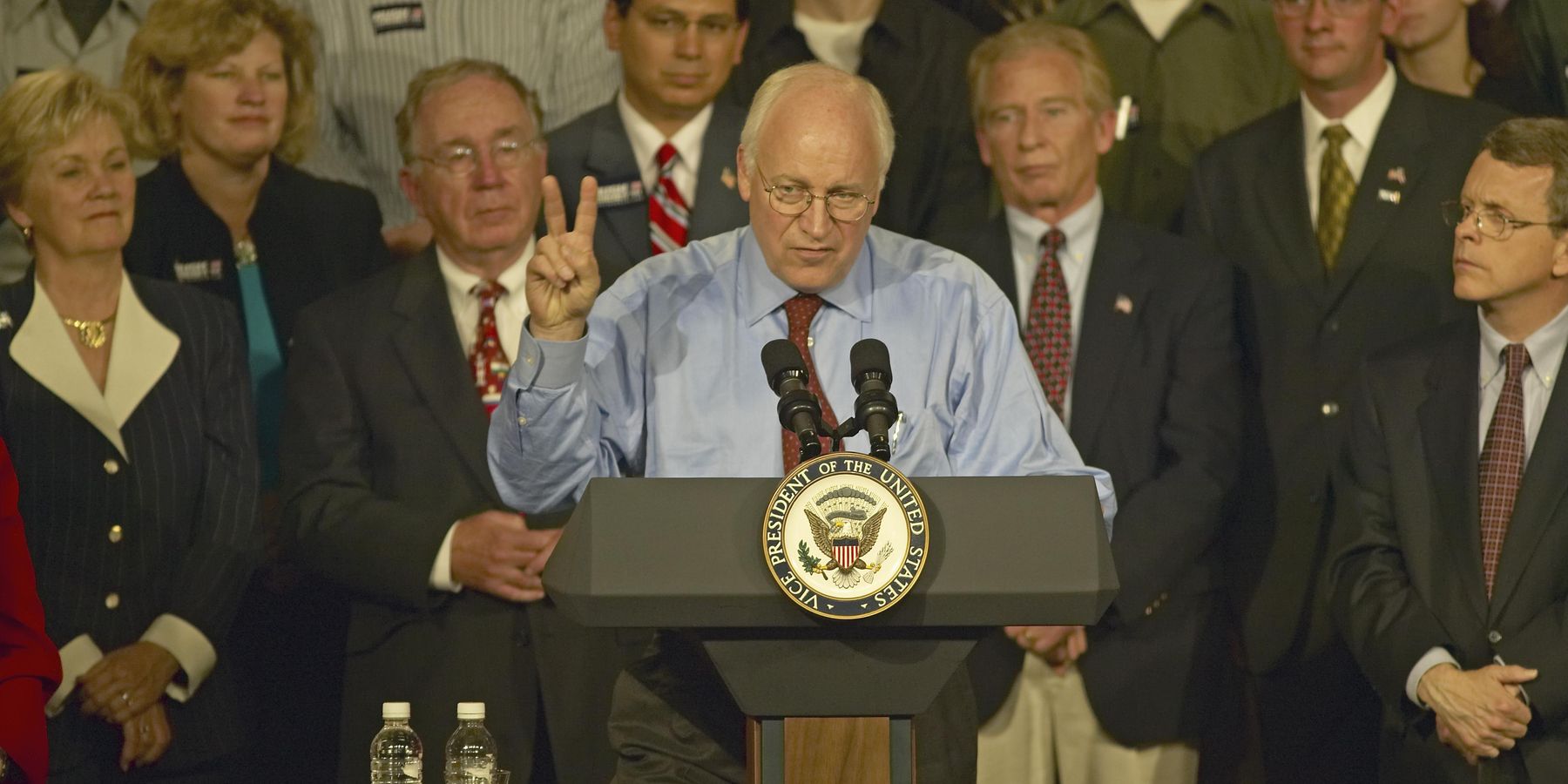
Dick Cheney has died, according to reports this morning, at the age of 84.
A formidable White House and defense department aide (under Presidents Richard Nixon and Gerald Ford) who left to head an equally formidable Texas-based oil company (with vast federal contracts) and then back in Washington as vice president to George W. Bush, Cheney is probably the most symbolic figure of the failure of the post-9/11 wars. In particular, the Iraq War. It was his amassed power and special cadre of operators known as neoconservatives inside the Old Executive Office building and E Ring at the Pentagon, who with strategic treachery dominated the politics and intelligence necessary to march Washington into the invasion of 2003 and to proliferate a Global War on Terror that lasted well beyond his tenure in office.
By all accounts it was his midwifed lies over WMDs that got us there, followed by the blunders (not anticipating the Iraqi insurgency), the loss of life (millions), the cost to our treasury, and the emergence of a new warfare marked by extrajudicial killing, torture, secrecy, and endless war that transformed American society and politics, perhaps forever.
For it was the exploitation of American grief, fear, and patriotism after 9/11 to pursue neoconservative wars in the Middle East that zapped the people's faith in government institutions. It pretty much destroyed the Republican Party and gave rise to populist movements on both sides of the aisle. It created a generation of veterans harboring more mistrust in elites and Washington than even the Vietnam War era. On the other end of the spectrum, it unleashed mercenary warfare, killer drones, civil wars, and police powers in the United States that have only served make the people less free and more fearful of their government. Thanks in part to Dick Cheney, the Executive, i.e. the president, has more power than ever — to bomb, detain, and "decapitate" any government leader he does not like.
There will be many obituaries written for Dick Cheney, all will be scarred with his role in the Iraq War. For a time he was a very, very powerful man and then he went away to retire and help raise his grandchildren. How many hundreds of thousands of American families were unable to do the same, plagued by death, disease, mental injuries, sterility, divorce, addiction, suicide — because of a war that he so relentlessly pushed but should never have been.
Cheney's quest for more Executive power and 'Machtpolitik'
Cheney first came to national prominence when he served as White House Chief of Staff (1975-77) to President Gerald Ford. In that position, he worked closely with Defense Secretary Donald Rumsfeld to counter and eventually derail Henry Kissinger's strategy of "detente" with the Soviet Union.
In that initiative, Cheney and Rumsfeld also worked closely with the Washington-based leaders of the emergent neoconservative movement, a number of them, including Richard Perle and Elliott Abrams, working in the office of Washington State Democratic Senator and Senate Armed Services Chairman Henry "Scoop" Jackson, to promote, among other things, Jewish emigration to Israel from the Soviet Union, and to persuade Ford to convene an ultra-hawkish "Team B" outside the intelligence community to hype the alleged military threat posed by Moscow in order to sabotage a nuclear arms control agreement.
Their mutual interest in pursuing a massive U.S. arms build-up and an aggressive foreign policy more generally would form the basis of an alliance between the aggressive nationalism and Machtpolitik of Cheney and Rumsfeld on the one hand, and the Israel-centered neoconservatives on the other that, more than two decades later, would blossom into the notorious Project for the New American Century in 1997 whose ideas and associates would ultimately dominate the George W. Bush's first-term post-9/11 "global war on terror" (GWOT) and the 2003 Iraq invasion for which he always remained unrepentant.
In the 1980s, Cheney, who chafed at Congress's post-Watergate restrictions on presidential power, particularly regarding foreign policy, served as Wyoming’s single congressman in the House of Representatives where he became a staunch and powerful defender both of Ronald Reagan’s anti-Soviet policies and of the “Reagan Doctrine” of rolling back leftist regimes and movements in the Global South, notably in Central America and southern Africa. A staunch defender of the protagonists of what became the Iran-Contra scandal, a secret operation to sell weapons to Iran and use the proceeds to fund the Nicaraguan contras (for whom Congress had expressly prohibited any U.S assistance), he later prevailed on President George H.W. Bush, for whom he served as defense secretary, to issue pardons to those, like Abrams, who were prosecuted or convicted of crimes as a result of their roles in the affair.
In the wake of the first Gulf War, Cheney directed his undersecretary of defense for policy, Paul Wolfowitz, to draft a long-term U.S. strategy, called the Defense Planning Guidance (DPG), whose global ambitions, when leaked to the Washington Post, provoked a flurry of controversy about the future U.S. role in the world.
Among other things, the draft called for Washington to maintain permanent military dominance of Eurasia to be achieved by “deterring potential competitors from even aspiring to a larger regional or global role” and by preempting, using whatever means necessary, foreign states believed to be developing weapons of mass destruction. It foretold a world in which U.S military intervention would become a “constant fixture” of the geopolitical landscape, and Washington would act as the ultimate guarantor of international peace and security.
One of the document’s principal drafters, I. Lewis “Scooter” Libby, would later become Vice President Cheney’s highly effective chief of staff and national security adviser during George W. Bush’s first term until he was indicted in October 2005 for perjury in connection with the leak of the identity of a CIA clandestine officer.
The draft DPG would essentially become the inspiration for what became in 1997 the PNAC, a letterhead organization launched by neoconservatives Bill Kristol and Robert Kagan that in some ways formalized the coalition of Machtpolitikers like Cheney, Rumsfeld, and John Bolton; pro-Israel neoconservatives like Perle, Abrams, Libby, Eliot Cohen, and Frank Gaffney; and Christian Zionists, such as Gary Bauer and William Bennett.
PNAC subsequently published a series of hawkish statements and open letters demanding substantial increases in the U.S. defense budget and stronger U.S. action against perceived adversaries, notably Iraq, Syria, and China. Led by Cheney as vice president and Rumsfeld as defense secretary, many PNAC associates, particularly neoconservatives, took key posts in the George W. Bush administration in 2001, while PNAC, along with the American Enterprise Institute, became the leading group outside the administration banging the drum for invading Iraq and aggressively prosecuting the GWOT.
Cheney's influence over foreign policy began to decline in 2005 when it had become clear that the U.S. faced a serious insurgency in Iraq. Several key neoconservatives, including Wolfowitz as Deputy Secretary of Defense, were dropped as Bush's second term opened, and Libby's departure that October marked a clear setback. Pressed by the Israeli government, Cheney pushed very hard beginning in 2007 on Bush to attack nuclear and other targets in Iran, but his appeals were reportedly rejected outright.
Cheney's legacy, however, lives on. His efforts to concentrate power in a "unitary executive" to reverse what he believed constituted a disastrous encroachment by Congress to limit presidential power and his belief that the United States should retain and exercise a right to unilaterally intervene militarily anywhere and anytime in pursuit of its own interests clearly have survived his passing.