

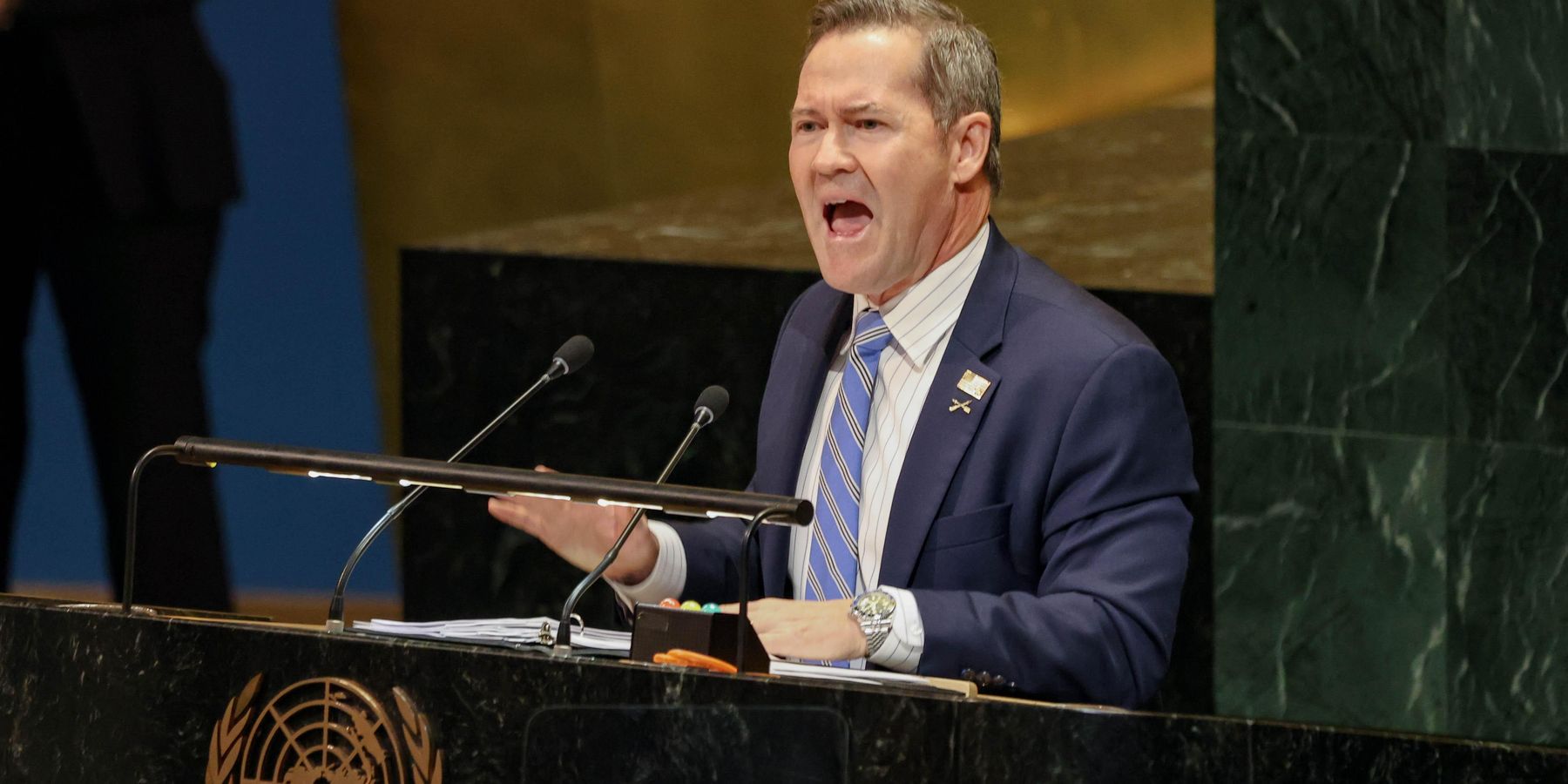
The United Nations General Assembly voted overwhelmingly for the 33rd time on Wednesday to condemn the U.S. embargo on Cuba, with 165 nations voting in favor, 12 abstaining and seven countries, including the U.S. and Israel, voting against.
Washington’s backdoor offensive against the resolution has been particularly intense this year, circulating diplomatic cables to allies in Europe and Latin America encouraging countries to reject the resolution, or abstain, over unfounded allegations that Cuba’s government has been complicit in sending thousands of its nationals to fight in Russia's war on Ukraine.
Cuban authorities have on numerous occasions rejected these allegations — based on estimated figures stemming from Ukrainian military intelligence — most recently saying it has initiated nine legal proceedings in Cuban courts against 40 individuals for the crime of mercenarism.
Cuba has “a practice of zero tolerance for mercenarism, trafficking in persons and the participation of its nationals in any armed confrontation in another country,” Cuba’s foreign ministry said earlier this month in response to the leaked cables, first reported by Reuters, where U.S. officials claimed that “after North Korea, Cuba is the largest contributor of foreign troops to Russia's aggression, with an estimated 1,000-5,000 Cubans fighting in Ukraine.”
U.S.-Cuba tensions spilled out in public Tuesday when U.S. Ambassador to the United Nations Mike Waltz, breaking from tradition, took the stage on the first day of speeches to rail against Cuban government repression and the failures of communism, telling countries to reject the resolution.
The speech drew a sharp rebuke from Cuban Foreign Minister Bruno Rodriguez. “Mr. Waltz, this is the United Nations General Assembly, not a Signal group of the House of Representatives,” he charged, referring not so obliquely to the “Signalgate” chat debacle last spring in which Waltz, then the head of the National Security Council, inadvertently invited a journalist onto a chat about pending U.S. military airstrikes against the Houthis.
Although this year’s vote tally garnered more support for the U.S. position than in previous years, it still reflects the ultimate limit to their backchannel efforts.
That doesn’t mean that Trump’s pressure fell flat with everyone.Hungary and North Macedonia voted with the U.S. this time, as did Latin American countries warming up to the Trump administration, like Ecuador, Paraguay, and Argentina.
After last year’s vote, Argentine president Javier Milei sacked his foreign minister Diana Mondino for voting in favor of the resolution, saying “our country is categorically opposed to the Cuban dictatorship and will remain firm in promoting a foreign policy that condemns all regimes that perpetrate human rights violations.”
This was also true during Trump’s first administration, where countries considered closely allied, such as Brazil, Ukraine, Moldova and Colombia, either abstained or voted against Cuba’s resolution.
Nevertheless, other U.S. allies in Europe and Latin America who are critical Cuba’s political and economic systems have maintained a firm position against the imposition of unilateral coercive measures, which they argue violate international law, impoverish the Cuban people, and do little to encourage human rights or economic reform on the island.
In 2016, as the Obama administration pursued a warming of relations with the Caribbean island-nation, not a single country voted against the resolution, with U.S. ambassador to the UN Samantha Power explaining the U.S. abstention by saying: “Instead of isolating Cuba, our policy isolated the United States, including right here at the United Nations.”
Earlier this year, Cuba presented its annual report, submitted alongside the draft UN resolution, on the impacts of the U.S. embargo on the island’s economy, alleging $7.5 billion is losses and damages stemming from fortified U.S. sanctions under the Trump administration.
These have included visa restrictions on foreign officials hiring Cuban doctors, the reversal of President Biden’s last-minute decision to lift Cuba’s state sponsor of terrorism designation, the inclusion of new Cuban entities on a State Department blacklist off limits to U.S. citizens, and a partial ban on U.S. travel for Cuban nationals, among others.
- Pope Francis worked miracles for US-Cuba, but not the biggest one ›
- Trump lifted sanctions on Syria. Now do Cuba. ›
- Today marks 60 years of the Cuban embargo. What exactly is it? ›