

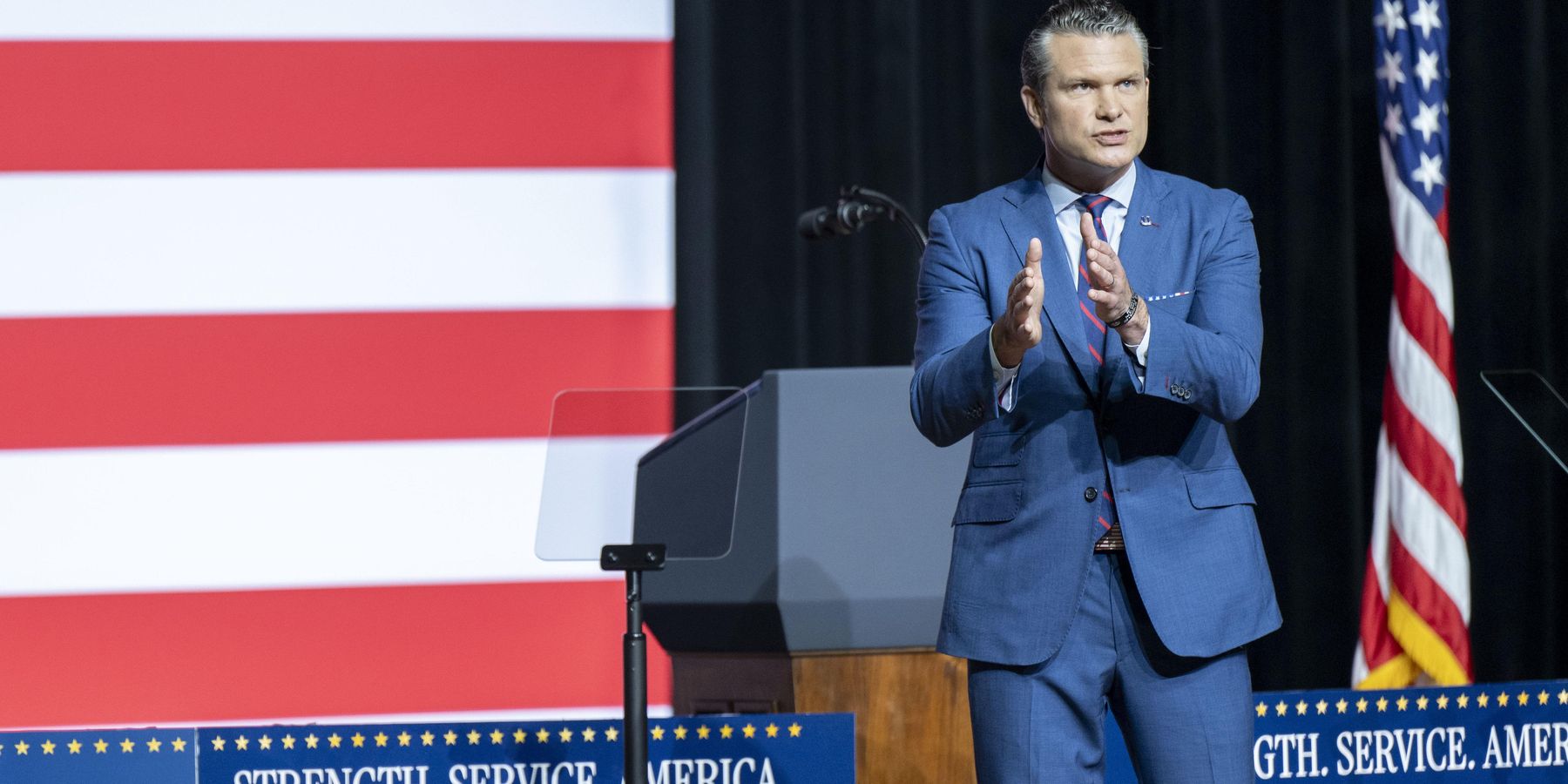
On September 30, Secretary of Defense Pete Hegseth summoned nearly 800 of America’s military generals, admirals, and senior enlisted officers to Quantico, Virginia on short notice. Though the unprecedented event was written off by many as a political stunt, a month later, it is clear the gathering was more important than many realized.
Of particular note were the speeches delivered by Hegseth and President Donald Trump which offer the clearest articulation yet of how the Trump administration thinks about and hopes to use military power. What’s more, taken together, the two sets of remarks appear to foreshadow both the current U.S. military build-up underway in the Caribbean and what might be on the horizon as U.S. operations there and elsewhere continue.
The key moment in Hegseth’s talk came near the end. “The United States has not won a major theater war since the name was changed to the Department of Defense in 1947,” he told the assembled audience, repeating President Trump’s rationale for jettisoning the Department’s old moniker in favor of its new one: The Department of War. “One conflict stands out in stark contrast, the Gulf War,” he continued. “Why? Well, there's a number of reasons, but it was a limited mission with overwhelming force and a clear end state.”
Many were puzzled at Hegseth’s call-up of this short-lived military operation from 35 years ago. After all, the first Gulf War, though widely considered a success at the time, ushered in three decades of heavy U.S. military involvement in the Middle East and, in many ways, set the stage for the very “forever wars” in Iraq and Afghanistan that Trump had campaigned against.
Hegseth’s point, however, was different. The Gulf War, he was telling those listening in person and at home, was an example of how the United States should be using military force going forward. Overwhelming military power that quickly annihilates the adversary, in pursuit of limited goals. Massive force, short duration, quick victory, no long-term commitment.
This model, which Vice President J.D. Vance has called the Trump Doctrine, was demonstrated earlier this year in the U.S. airstrikes on Iran’s nuclear facilities and during Trump’s first term in his assassination of Iranian military commander Qassem Soleimani.
Trump’s preferred approach to the use of force is on display again in Latin America, where the U.S. military has increased the frequency and scope of its strikes on alleged drug smuggling boats while a growing American armada loiters off the coast of Venezuela. Today, over ten percent of U.S. deployed naval power, including a carrier strike group and attack submarine armed with Tomahawk missiles, dozens of fighter aircraft including F-35s, and at least 10,000 military personnel are stationed in the Caribbean.
The ostensible purpose of this massive accumulation of warships, aircraft, and military personnel is interdicting drugs on their way to the United States (for now by sea and maybe in the near future by land). However, many speculate that the ultimate target is Venezuela’s leader, Nicolas Maduro, who Trump may hope to drive from power.
Some observers have questioned whether the extraordinary amount of military firepower involved in the operation is required, given the relatively limited threat drug smugglers generally or Maduro himself pose to the United States. But the excess is a feature of Trump’s approach, not a bug. As the president said just last week in Japan, under his command, the United States will “blast the hell out of countries” on its way to decisively winning wars.
In his own speech on September 30, Trump offered additional context helpful to understanding expanding U.S. operations in Latin America. At Quantico, he spoke of the “war on the enemy within,” which he described as the battle against the foreign drug smugglers and criminal networks that pose a threat to the United States from the inside.
In a sense, the U.S. military campaign in the Caribbean today is simply the external manifestation of this inward-focused struggle and a natural outgrowth of Trump’s militarized approach to his immigration agenda, which has expanded over the course of his second term. There is a certain logic to this. After all, the United States should not waste time looking for adversaries abroad until threats emanating from its backyard, often the root causes of domestic ills, are neutralized.
Still, the military’s role in ongoing operations in the Western Hemisphere should be scrutinized. It's not clear, for instance, that blowing alleged drug smugglers out of the water one by one or even threatening them on land will dry up the drug trafficking that afflicts U.S. cities. Similarly, Maduro may not respond to the military pressure by stepping down and if he does, military power cannot guarantee what comes after the regime change advances U.S. or the region’s long-term interests. Trump and his advisors may be underestimating the capabilities of Venezuela’s defense force or overestimating the ease with which the U.S. military will achieve its larger political goals.
Moreover, the Trump administration’s apparent theory of military force has limits. Large displays of firepower may awe voters or restore pride in U.S. military power after the embarrassing losses of the wars in Iraq and Afghanistan. They may even scare small states into bowing to U.S. dictates. But the “overwhelming force, limited objectives” approach applies less well to near peer adversaries capable of matching U.S. military power and unlikely to be so easily dissuaded by U.S. military threats.
So how does the so-called “Trump doctrine” apply to competitors like China and Russia? One possibility is that Trump is simply not willing to fight in major power wars given the likely costs and demands of doing so, not to mention the immense political risk and potential for enduring entanglements.
This reluctance would be good for U.S. interests even if it is a change in U.S. foreign policy, and it would fit with Trump’s distaste for the long ground campaigns the United States fought in the Middle East after September 11.
The other option is that Trump does hope or believe that ominous threats and large displays of military force will work against China or Russia in a future contingency. This is the more dangerous of the two explanations, as this strategy could invite at retaliatory attacks on the U.S. homeland and possibly even nuclear war — a catastrophic outcome.
Important questions about how Trump plans to use military power, therefore, remain. Still, we should not forget the gathering at Quantico too quickly. We may look back on it as significant moment in the evolution of the U.S. approach to the use of force.
- Venezuela regime change means invasion, chaos, and heavy losses ›
- Top admiral resigns amid Venezuela ops: Who’s got the scoop? ›
- Hegseth wants to make the Pentagon a global weapons bazaar | Responsible Statecraft ›