

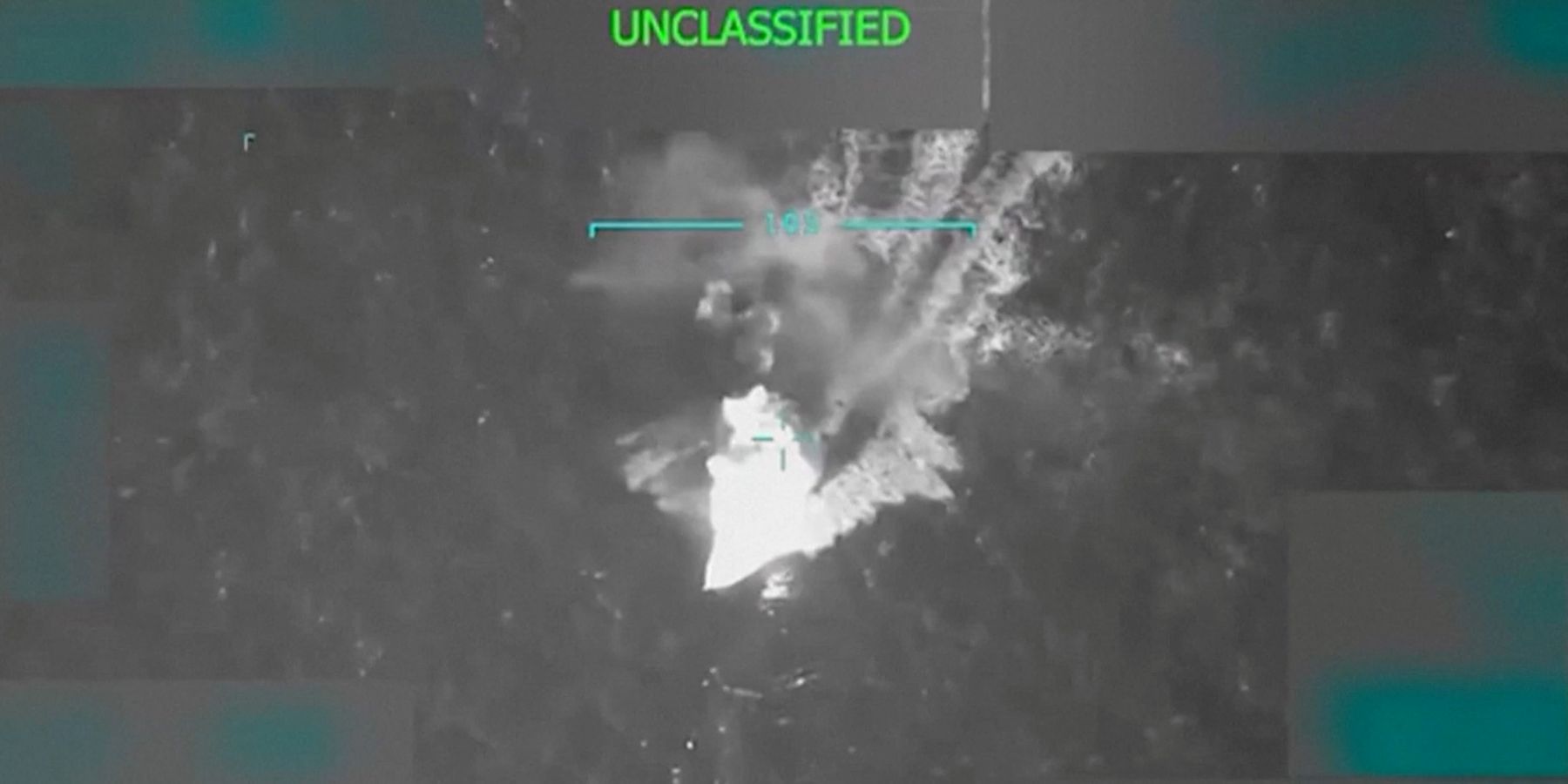
Military tensions in the southern Caribbean have rapidly grown following President Trump’s decision to launch an airstrike on a boat allegedly smuggling drugs near Venezuela. As the U.S. announced the deployment of 10 F-35 fighter jets to bolster its forces in the region, a pair of Venezuelan planes flew over an American warship in a move that the Pentagon described as “highly provocative.”
All evidence suggests that a broader military operation could be in the offing. Last Thursday, Secretary of State Marco Rubio pledged to continue the attacks and said regional governments “will help us find these people and blow them up.”
Meanwhile, Defense Secretary Pete Hegseth, asked whether the end goal is regime change in Venezuela, told Fox and Friends that the Pentagon is “prepared with every asset that the American military has” should Trump choose to move forward with such an operation.
The rapid escalation seems to have put Congress on the back foot. While many lawmakers moved quickly to condemn Trump’s attacks on Iran earlier this year, strikingly few members of Congress have shown the same level of enthusiasm when it comes to Venezuela.
Responsible Statecraft reached out to 19 congressional offices about the campaign but only heard back from Rep. Adam Smith (D-Wash.), who simply shared a statement asking a series of questions about the goals and legality of the strike. (Smith later used stronger language, accusing Trump Thursday of trying to start “a war with Venezuela.”)
A smattering of other lawmakers have put out statements condemning the strikes. Rep. Chuy Garcia (D-Ill.) lamented that Trump launched the campaign without congressional authorization and called on Congress to act in order to avoid a new “forever war.” Sen. Rand Paul (R-Ky.), for his part, told Newsmax that “it isn’t our policy just to blow people up.” But Sen. Tim Kaine (D-Va.), Sen. Bernie Sanders (I-Vt.), Rep. Ro Khanna (D-Calif.) and Rep. Thomas Massie (R-Ky.)—all of whom often rail against presidents for starting conflicts without consulting Congress—have so far stayed silent on the issue.
This relative quiet contrasts sharply with the outrage expressed by legal experts, who have loudly rejected Trump’s claim that he has the right to blow up alleged drug traffickers in order to defend the United States from “narco-terrorists.” As Andy McCarthy of the National Review noted, Trump is taking the position that a boat operated by a designated terror group is “functionally the same as a hostile foreign naval force that is in the act of conducting an armed attack against the United States”—a “controversial claim, to put it mildly.”
“When you see the premeditated killing of another person outside of an armed conflict, there’s a term for that, and that term is murder,” former State Department lawyer Brian Finucane told NPR, noting that the administration has failed to establish that the U.S. is at war with the organizations it is now bombing. “This is not an appropriate use of lethal military force.”
The Trump administration sought to legally justify the strikes in a notification to Congress in which it argued that the threat from drug trafficking has reached a “critical point” that can only be resolved using “military force in self-defense.” But the brazen nature of the strikes has even drawn some criticism from within the Trump administration. An anonymous senior Pentagon official told the Intercept that the attack amounted to an illegal execution of civilians. “The U.S. is now directly targeting civilians,” the official said. “Drug traffickers may be criminals but they aren’t combatants.”
This week could offer an indication of whether lawmakers are willing to take steps to rein in the rapidly escalating standoff in the southern Caribbean. Rep. Greg Casar (D-Texas) has introduced an amendment to this year’s National Defense Authorization Act that would block funds for any use of military force “in or against Venezuela.” In a statement on X, Casar emphasized that “Only Congress has the power to declare war.”
If the proposal makes it through the Rules Committee, then lawmakers will be forced to take a side on the issue. In the meantime, most members of Congress appear content to take a back seat as Trump tests his ability to bring the war on terror to the Western Hemisphere.
- US non-profits 'in the tank' for Exxon, Chevron over Venezuela oil ›
- Trump hails US airstrike against smugglers in the Caribbean ›
- Trump doubles down on strikes against alleged smugglers in Caribbean | Responsible Statecraft ›
- Spineless Congress outdoes itself on Caribbean strikes | Responsible Statecraft ›
- Will Trump really attack Venezuela? | Responsible Statecraft ›
- GOP senator: Congress in dark on ‘narco’ strikes | Responsible Statecraft ›
- Senate vote fails to block Trump attacks on Venezuela | Responsible Statecraft ›
- Dick Cheney's ghost has a playbook for war in Venezuela | Responsible Statecraft ›
- Ask Americans — they don't want a war on Venezuela | Responsible Statecraft ›
- Trump bombs Venezuela, captures Maduro | Responsible Statecraft ›