
Follow us on social

google cta
Trump hails US airstrike against smugglers in the Caribbean

Trump hails US airstrike against smugglers in the Caribbean

Military attacked a 'drug carrying' boat after it departed Venezuela, killing 11 suspected gang members

Reporting | QiOSK
google cta
google cta

The U.S. military attacked a “drug-carrying boat” after it departed from Venezuela, according to President Trump, who recently surged American troops to the southern Caribbean in what he says is an effort to fight drug trafficking.

A senior U.S. defense official confirmed the attack in a statement to Responsible Statecraft, describing the operation as a “precision strike against a drug vessel operated by a designated narco-terrorist organization.” In a post on Truth Social, Trump claimed that the strike killed 11 members of Tren de Aragua, a Venezuelan gang that the U.S. says is controlled by Venezuelan President Nicolas Maduro. Trump added that the attack took place in international waters.

The strike represents a serious escalation of Trump’s ongoing conflict with Latin American criminal organizations. As a candidate, Trump promised to use military force against Mexican cartels, and since taking office, he has designated multiple Mexican cartels and Venezuelan gangs as foreign terrorist organizations, a designation that includes groups like al-Qaeda and ISIS.

Tuesday’s operation comes amid furious speculation over why Trump has surged U.S. forces to the southern Caribbean, including roughly 4,000 soldiers, seven warships and a nuclear submarine. Some observers frame the surge as a symbolic show of force, noting U.S. statistics showing that the vast majority of cocaine flowing to the United States from South America comes through the Pacific rather than the Caribbean. Maduro described the deployment as an “absolutely criminal and bloody threat” to his government. Military analysts, for their part, say that the relatively small size of the troop surge makes a full-scale invasion unlikely, though the force would be more than large enough to continue operations like the one carried out on Tuesday.

It remains unclear what legal authority the U.S. is using to justify the attack. Last month, the New York Times reported that Trump “secretly signed a directive” that authorized the military to target cartels, but Congress has yet to pass an authorization for the use of military force.

U.S.-Venezuela tensions have grown in recent months as Trump has increased pressure on Maduro by designating him as a terrorist under U.S. law and putting a $50 million bounty on his head.

The attack comes as Secretary of State Marco Rubio travels to Mexico this week, where he will meet with high-level officials to discuss drugs and immigration. The possibility of U.S. airstrikes against Mexican cartels will loom over those conversations, with Tuesday’s attack highlighting America’s willingness to opt for military force.

Many military experts argue that bombing the cartels is an ineffective approach to stopping the flow of fentanyl into the U.S. “If the objective is to bomb the cartels into submission or convince them to stop producing and shipping drugs across America’s southern border, then an air campaign will fall flat,” argued Dan DePetris in a recent article for Responsible Statecraft, citing America’s failed efforts to destroy poppy farms in Afghanistan in order to cut off the Taliban’s drug revenue.


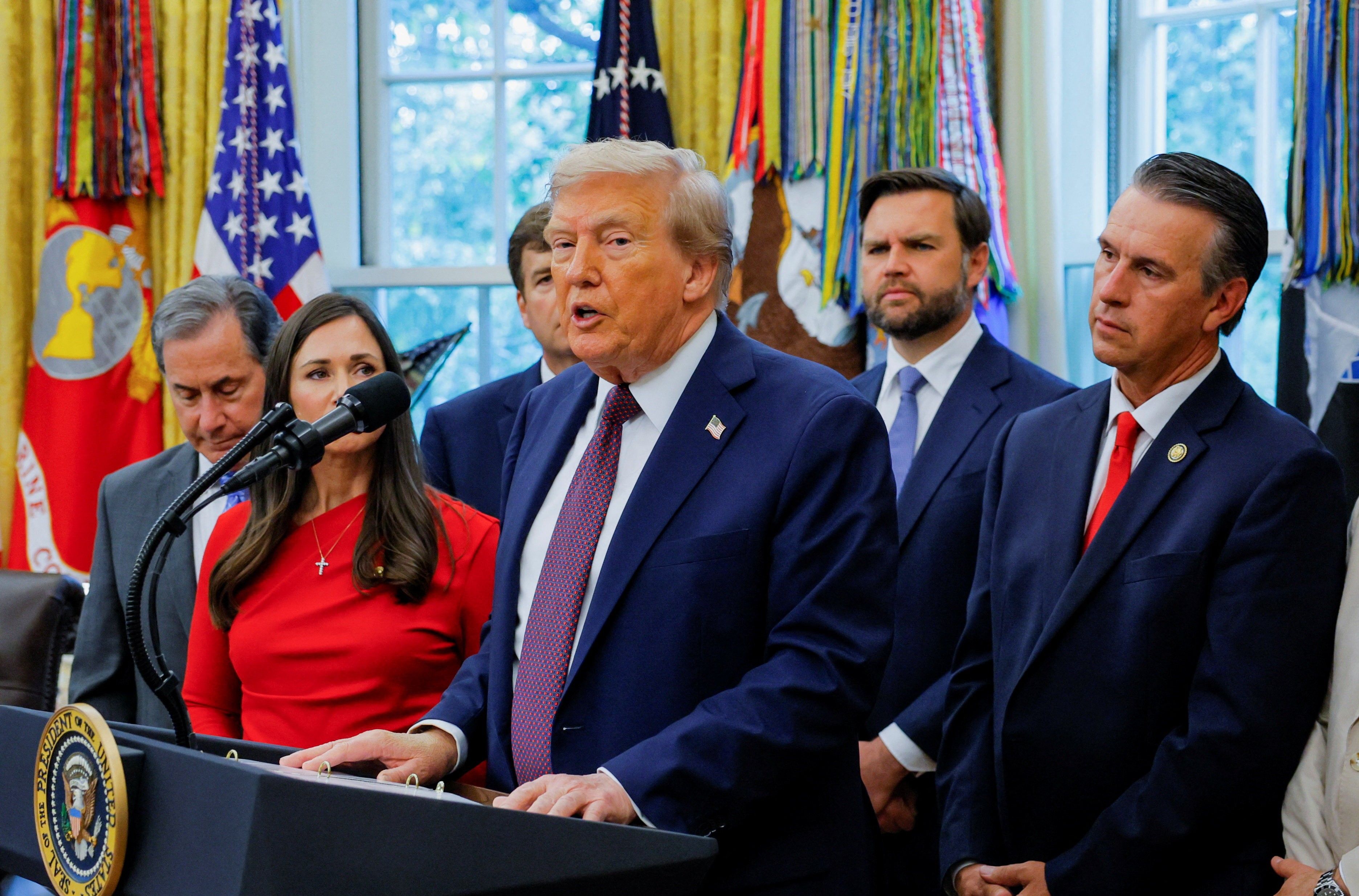
Top image credit: U.S. President Donald Trump replies to a question during an event to announce that the Space Force Command will move from Colorado to Alabama, in the Oval Office at the White House in Washington, D.C., U.S., September 2, 2025. REUTERS/Brian Snyder
google cta
Reporting | QiOSK
Trump corollory
Top image credit: President Donald Trump holds a cabinet meeting, Tuesday, December 2, 2025, in the Cabinet Room of the White House. (Official White House Photo by Daniel Torok)

Trump's 'Monroe Doctrine 2.0' completely misreads Latin America

Latin America

The “Trump Corollary” to the Monroe Doctrine, “a common-sense and potent restoration of American power and priorities, consistent with American security interests,” stating that “the American people—not foreign nations nor globalist institutions—will always control their own destiny in our hemisphere,” is a key component of the National Security Strategy 2025 released last week by the Trump administration.

Putting the Western Hemisphere front and center as a U.S. foreign policy priority marks a significant shift from the “pivot to Asia” launched in President Obama’s first term.

keep readingShow less
Doha Forum 2025
Top image credit: a panel discussion during the 23rd edition of the Doha Forum 2025 at the Sheraton Grand Doha Resort & Convention Hotel in Doha, Qatar, on December 6, 2025. (Photo by Noushad Thekkayil/NurPhoto via REUTERS CONNECT

'In Trump we trust': Arab states frustrated with stalled Gaza plan

Middle East

Hamas and Israel are reportedly moving toward negotiating a "phase two" of the U.S.-lead ceasefire but it is clear that so many obstacles are in the way, particularly the news that Israel is already calling the "yellow line" used during the ceasefire to demarcate its remaining military occupation of the Gaza Strip the "new border."

“We have operational control over extensive parts of the Gaza Strip, and we will remain on those defence lines,” said Israeli military chief Lieutenant General Eyal Zamir on Sunday. “The yellow line is a new border line, serving as a forward defensive line for our communities and a line of operational activity.”

keep readingShow less
‘This ain’t gonna work’: How Russia pulled the plug on Assad
Top Image Credit: Syrian President Bashar al-Assad (Harold Escalona / Shutterstock.com)

‘This ain’t gonna work’: How Russia pulled the plug on Assad

Middle East

In early November of last year, the Assad regime had a lot to look forward to. Syrian President Bashar al-Assad had just joined fellow Middle Eastern leaders at a pan-Islamic summit in Saudi Arabia, marking a major step in his return to the international fold. After the event, Turkish President Recep Tayyip Erdogan, who had spent years trying to oust Assad, told reporters that he hoped to meet with the Syrian leader and “put Turkish-Syrian relations back on track.”

Less than a month later, Assad fled the country in a Russian plane as Turkish-backed opposition forces began their final approach to Damascus. Most observers were taken aback by this development. But long-time Middle East analyst Neil Partrick was less surprised. As Partrick details in his new book, “State Failure in the Middle East,” the seemingly resurgent Assad regime had by that point been reduced to a hollowed-out state apparatus, propped up by foreign backers. When those backers pulled out, Assad was left with little choice but to flee.

keep readingShow less
google cta
Want more of our stories on Google?
Click here to make us a Preferred Source.

LATEST

QIOSK

Newsletter

Subscribe now to our weekly round-up and don't miss a beat with your favorite RS contributors and reporters, as well as staff analysis, opinion, and news promoting a positive, non-partisan vision of U.S. foreign policy.