

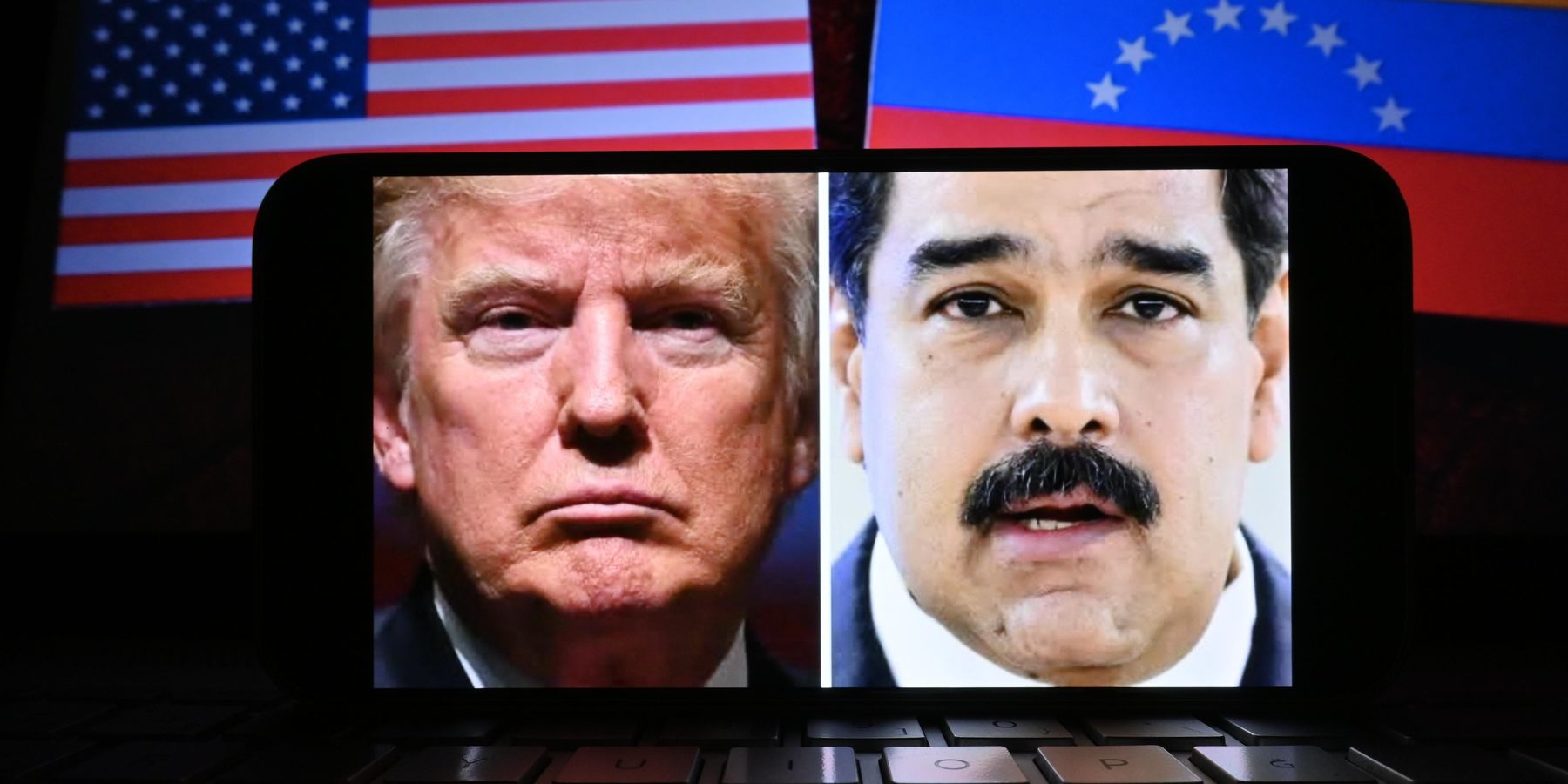
The White House is ready for war.
As the Trump administration’s made-for-Hollywood strikes on alleged drug-smuggling boats have dominated the news, the Pentagon has been positioning military assets in the Caribbean and Latin America and reactivating bases in the region. More recently, The Washington Post reported that high-level meetings were held about a possible imminent attack on Venezuela and The New York Times has learned that the president gave authorization for CIA operations there.
There is one problem: Americans don’t seem to be very enthusiastic.
While voters returned Donald Trump to office in 2024 based on a host of campaign promises, his faithful took his long-voiced complaints about spending on foreign aid and entanglement in overseas wars as vows to focus on the homeland. A range of Americans are in sync with his past statements about avoiding war; opposition to military intervention abroad is common for the left and right. Simply put, the public is not interested in going to war. Indeed, one recent poll found that just 15% of American adults support invading Venezuela.
Some see Trump's Venezuela moves as an attempt to distract from domestic policy failures or the Jeffrey Epstein scandal, but his actions can't be dismissed as wagging the dog. Trump has shown himself willing to engage with militarism. It's not just "drug boats," and it's not just Venezuela. He has spent 2025 belying the myth, which has persisted over his three campaigns for president, that he is averse to war-making.
What polls say about Venezuela
The public has mixed views on some of the Trump administration's specific actions toward Venezuela. Asked in a recent YouGov poll about the U.S. Navy's presence in Caribbean waters, for example, the percentage who approve (30%) was not much lower than the percentage who disapprove (37%).
Framing its actions against the South American nation as narcotics enforcement seems to have benefited the administration: A Harvard/CAPS poll in early October found 71% of registered voters in favor of "the US destroying boats bringing drugs into the United States from South America." Different wording — and perhaps media coverage of the continued boat strikes raising issues of their necessity, legality, and effect — could help explain why a Reuters/Ipsos poll in mid-November found only 29% answered yes to the question, "Should the U.S. government kill suspected drug traffickers abroad without judicial process?"
Importantly, however, in YouGov's survey, roughly two-thirds of American adults said they oppose an invasion of Venezuela and, as noted above, only 15% support one. Over half oppose the U.S. using the military to overthrow the country's president, Nicolás Maduro.
A 2023 survey found a souring of views of military intervention more broadly, with growing numbers believing that intervention by the U.S. tends to "worsen situations." Respondents seem to have based this on more recent examples, including the wars in Iraq and Afghanistan and the Syrian and Yemeni civil wars. None of these interventions were seen by the majority of those polled as "successful" uses of U.S. forces abroad.
A cost-benefit analysis
Overall, Americans do not want to get, to use Trump's own words, "bogged down" in foreign wars. Public opinion on intervention appears driven by a cost-benefit analysis as John Mueller, Professor of Political Science Emeritus at Ohio State University describes it. This may be why some Americans are more willing to accept action in the form of targeted strikes such as the boat bombings and limited displays of military might.
Since the Cold War and especially the 9/11 attacks, the U.S. has become increasingly militarized. One measure of this, of course, is government spending. The Costs of War project at The Watson School of International and Public Affairs estimates that the U.S. has spent $8 trillion as a result of the post-9/11 wars. The $22 billion in support for Israel’s war in Gaza since Oct. 7, 2023 is one of the latest and most egregious instances of the U.S.’s support for a military first approach.
Unfortunately, the official end of the post-9/11 wars was not the end of their financial costs to ordinary Americans. The percent of the discretionary federal budget devoted to the military continues to rise and at the expense of domestic programs. Pentagon spending alone in 2026 will jump to well over $1 trillion. Though many of the economic costs of war are hidden and/or deferred to an indeterminate future — especially when they are funded through deficit spending — Americans still rightly worry about getting involved in costly conflicts like the wars in Iraq and Afghanistan.
Can public opinion halt Trump's militarism?
Many have taken note of how Congress's passage of the 2001 Authorization for Use of Military Force has helped concentrate power in the executive, enabling swifter, unilateral military deployment by the commander-in-chief. With the AUMF, Congress relinquished its constitutionally assigned war powers and ceded to the president its duty to decide whether, when, and where to use the military to combat terrorism. Since then, the executive branch has conducted counterterrorism activities in an astounding 78 countries.
Despite Americans' low trust in Congress, they nonetheless want the president to seek congressional approval before going to war. Feeding their mistrust, Congress has failed to respond to them on this crucial issue.
Look at how a compliant Congress has abdicated responsibility for oversight of the bombings in the Caribbean — which have now killed more than 83 people — as the Pentagon arrays warships, missiles, drones, and jet fighters in the region. Senate Republicans voted down legislation that would have required Trump to get their approval for any attacks on Venezuela, blatantly ignoring the disapproval of a public they are meant to represent.
So the bombings and the build-up continue, with Trump matter-of-factly telling a journalist, "We’re just going to kill people" without seeking congressional approval.
In the end, Trump may not attack Venezuela, but it likely won't be because the people are against it. He is in the process of commandeering all armed capacities of the U.S. government, military, and law enforcement to serve his purposes foreign and domestic. Reasserting the rights of the people, including the right to peace, requires Congress to aggressively reassert its constitutional duty and the citizenry to demand its will be met.
- Dick Cheney's ghost has a playbook for war in Venezuela ›
- Will Trump really attack Venezuela? ›
- Why is Congress MIA on looming Venezuela war? ›
- Doubt is plaguing Trump’s Venezuela game | Responsible Statecraft ›
- Tracking congressional criticism of Trump's attack on Venezuela | Responsible Statecraft ›
- Trump’s quest to kick America's ‘Iraq War syndrome’ | Responsible Statecraft ›