This article is part of a special series recognizing the four-year anniversary of the Ukraine War
Over the past four years, the Ukraine War has done more to change military weapons and tactics than any other conflict since 1945. Israel’s victories in 1956, 1967 and 1973 were won by World War Two weapons and tactics. The lessons of guerrilla wars in Vietnam and Afghanistan had mostly already been taught by Spanish guerrillas and Russian partisans more than two centuries ago.
In other wars, like those of the U.S. against Iraq and Panama, the balance of forces was so one-sided that it was hard to draw lessons for full-scale war. Russia and Western-armed Ukraine, by contrast, have been peer competitors, with comparable weaponry, training and (surprisingly) numbers.
That said, the lessons of the first year of the war were mostly old ones. Through appallingly poor intelligence (possibly worsened by an unwillingness to tell Putin uncomfortable truths), the Russians wholly underestimated the strength and determination of Ukrainian resistance. This stemmed from old and new prejudices, including the belief that President Volodymyr Zelensky, whom the Russians regarded as an insignificant TV comedian, would flee or surrender in the face of the Russian assault.
The Russian general staff should have studied a cartoon of 1879 in the British magazine Punch, published after a British force equipped with modern rifles and artillery was wiped out at Isandlwana by a Zulu army armed with spears. It shows a Zulu warrior writing on a blackboard, “Despise not your enemy!” Moreover, when their original plan to seize Kyiv and decapitate or subjugate the Ukrainian government failed, the Russians had no viable Plan B.
Underestimating the Ukrainians led to another classic mistake. The Russians not only deployed far too few troops for the tasks at hand, but divided them between six different goals. As a result, only one of them was achieved: the conquest of a “land bridge” between Russia and Crimea. Thereafter, the Russian government’s unwillingness to deploy conscripts or spend huge sums on increasing the professional army meant that Russia lacked the troops even to hold some of the land it had already taken.
The first month of the war did however teach one striking lesson. A combination of Ukrainian hand-held anti-tank and anti-aircraft missiles nullified the Russian combination of armor, attack helicopters and ground attack aircraft that had been at the heart of Soviet, Russian and U.S. planning for offensive action in “big wars.”
As the war progressed, it diverged further and further from the experience of the previous century. This has been above all because of the tremendous advantages that a combination of old and new weapons gives to the defense. Satellite intelligence allowed both the Russians and the Ukrainians (with U.S. help) to spot where the other side was concentrating troops for an attack, and thereby to concentrate troops in response. This helped the Russians to defeat the Ukrainian counteroffensive in the summer of 2023, and the Ukrainians to hold subsequent Russian advances to a crawl.
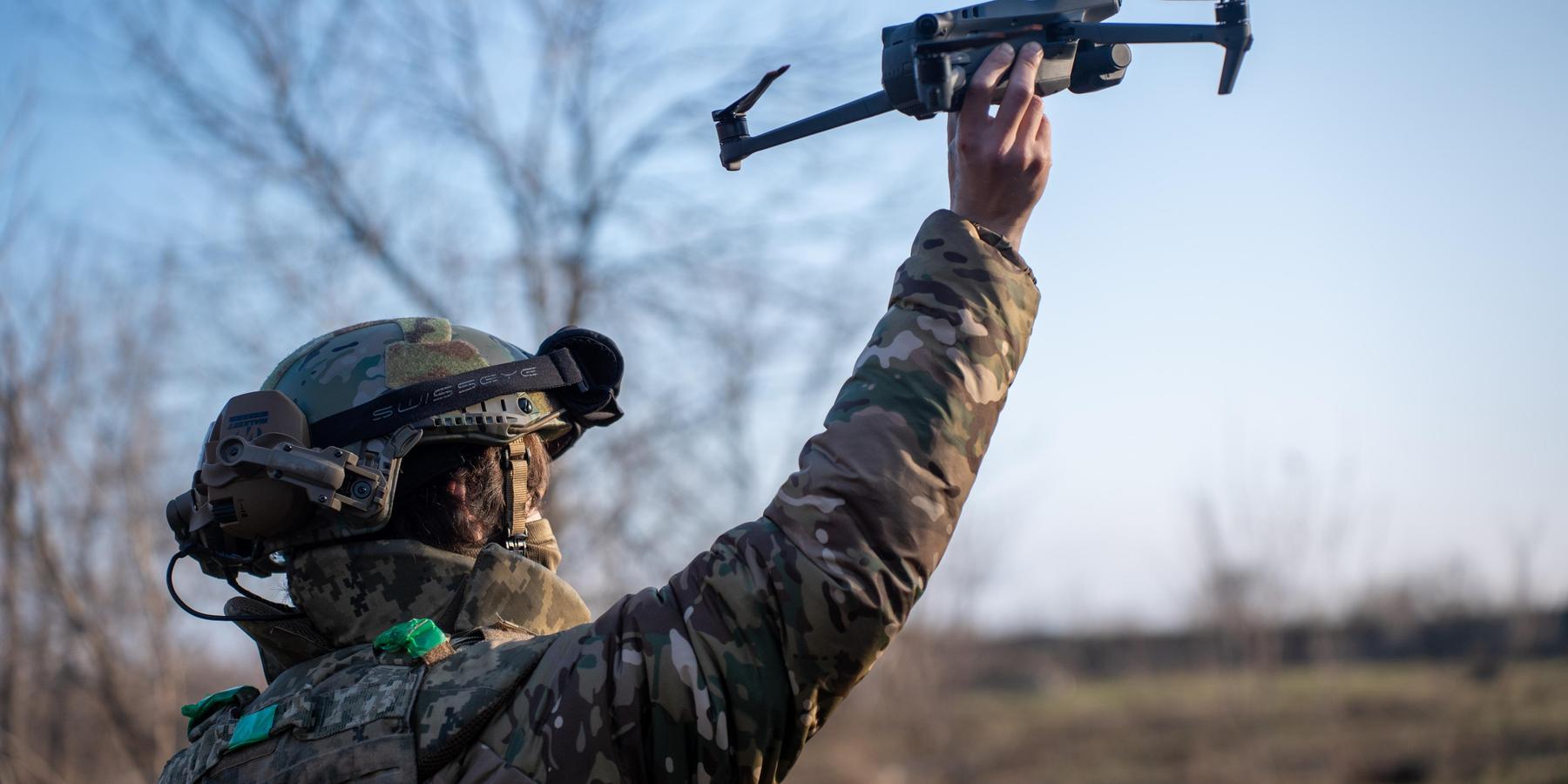
This ability goes back to the development of reconnaissance aircraft in World War I; but unlike aircraft, satellites for the moment at least are safe from attack. Above all, as now generally recognized, it is drones that have transformed the battlefield. The vast deployment of drones by both sides has created a no man’s land more than 15 miles wide, in which any visible movement is very likely to be fatal for men, and certainly for machines. Even well-dug-in troops can be spotted and hunted down one by one.
Drones also make it impossible to clear the mines with which these zones are now choked and which are a huge barrier to movement. Whether done by men or machines, clearing mines takes time and is carried out in the open — and that is impossible with drones overhead.
Since the second half of the 19th century, increases in firepower have led to a progressive “thinning out” of infantry on the ground. Drones have increased this to a truly revolutionary extent. Not only have they made it impossible to accumulate the mass of men and machines for a decisive breakthrough; over the past two years, they have even forced the Russian army to split up its attacking forces into groups as small as two or three men.
This has had a critical effect on the willingness of troops to advance in the face of acute danger. King Frederick the Great was only stating an old military truth when he said that, to get soldiers to advance against fire, they had to be more afraid of their own non-commissioned officers than of the enemy. In a unit of three men, that is impossible. There is no senior NCO to frighten them, and no officer to inspire them. Unless they possess exceptionally high morale and determination, faced with heavy fire they will simply go to ground.
These military lessons will remain true even if, through sheer exhaustion or the withdrawal of Western support, the Ukrainian army eventually collapses. For it has already put up a fight that before the war military experts considered impossible, and that would in fact have been impossible without the military transformation that I have described.
These lessons would seem so obvious that they would be impossible for Western militaries to ignore; but one should never underestimate military conservatism. After all, soldiers spend the vast majority of their active careers not at war but exercising in peacetime, which essentially means pretending to fight themselves.
In the contemporary U.S. and Europe, adherence to existing weapons systems is colossally reinforced by the interest of the military industrial complex and its political allies in continuing to produce large, sophisticated and hugely expensive weapons platforms, as opposed to cheap drones and mines. In Europe, to this is added the (probably false) promise that spending on tanks and warplanes can rebuild national industries. In Germany, this misdirection of military spending is — fortunately — already leading to pushback from more objective analysts.
Even after commanding in the First World War, the British Field Marshal Haig could still state in 1926 that “Aeroplanes and tanks are only accessories to the men and the horse, and I feel sure that as time goes on you will find just as much use for the horse — the well-bred horse — as you have ever done in the past.” He had after all lived on friendly terms with horses for far longer than with tanks and aircraft. We can therefore confidently expect that for many years to come, our soldiers and military experts will continue to advocate the absolute necessity of the well-bred tank (and its human crew), all evidence to the contrary.
Of course, every development in weaponry favoring the defense is sooner or later met with new weapons restoring the power of the offense, and vice versa. Thus in World War One on the Western Front, bloody stalemate and the slaughter of the infantry led to the development of the tank and the bomber aircraft.
In our time, the next development seems certain to be the creation of attack robots, that — unlike men — can be made to go on attacking even when their comrades are being destroyed all around them (until, perhaps, they eventually utter the robotic equivalent of “Sod this for a game of soldiers” and turn on their human masters). Even when backed by AI, however, the development of such weapons is likely to take considerable time. In the meantime, drones will remain the lords of the battlefield.
The most immediately consequential lesson should be for China and the U.S. concerning a war over Taiwan. For perhaps the most striking development of all in the Ukraine War has been the way in which Ukraine — with no navy whatsoever — has been able to defeat the Russian Black Sea fleet with land-based missiles and airborne and seaborne drones.
On the one hand, this should show the Chinese that they would be taking an appalling risk by trying to launch an amphibious invasion of Taiwan in the face of strong resistance. On the other hand, it should show the U.S. that American warships operating close to China would be in mortal danger of destruction even if the Chinese navy were sunk or pinned within its own ports.
Even if nuclear war could be avoided, the result — as in Ukraine — would likely be a bloody stalemate. Let us hope therefore that the greatest lesson of the Ukraine War for states will be not to go to war in the first place.
- Right now NATO could not win a war with Russia ›
- How NATO military doctrine failed Ukraine on the battlefield ›
- The 2026 bill for the Ukraine war is already in the mail ›

 Screengrab via niacouncil.org
 Screengrab via niacouncil.org