

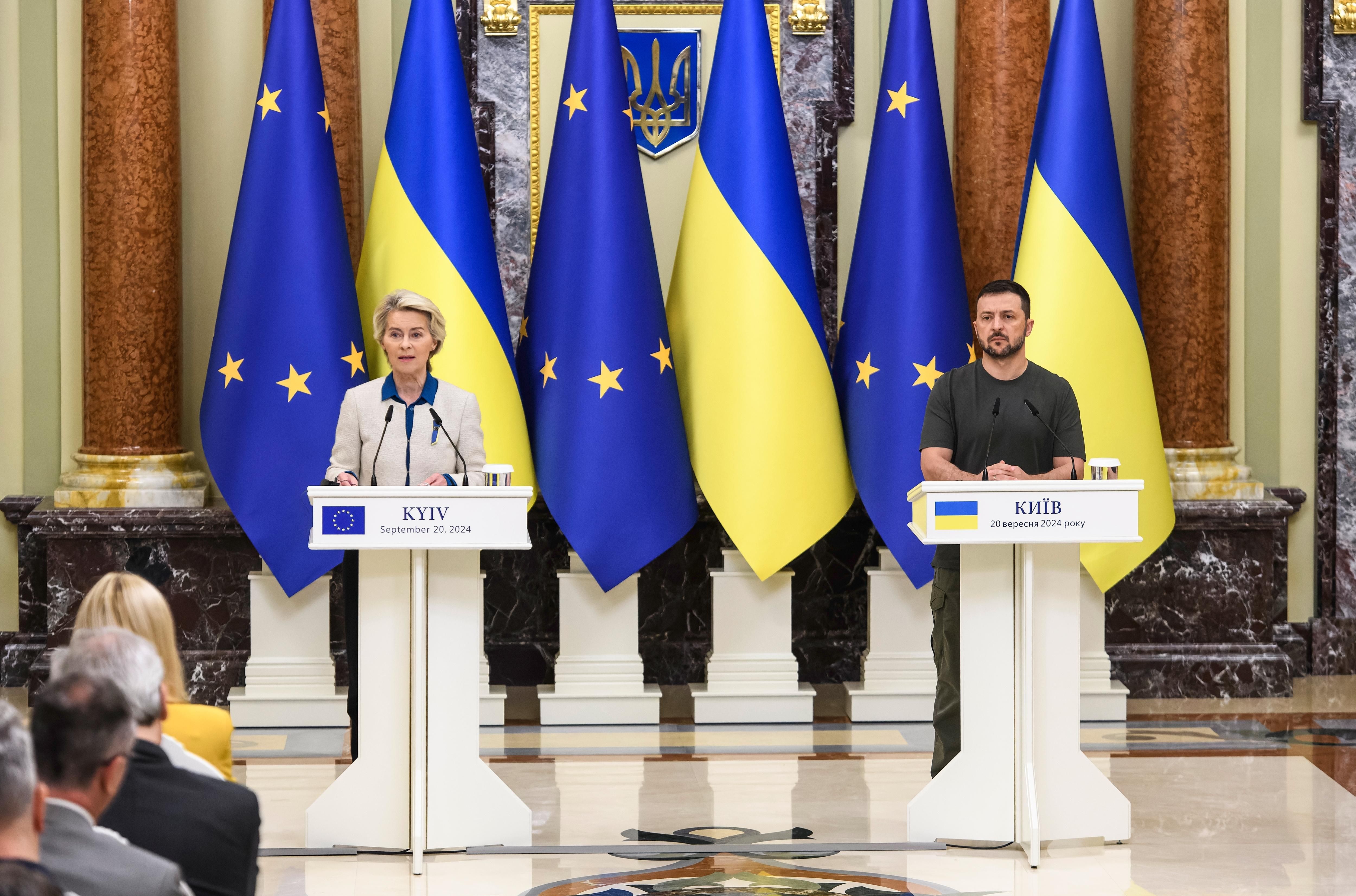
Trying to accelerate Ukraine’s entry into the European Union makes sense as part of the U.S.-sponsored efforts to end the war with Russia. But there are two big obstacles to this happening by 2027: Ukraine isn’t ready, and Europe can’t afford it.
As part of ongoing talks to end the war in Ukraine, the Trump administration had advanced the idea that Ukraine be admitted into the European Union by 2027. On the surface, this appears a practical compromise, given Ukrainian President Volodymyr Zelensky’s concession that Ukraine will drop its aspiration to join NATO.
However, the idea of accelerated entry for Ukraine has not been met with widespread enthusiasm in Europe itself. Diplomats in Brussels dismissed the notion as “nonsense: There needs to be an appetite for enlargement that isn’t there.”
There are two big problems with Ukraine’s rapid accession, the first being readiness and the second cost.
Firstly, Ukraine is nowhere near ready to meet the EU’s exacting requirements for membership. The process of joining the bloc is long and complex. At the start of November, in presenting its enlargement report, the EU said that it could admit new members as early as 2030, with Montenegro the most advanced in negotiations.
After it was formally granted candidate status in June 2022, Ukraine this year passed screening of its progress against the various chapters of the acquis (regulations) that it needs to pass before accession is granted. However, the EU enlargement report on Ukraine downgraded the country’s status from A+ to B, largely in light of the corruption scandal that first erupted in the summer and that rumbles on today.
The report indicated that Ukraine had made good progress on just 11 of the 33 chapters required for accession. It has made limited progress on 7 of the chapters, including on corruption, public procurement, company law and competition policy. It has yet to finalize negotiations on any of the chapters. And, of course, with war still raging, it is incredibly difficult to both agree and put in place the reforms needed to align itself with EU rules and standards. So, even if the war ended by Christmas, which despite the progress still appears optimistic, it would be unlikely to do all of the necessary work in the space of a year to be ready for accession.
The second, possibly more insurmountable challenge is cost.
In July, German Chancellor Friedrich Merz commented that Ukraine was unlikely to join before 2034. The EU has already formalized its next seven year budget through to that time, coming in at $2.35 trillion.
As I pointed out for Responsible Statecraft last year, Ukrainian membership of the EU would come with an enormous price tag. In total, according to a 2023 estimate, Ukraine could be eligible for over $31 billion per year in EU subsidies should it join on equal terms to existing member states. That would eat into the generous subsidies currently received by other member states. Neighbouring Poland, by far the largest recipient of EU subsidies, has a proposed allocation of $145 billion in the upcoming budget. The other winners are bigger, wealthier G7 countries such as France ($106 billion), Italy ($102 billion) and Germany ($80.5 billion). Unlike Poland, those countries pay into the budget more than they receive. But lower subsidies would effectively mean they had to pay in more.
Let’s take agricultural subsidies, from which Ukraine might benefit to the tune of $113.5 billion over an EU budget cycle of seven years. This would lead to a 20.3% cut to agriculture subsidies to farmers in other member states. So, for example, that would lead to France losing around $2.2 billion per year in farming subsidies, and Poland losing around $1.2 billion. Polish farmers have consistently protested since the start of the war at the inflow of cheap Ukrainian food products. French farmers have historically been extremely protectionist and will almost certainly resist any loss of their subsidies – the most generous in Europe.
So the economic cost of delivering Ukrainian membership may not be politically viable any time soon, and certainly not before 2034, as the German premier has indicated.
To be clear, I have consistently supported Ukraine’s membership in the EU. Neighboring Poland has enjoyed an average economic growth of nearly 4% since it joined the EU in 2004. Of course, the Ukraine crisis initially bubbled up in 2013 because of a tug-of-love over whether that country should sign a Deep and Comprehensive Free Trade Agreement with the EU or join the Russian-inspired Eurasian Economic Union. With practically all Russia-Ukraine economic ties severed over the past decade, Russian President Vladimir Putin has dropped his opposition to EU membership for Ukraine. An end to the war would allow Ukraine, finally, to start to reform and rebuild its bankrupt economy, and EU membership could accelerate that process.
That’s why Zelensky’s decision to drop the aspiration to NATO membership is such an important stepping stone. It has been abundantly clear since the start of the war that Russia’s NATO red line will never change. Russia has verbalized its opposition at least since Putin’s Munich Security Conference speech in 2007, when he said that NATO expansion “represents a serious provocation that reduces the level of mutual trust.” He followed that up at the 2008 Bucharest NATO Summit by saying, “we view the appearance of a powerful military bloc on our borders...as a direct threat to the security of our country.”
Ukraine needs hope that EU membership will sweeten the bitter pill of losing out on NATO. However, it faces other challenges too. Countries like Hungary oppose Ukrainian membership in the EU, having had fraught relationships throughout the war. If Ukraine is allowed to jump the queue, other countries much further forward in the accession process — such as Montenegro, which because of its size doesn’t carry the same price tag as Ukraine — may rightly ask, ‘what about us?’
That’s not to say that a political workaround might not be found to allow Ukraine to declare itself an EU member by 2027, as part of Washington's monumental efforts to end this needless war. But if that be so, I should be surprised if membership amounts to much more than an EU flag to fly over Ukrainian buildings.
- Cracks in European ‘unity’ on Ukraine ›
- Why is Putin OK with Ukraine joining the EU? ›
- Could Hungary's fight over oil change course of Ukraine War? | Responsible Statecraft ›
- Zelensky versus the EU: Will Ukraine ever get in? | Responsible Statecraft ›