

There is a dangerous pattern on display by the Trump administration. The president and Secretary of Defense Pete Hegseth seem to hold the threat and use of military force as their go-to method of solving America’s problems and asserting state power.
The president’s reported authorization for the Pentagon to use U.S. military warfighting capacity to combat drug cartels — a domain that should remain within the realm of law enforcement — represents a significant escalation. This presents a concerning evolution and has serious implications for civil liberties — especially given the administration’s parallel moves with the deployment of troops to the southern border, the use of federal forces to quell protests in California, and the recent deployment of armed National Guard to the streets of our nation’s capital.
Last week, the Pentagon sent three guided-missile destroyers to interdict drug cartel operations off the coast of South America, giving the U.S. Navy unprecedented counternarcotics authority and foreshadowing a potential military stand-off against Venezuelan President Nicolas Maduro, who is wanted by the United States on charges of narco-terrorism. This development is echoed by President Trump reportedly seeking authorization to deploy U.S. military forces on the ground against drug cartels in Mexico.
These efforts are not new. Trump and the GOP have increasingly called for U.S. military interdiction against Mexican drug cartels under the banner of counterterrorism. During his first administration, Trump seriously considered launching strikes at drug labs in Mexico in an effort that was successfully shut down by then-Secretary of Defense Mark Esper.
But there are no such guardrails in the new Trump administration, and the rhetoric has progressively crept toward the use of U.S. special operations, specifically. During an interview on Fox News in November, incoming Border Czar Tom Homan announced that, “[President Trump] will use the full might of the United States special operations to take [the cartels] out.”
If that is indeed the direction the administration wants to go, it appears to be taking action to set plans into motion, starting with an executive order on day one that designated cartels as foreign terrorist organizations — thus opening a Pandora’s box of potential legal authority to use military force. On signing the order, President Trump acknowledged, “People have been wanting to do this for years.” And when asked if he would be ordering U.S. special forces into Mexico to “take out” the cartels, Trump replied enigmatically, “Could happen … stranger things have happened.”
The executive order upholds that drug cartels “operate both within and outside the United States … [and] present an unusual and extraordinary threat to the national security, foreign policy, and economy of the United States.” It declares a national emergency under the International Emergency Economic Powers Act. The specificity of both “within and outside” the U.S. combined with the declaration of a national emergency is perhaps the first step toward the broader use of executive power to deploy military forces in counternarcotics operations not only within Mexico, but potentially the United States too.
To be sure, the Trump administration is already testing the limits of Posse Comitatus — the law that prevents presidents from using the military as a domestic police force — by invoking questionable authorities to use National Guard and active duty troops during the counter-ICE protests in California and, most recently, to declare a “crime emergency” in Washington, D.C. federalizing the police force and deploying troops to patrol the district’s streets. Reports this week suggest the administration is preparing to do the same in Chicago.
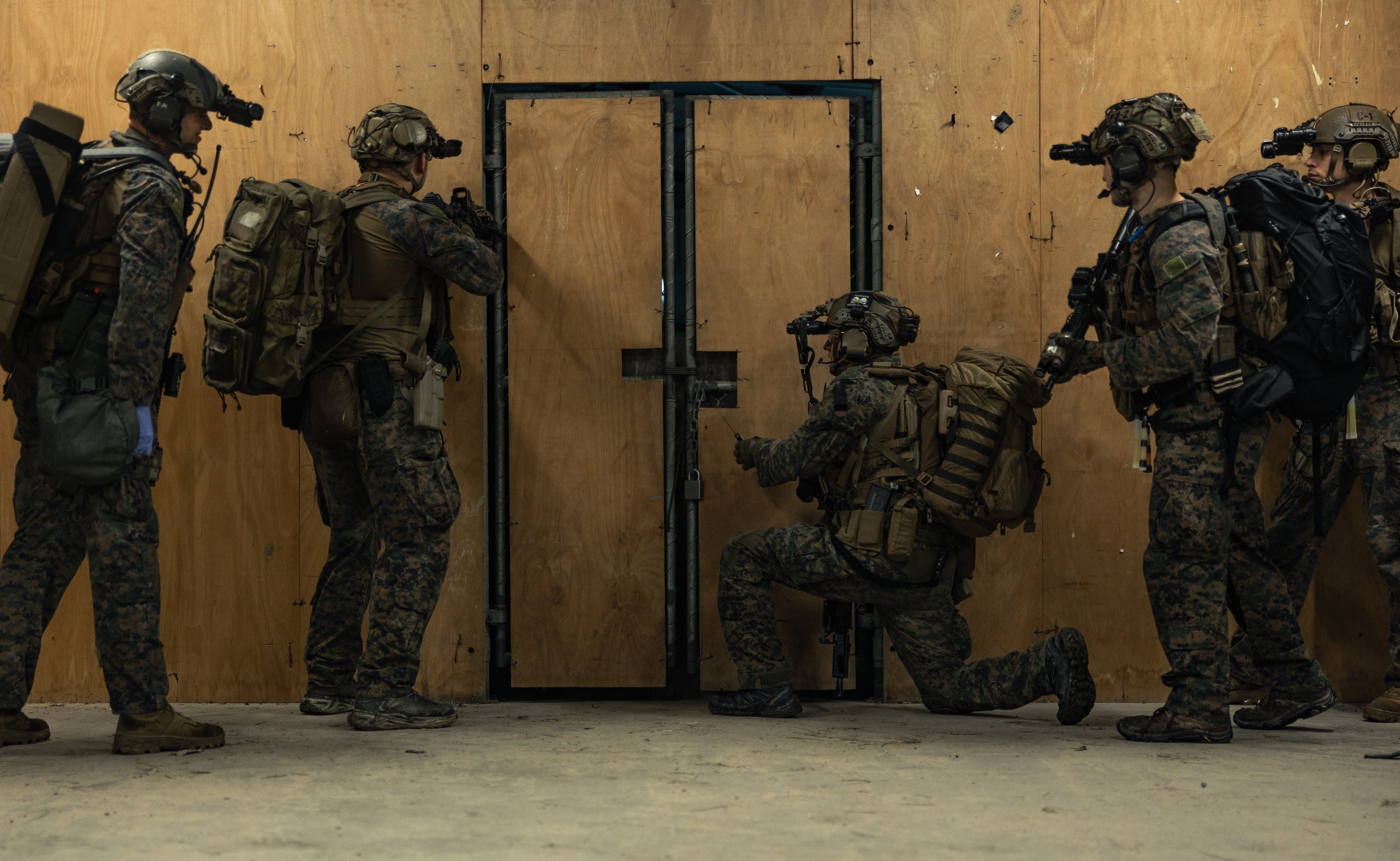
The naval operations in South America are likely just the beginning. If the U.S. military were to engage in Mexico, the most likely forces to execute an operation would be a task force under the U.S. Army’s 7th Special Forces Group, whose area of responsibility includes Central and South America, or a specialized task force under the Joint Special Operations Command.
Historically, along with past administrations, Trump has been inclined toward the use of special operations forces as his default problem-solver. Hegseth has amplified the same proclivity, noting at an industry forum in May that the presidentially-directed use of special operations forces has increased exponentially in the past three years and will only continue, pledging a significant increase in funding for the U.S. Special Operations Command.
Under both Authorizations for the Use of Military Force (2001, 2002) to counter global terrorism, recent presidents, including Trump, have enjoyed an incredible level of authority to unilaterally deploy U.S. military forces for crises or other contingencies without congressional approval. Because of their relatively low troop footprints and the ability to accomplish targeted and short-duration missions (creating a convenient perception of limited military involvement) special operations forces are often preferred.
However, the prospect of using military force in counterdrug operations under the banner of counterterrorism is not only legally debated, it is doctrinally unsound. The Department of Defense defines terrorism as “the unlawful use of violence, or threat of violence, often motivated by religious, political, or other ideological beliefs, to instill fear and coerce governments or societies in pursuit of goals that are usually political.” This is paralleled by the FBI’s definition of terrorism. However, there is no evidence that America’s illicit drug problem is driven by anything other than the pursuit of profit on part of disparate criminal organizations and individuals — fueled by the desire and demand for illicit drugs on part of the millions of Americans consuming them. Therefore, America’s drug problem, as concerning as it is, does not meet the United States’ own definition of terrorism.
While there are malign actions on part of the cartels that parallel activities committed by terrorist organizations — such as the use of violence and intimidation against the civilian populace, government officials, and military and law enforcement — the overriding motivation of drug cartels is not inherently political, or religious, or ideological in nature. Rather, it is largely financial. As with many other categories of criminal activity, illicit drug activity must remain within the domain of law enforcement, and any undermining of government authority by drug cartels is done mainly in the interest of securing profit.
This is a very important delineation when contemplating the use of American warfighters. During the “war on terror,” U.S. forces conducted counterdrug operations across the Middle East. I was directly involved in counternarcotics activities against ISIS-K as a part of the Special Operations Task Force - Afghanistan. However, ISIS was carrying out these operations to directly fund terrorist activities toward the deliberate, ideologically- and politically-driven aim of overthrowing state governments.
Equally important, the Mexican government has made it clear that the deployment of U.S. military forces within Mexico is neither desired nor welcomed and would be considered a violation of Mexico’s sovereignty. Mexico already collaborates with U.S. federal law enforcement in its fight against the drug cartels.
Rather than deploying special operations forces to conduct the kind of activities that would likely lead Mexico into full-scale counterinsurgency conflict — with U.S. forces directly entangled — we should instead nourish long-standing law enforcement partnerships. This would be the most legally appropriate and strategically sound course of action both diplomatically and in interest of regional security.
- Ripping up Trump's 'battle plan' of attack on Mexico's cartels ›
- A cartel war is an insane way to address fentanyl crisis ›
- Trump takes US military one step closer to bombing drug cartels ›
- With Venezuela, Trump poised to make mistake of epic proportions | Responsible Statecraft ›