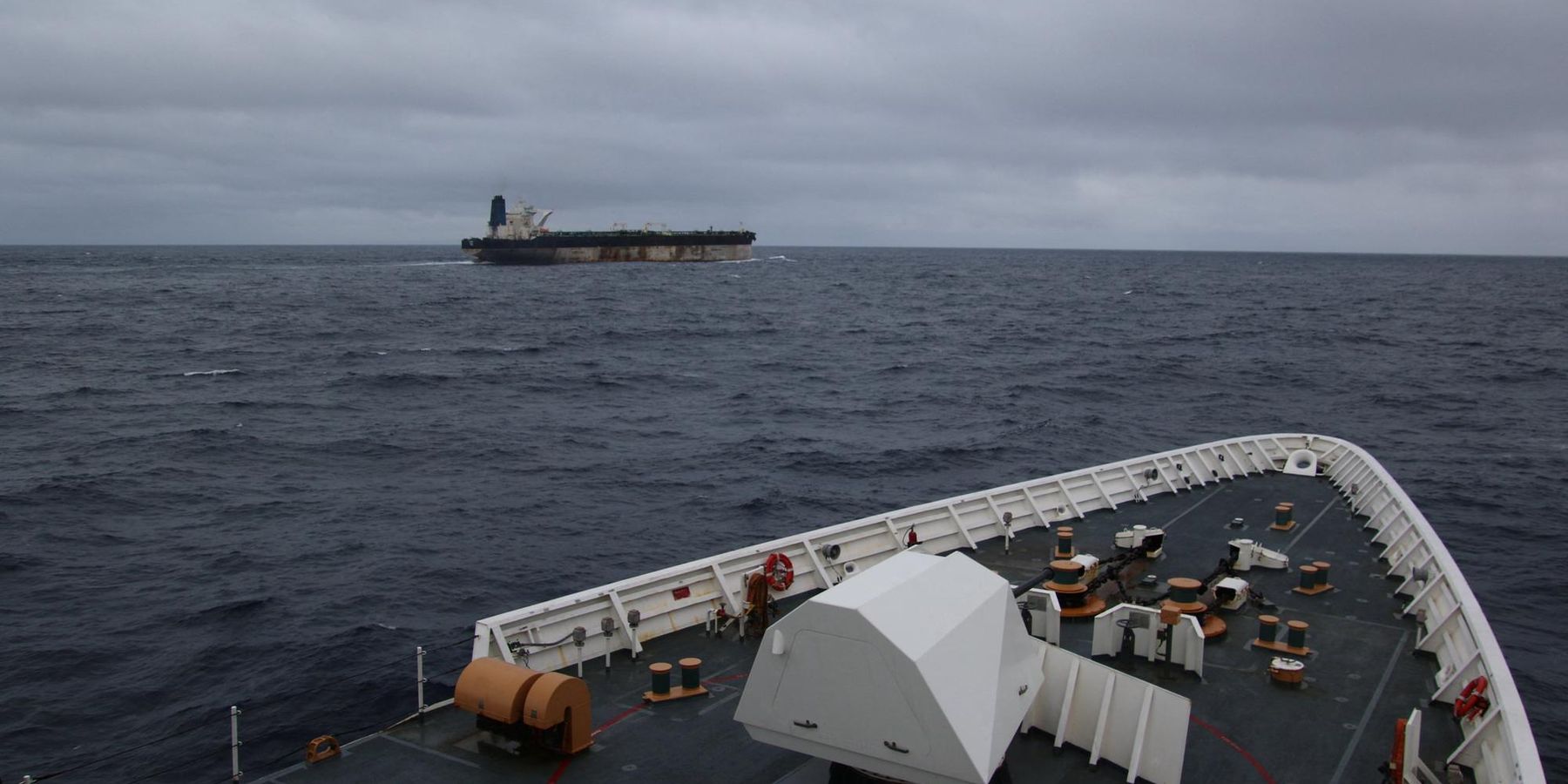
Today’s U.S. seizure of a Russian-flagged, Venezuelan-linked oil tanker in the Atlantic Ocean threaten the success of critical Ukraine war talks, where negotiations for security guarantees for a post-war Ukraine are now underway.
For its part, Russia condemned today’s tanker seizure, calling it illegal under maritime law. Russia says the seized tanker, part of a “shadow” fleet aiming to avoid oil sanctions, had temporary permission from Russia to fly its flag. But the U.S., calling that tanker “stateless after flying a false flag,” is considering prosecuting its personnel to enforce these sanctions. The U.S. also captured a second tanker near the Caribbean Sea today.
This tit-for-tat, experts say, stands to cause greater friction at a significant diplomatic moment.
“Since the ship adopted the Russian flag and after Russia sent a submarine to protect it, seizing the tanker has…serious implications. It will no doubt irritate Moscow and potentially setback a diplomatic process [for Ukraine] that is already struggling,” Jennifer Kavanagh, senior fellow and director of military analysis at Defense Priorities, told RS.
“The benefits to the United States here just seem so low, and the costs quite high,” Kavanagh said.
“It will certainly damage U.S.-Russian relations,” Anatol Lieven, the director of the Quincy Institute’s Eurasia program, told RS.
Experts also fear that, if Europe takes Washington’s lead, and starts capturing other shadow fleet tankers, that it will risk a direct NATO-Russia confrontation.
“The greatest danger…would be if European states imitate this and start seizing Russian cargoes on the high seas — as opposed to in their ports and territorial waters, which they are already doing,” Lieven told RS.
“Russian officials have told me that in that event they will use Russian warships to escort the ships, with orders to fight if intercepted. We would then take a huge step towards direct war with Russia,” he said.
“While the loss of several tankers…can be written off as the cost of doing business under sanctions, the questions people in Moscow are likely asking themselves is, what kind of precedent this sets and whether or not European countries will follow suit in more aggressively pursuing these shadow fleet tankers,” Mark Episkopos, a research fellow at the Quincy Institute's Eurasia program, told RS. “That is where the real risk of escalation lies.”
“If such a policy is universalized by the West, it would not just tighten the already narrow window for a settlement in Ukraine, but ratchet up the risks of a direct clash between Russia and NATO,” Episkopos said.
Today’s tanker seizure follows a U.S. military operation over the weekend to capture Venezuelan leader Nicolas Maduro. The U.S. has since said it will “run” Venezuela until a successful transition of power can occur.
- Europe's risky war on Russia's 'shadow fleet' ›
- Will the US try to interdict Iranian tankers bound for Venezuela? ›
- If Europe starts attacking Russian cargo ships, all bets are off | Responsible Statecraft ›
 Screengrab via niacouncil.org
 Screengrab via niacouncil.org