

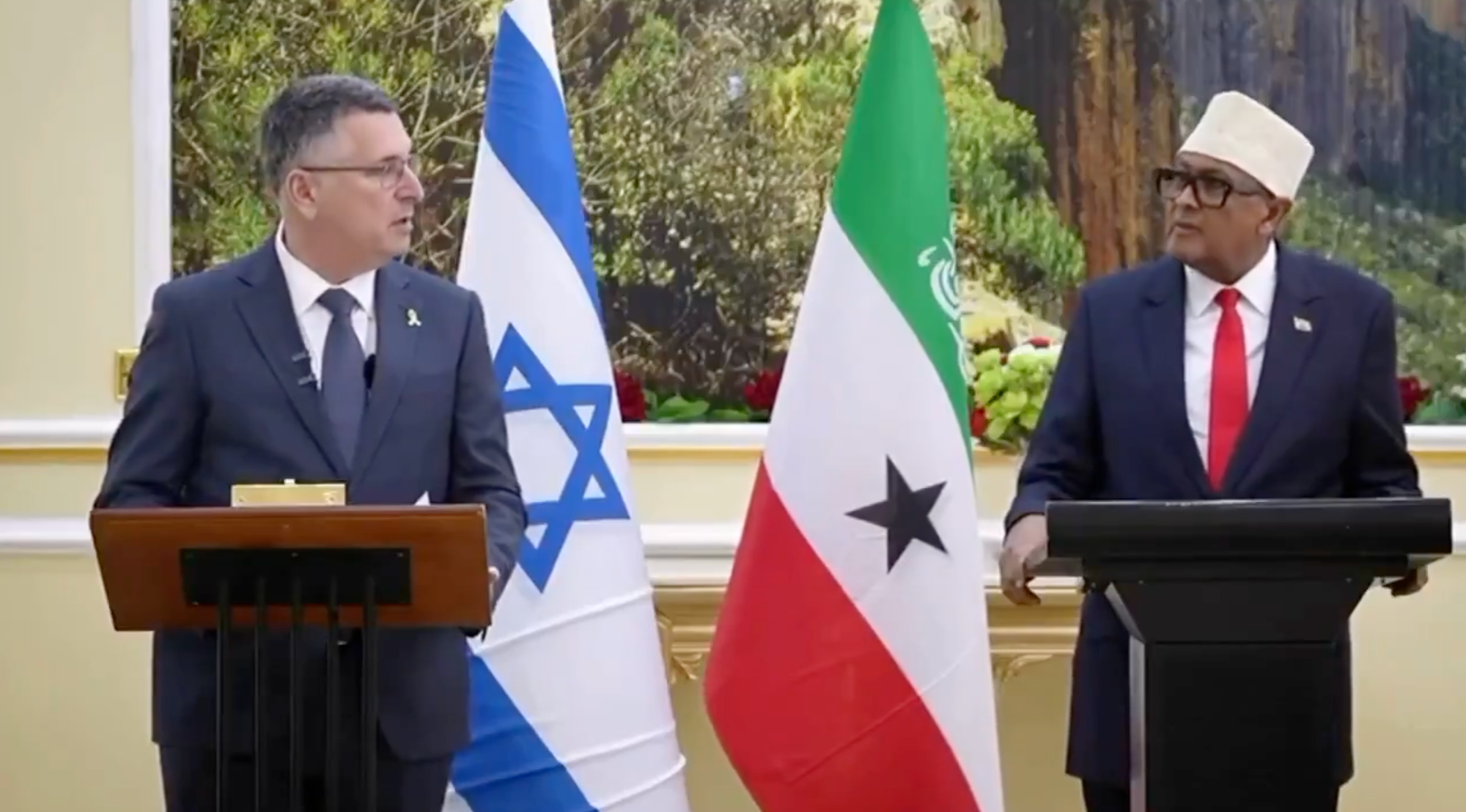
Israeli Foreign Minister Gideon Saar arrived in Somaliland Tuesday for an official visit to the disputed territory, just 10 days after Israel became the first country to recognize its independence from Somalia.
The trip, which Somaliland officials quickly trumpeted on X, highlights Israel’s enthusiasm about its budding ties with the breakaway state, which lies on the northern side of the Horn of Africa, roughly 160 miles from Yemen by sea. “No one can ignore the strategic location of Somaliland,” Danny Danon, Israel’s ambassador to the United Nations, told the Wall Street Journal. “The straits are a strategic point,” he added, referencing the territory’s position at the mouth to the Red Sea, through which 30% of global shipping trade travels.
Both countries have a lot to gain from the new relationship. Israel gets a rare ally in Africa and a strategic outpost on the Red Sea, and Somaliland gets a first step toward the global recognition that it has sought for the past three decades, following atrocities committed by Somalian authorities against its people.
But the costs of the surprise move have already started to come into focus. The decision drew sharp backlash from the international community, with 14 of the 15 United Nations Security Council members condemning Israel’s decision. (The sole exception is the United States, which defended Israel but refrained from recognizing Somaliland itself.) Somalia, which is a member of both the African Union and the Arab League, warned that the move may be part of a plot to relocate Palestinians from Gaza, slamming it as a sign of “utter disdain for law and morality.”
So it is that, by recognizing Somaliland, Israel has made a bold bet — one premised on the idea that mere diplomatic blowback should not deter it from expanding its military influence into the Horn of Africa, where other Middle Eastern powers have been jockeying for influence in recent years. Somaliland, for its part, has made an ambitious bet of its own, based on the theory that recognition by a regional pariah is better than no recognition at all. But, given the possible destabilizing effects of the move, could both countries come to regret their decision?
“The potential fallout from this, if it does go ahead, in terms of instability in the region — I just cannot imagine how bad this can get,” said Samar Al-Bulushi, a non-resident fellow at the Quincy Institute, which publishes RS. “The potential for backlash from groups in the region, who I think would have popular support, is tremendous and frightening.”
Beggars can’t be choosers
Supporters of an independent Somaliland have a lot of evidence in their favor. During the colonial period, British authorities governed Somaliland as a separate entity from the rest of the territory that would one day become Somalia, which Italy controlled at the time. Somaliland even briefly existed as an independent state in 1960, garnering recognition from roughly 30 other countries.
But, within days of declaring independence, Somaliland officials made the consequential decision to enter into a union with neighboring territories and form what we now know as Somalia. Profound political problems plagued the state from the start. These challenges eventually grew into a civil war, during which the Somalian military killed at least 50,000 Somaliland civilians in acts later described as genocide.
This violence led Somaliland to declare its independence in 1991, with its capital in Hargeisa. Despite never gaining international recognition, it has functioned as a de facto independent state ever since, according to Matt Bryden, a former United Nations official who now works as a strategic consultant in Kenya. The local government has even managed to create a fairly democratic system for its 6 million inhabitants, spread across a territory roughly equivalent to the size of Florida.
Supporters of Somaliland independence also point out that reintegration with the Somali government would likely lead to bloodshed. “They don't want to rejoin the larger federal state of Somalia, and to make them do that would require force,” said Peter Harris, a political science professor at Colorado State University.
Still, the international community has held strong in its opposition to Somaliland’s independence. One reason for this is widespread fear that recognizing Somaliland will bolster efforts by other separatist movements, undermining stability across Africa and the Middle East, where such movements proliferate. (Just last week, separatist forces in Yemen attempted to declare an independent state in the country’s south.)
But perhaps most consequential is the fact that Israel, in particular, made the decision to recognize Somaliland first. Alongside the announcement of Israel’s recognition came a sea of rumors about what Hargeisa may have given up in the deal. Somali officials have made particularly attention-grabbing claims, alleging that Somaliland is now set to host an Israeli military base and perhaps even camps for Palestinians forcibly displaced from Gaza.
Somaliland officials have emphatically denied these allegations, both in public and in private conversations, according to Bryden, who recently visited Hargeisa and spoke with officials. But there is little doubt that the new relationship will increase Israel’s presence in the country, perhaps starting with a “listening post” or some other intelligence operation pointed toward Yemen, Bryden said.
Even a small Israeli presence could draw a violent response from its regional foes, according to Andreas Krieg of King’s College London. “Any perceived Israeli node in Somaliland would likely attract hostile attention from the Houthis and their partners, not only for direct retaliation but to demonstrate that the Gulf of Aden is not a sanctuary,” Krieg told RS. “The risk would be escalation by proxy, increased pressure on shipping and greater volatility around commercial infrastructure linked to Berbera [Somaliland’s primary port] and adjacent corridors.”
Somaliland also faces a risk that Israel has now poisoned the diplomatic well, given that few states in the Middle East or Africa want to be seen as following Israel’s lead in international affairs, particularly following Israeli atrocities in Gaza. Even Harris, who supports independence, conceded that the move creates a “potential liability” for Hargeisa. “If the leaders of Somaliland were going to choose a country to recognize them first, it wouldn't have been Israel,” he said.
An ever-expanding ‘cold war’
Israel may have been the state that made the first move, but there’s good reason to believe that another country is actually in the driver’s seat. “Many people argue that, behind the scenes, it's the UAE that supported and even encouraged this Israeli recognition of Somaliland,” said Cameron Hudson, an independent political analyst and a former Africa director in the U.S. National Security Council. Bolstering this argument is the fact that Emirati border officials quietly began accepting Somaliland passports, despite not officially recognizing the breakaway state.
In recent years, the UAE has dramatically expanded its presence in East Africa, investing in infrastructure and diplomatic relationships across Somalia, Kenya, Ethiopia and Sudan. Abu Dhabi has developed a particularly close relationship with officials in Somaliland, where it has built a port and a military base. Meanwhile, Emirati officials have developed an increasingly close relationship with Israel, which they view as a useful partner in balancing against other Middle Eastern powers.
In this sense, the Israeli entry into East Africa represents a new escalation in the growing “cold war” between Middle Eastern states for influence and investment opportunities in the region, according to Hudson. “First and foremost is this confluence of security and economic interests, and overlaid on top of that is this regional competition — regional competition for markets, regional competition for legitimacy,” he told RS. “The Horn of Africa and into Africa, that's the emerging market” for Middle Eastern economies, he added.
This competition — which pits the UAE and Israel on one side against Egypt, Saudi Arabia, and Turkey on the other — has already had devastating consequences on regional stability. In Sudan, for example, Emirati support has allowed the Rapid Support Forces to fight the Sudanese military and expand its territory to include Darfur, where the RSF has carried out widespread massacres in recent months. The Sudan case could provide a frightening preview of the future for Somalia, which even today struggles to maintain security and fight the insurgent group Al Shabaab, if the troubled country falls prey to this sort of “rabid regional competition,” Hudson said. (This has already started to play out in some ways, given Turkey’s emphatic support for the government of Somalia and its territorial integrity.)
In the near term, the UAE will likely try to use its “network of client states” in East Africa to promote its interests in Somaliland, according to Hudson. These include Ethiopia and Kenya, both of which have become beholden to Emirati interests because of significant UAE investment there in recent years. But it remains unclear whether that will be enough to persuade these countries to recognize Somaliland given the strong opposition of the African Union, which is based in Ethiopia.
Realistically, the United States is the only country powerful enough to force the issue of Somaliland independence, experts told RS. Some Republicans, including Sen. Ted Cruz (R-Texas), have thrown their support behind the breakaway state, but the Trump administration has yet to indicate any public interest in recognizing Somaliland. Still, analysts believe that President Donald Trump might be persuaded to back Somaliland’s independence if the country joins the Abraham Accords, which could lead to recognition from countries like Bahrain and Morocco as well.
Regardless of what happens in the near term, it is now clear that Middle Eastern powers are determined to press their interests in East Africa, whatever the consequences. “A lot of the rivalries within the Middle East are now starting to spill over into the Horn of Africa region,” Al-Bulushi said. “It will be the people of the Horn of Africa that pay the price.”
- Red Sea is today's arena for clash of African-Arab power politics ›
- Why is Project 2025 concerned with Djibouti? ›
- US trashed Somalia, can we really scold its people for coming here? | Responsible Statecraft ›
- Israel’s push for Somaliland base raises fears of wider war ›