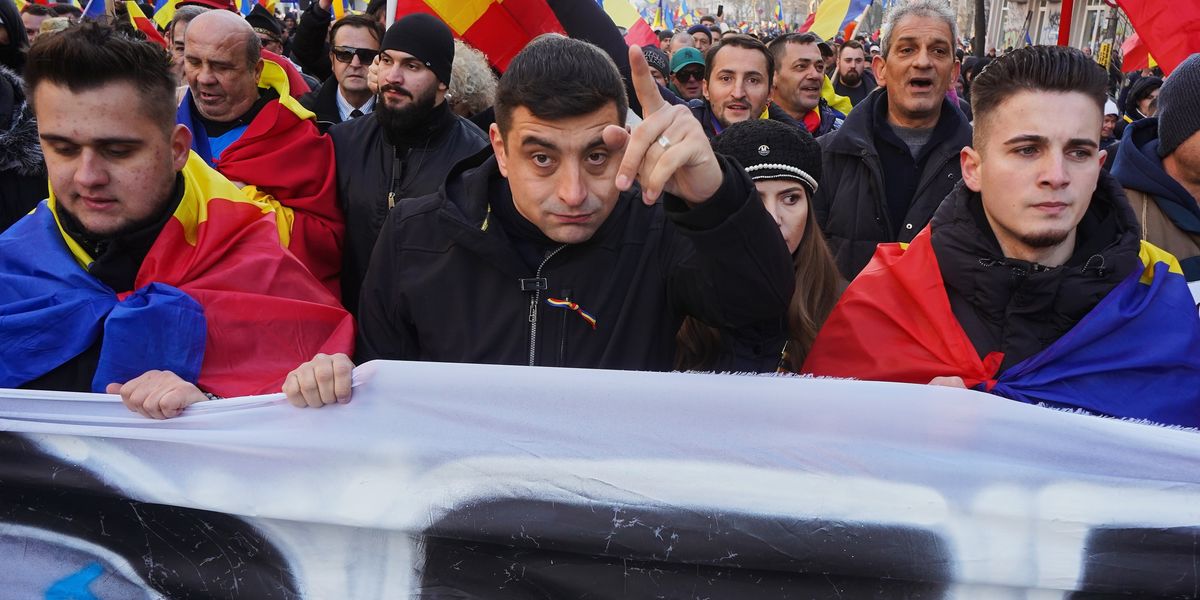
The head of Romania’s “sovereigntist” camp, George Simion won Romania’s first round presidential race on Sunday with 41% of the vote in a field of 11 candidates.
Simion leads the Alliance for the Union of Romanians (AUR) party, the leading opposition force in parliament. Simion — who as president would have substantial powers in the realm of foreign and security policy — supports Romania’s NATO commitments, but is not an enthusiastic supporter of sending further military aid to Ukraine. His victory could strengthen the dissident camp on this issue within the EU.
This first round result seems to be a decisive rebuke by the electorate of the cancellation of the first-round contest of last November, after the surprise first-place finish of Calin Georgescu, another nationalist-populist candidate. Georgescu, an AUR member until 2022, endorsed Simion, and the two men appeared together throughout the campaign.
Simion seems to have succeeded in winning support from those angered by Georgescu’s disqualification. (The combined tally of votes in November for Georgescu and Simion, who finished fourth, was 37%). Georgescu was barred from running, because his November campaign allegedly benefited from covert financing from Russia, including effective TikTok advertisements.
Simeon’s AUR was founded in 2019 initially advocating linguistic and cultural rights of ethnic Romanians in Moldova and Ukraine, but has broadened its appeal by espousing nationalist-populism and criticism of the EU. Ukraine barred him from entering the country on grounds that he was fomenting discontent within the ethnic Romanian minority (numbering about 150,000) in Ukraine.
In the runoff to be held on May 18, Simeon will face popular Bucharest mayor Nicosur Dan, a pro-EU anti-corruption campaigner who received just under 21% of the first round vote, slightly ahead of the pro-establishment standard-bearer Crin Antonescu. Dan founded the liberal reformist Union for the Salvation of Romania (USR) party which is represented in parliament, but he ran as an independent.
The May election rerun was conducted under stricter controls of campaign financing and monitoring of social media for inauthentic posts. Echoing some of Simion’s campaign rhetoric, Social Democrat Victor Ponta also ran a “Romania First” campaign, winning 13% of the vote. Those voters could give Simion an easy path to victory in the runoff. Simion’s AUR party is in the European Conservatives and Reformists (ECR) bloc in the European parliament, with the party of Italian Prime Minister Georgia Meloni and the Polish Law and Justice Party. Simion has called Meloni his political hero.
Romania’s mainstream center right National Liberals and center left Social Democrats govern together in coalition, and are held responsible by much of the electorate for steady population decline, emigration of much of the workforce, lackluster economic performance, and corruption. Simion won 60% of the Romanian diaspora vote. Many rural and traditionalist voters are clearly disaffected and keen to see dramatic change.
Sovereigntists vs Europhiles
The self-described sovereigntist Simion clearly aligned himself with the Trump administration, alleging that Romanian independence and dignity needed to be reasserted. Simeon clearly sought to emulate the model of Trump — and perhaps also Meloni — in his appeal to voters. Nationalist-populist parties in Italy, France and Poland celebrated Simion’s victory.
On May 2, Simion posted on X that the election was not about any one candidate but was instead about “every Romanian who has been lied to, ignored, humiliated, and still has strength to believe and defend our identity and rights.”
Dan has made fighting official corruption the centerpiece of his political career. His success represents a liberal rebuke of the political establishment and in particular the ruling coalition of the center right and center left (National Liberals and Socialists).
NATO and Ukraine
Simion is somewhat more sympathetic toward Ukraine than Georgescu, although unlikely to favor providing further financial or military support. Romania is important to sustaining the economy and war effort in Ukraine. A large share of Ukrainian wheat exports is shipped from Romanian ports, and NATO conducts operations from bases in Romania.
Simion favors following Trump’s lead on Ukraine and not that of those Europeans who vow to support Ukraine’s war effort even as the U.S. reduces or potentially halts its support. For better or worse, Simion has staked his campaign on the popularity of Trump’s administration. He sees continued U.S. support for NATO as essential to the defense of Europe, but recently expressed doubt that Russia poses a threat to Romania or NATO.
Prospects for May 18 runoff
Simion’s performance suggests that the populist right anti-establishment movement has a strong base of domestic support, as do similar parties across Europe, and is not an artifact of foreign meddling. The EU’s leadership likely dreads a Simion victory, which could reinforce the dissident stance of Hungary and Slovakia on the Ukraine war and the resolute stance against Russia. Simion will no doubt play up his affiliation with the slightly more acceptable faces of European populism, such as Meloni and former Polish Prime Minister Mateusz Morawiecki.
After the cancellation of last November’s election, the EU gave Romania its long-sought membership in the Schengen group, facilitating free movement within the EU. Rather than foregrounding attitudes toward Russia, the election contest in its first and second rounds pits Trump’s America against the European Union, sovereigntists vs. Europhiles.
Simion goes into the runoff with a strong advantage, especially as Dan, a critic of the status quo, may not get wholehearted support from the mainstream parties. Although inspired by a wave of structural popular discontent, Simion’s continued success depends to some extent on the attractiveness of the U.S. under President Trump to Romania’s nationalist minded voters.