

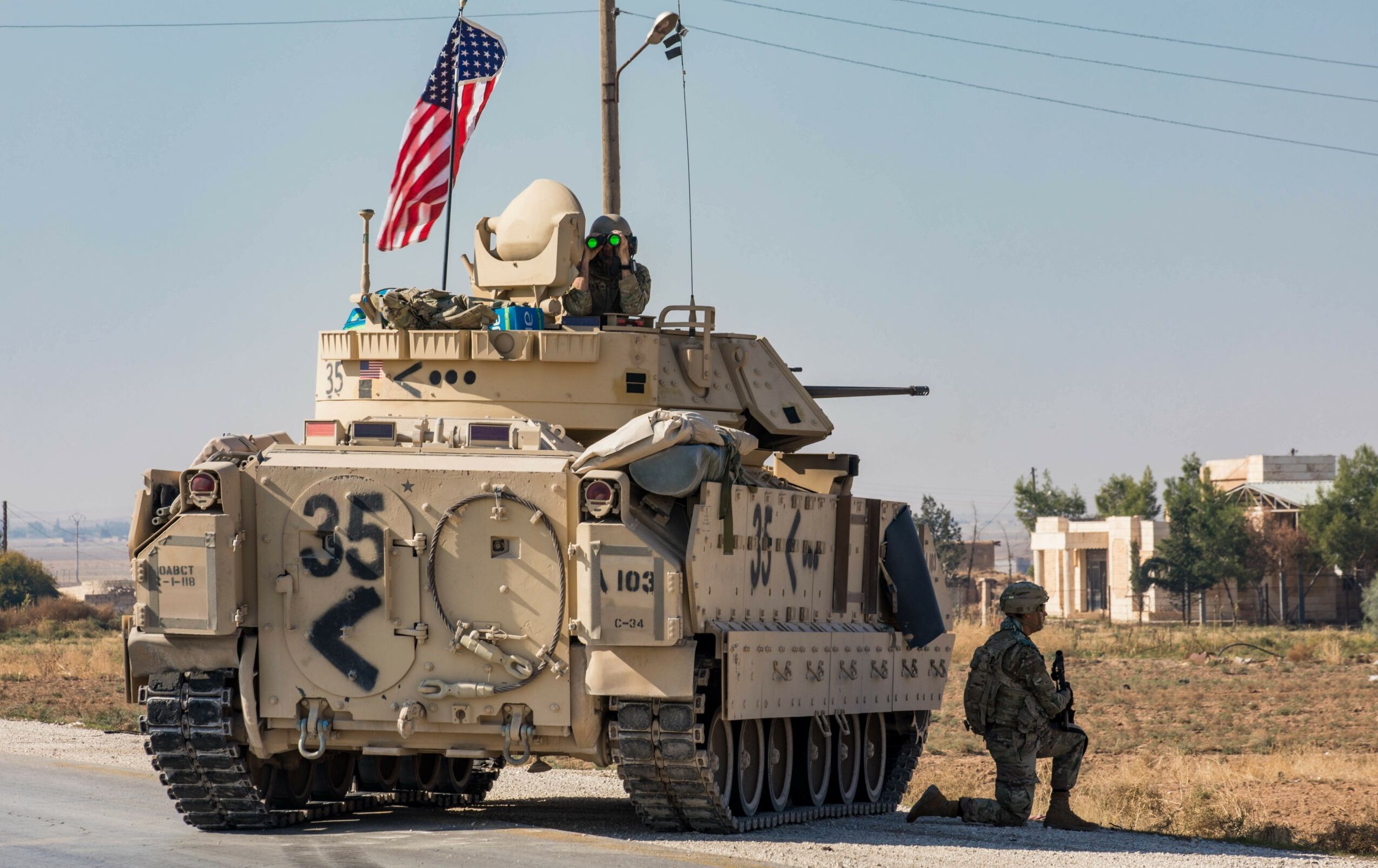
Washington tells us (but not very often, certainly not very clearly), that the U.S. continues to have military boots on the ground in Syria because of ISIS.
But the killing of two Iowa National Guardsman, and an American civilian and wounding of three others on Saturday raises the question of whether the U.S. government is needlessly putting American troops into harm's way. How much is ISIS still a security threat to the homeland? After more than a decade a new government is in control of Syria. Why must the U.S. continue to send troops, in relatively low numbers (supposedly 1,400) so that they serve essentially as sitting ducks in between raids to pick off suspected ISIS leaders, which we have no idea is actually effective or not?
Most importantly, with active duty U.S. military ostensibly well trained for this kind of work (tracking bad guys, targeted raids, guarding oil fields), why do we have to deploy part-time soldiers who are obligated to serve their own states during crisis to places like Syria, which has barely healed from a 14-year civil war? What were these guardsmen doing in central Syria — Palmyra — when we are told they are largely positioned in Kurdish-held areas in North and Southeastern parts of the country?
“Americans are right to ask why U.S. troops remain exposed to lone-wolf ISIS attacks in the Syrian desert," charges Adam Weinstein, Deputy Director of Middle East program at the Quincy Institute. "Using our soldiers this way simply doesn’t make sense.”
These questions become much more salient when you read the murky and disturbing details of Saturday's shooting. ISIS as of Sunday did not take responsibility. According to CNN the shooting "happened as leaders from the coalition and Syria’s Internal Security Forces carried out a joint tour earlier Saturday in the Badia region. The delegation later entered a 'fortified command facility' belonging to the Syrian Internal Security Forces leadership."
CNN reports that the shooting happened at the gate by man with "extremist ideas" who President Donald Trump said later was ISIS. But the Wall Street Journal said, according to a U.S. official, the soldiers were guarding a meeting between U.S. officers and a official from the Syrian Interior Ministry when, "as the meeting was occurring, a lone gunman popped up in a window and opened fire on the troops with a machine gun. The U.S. and Syrian forces opened fire and suppressed the gunman, according to the official. U.S. officials then called in a medical evacuation team, while Syrian forces pursued and killed the gunman."
During the civil war, Palmyra was captured by ISIS in 2015 and then fully retaken in 2017 by the government of Bashar Assad. He was toppled last year by Hay'at Tahrir al-Sham militants under the leadership of Ahmed Al-Sharaa, who is now the president of Syria.
Various other unconfirmed details are flooding social media Sunday, some which say the shooter infiltrated the new government as part of an ISIS cell. CNN reported that Nour Eddin al-Baba, an interior ministry spokesman, told Syrian state television that leadership in the country’s Internal Security Forces in the Badia region had alerted the U.S. about "a possible breach or expected ISIS attacks.”
“However, (coalition) forces did not take the Syrian warnings into account,” al-Baba said.
Weinstein said the new Syrian government will no doubt "market this as proof that they are Washington’s only reliable partner," but "this incident also reveals that the new Syrian state has an infiltration problem that exposes U.S. troops." While the U.S. military could help with intelligence sharing, equipment, even training, "as long as U.S. troops conduct forward patrols, they will remain exposed to senseless loss of life.”
The Trump administration — Trump and Hegseth both — are already promising a "ruthless" and "serious retaliation." Does this mean more deployments? Bombings? Isn't this exactly what ISIS wants? The remnants of this terror organization may be mobilizing against the new government for a host of reasons, the least of which they were all part of the roiling, factional opposition that eventually brought down Assad last year. But the fact that the U.S. is still there breathes life and gives purpose to it. We are told that Americans must sustain a fight we no longer understand as our own.
National Guardsman are dying here and dying there, and it all goes back to interventions and deployments we are told to believe were and are for our own good. But are they?
- Why are we still at war in Syria? ›
- If true, Trump move to withdraw US military from Syria is the right one ›
- Did mission creep kill 3 Americans in Syria? | Responsible Statecraft ›
- The military's dependence on our citizen soldiers is killing them | Responsible Statecraft ›