

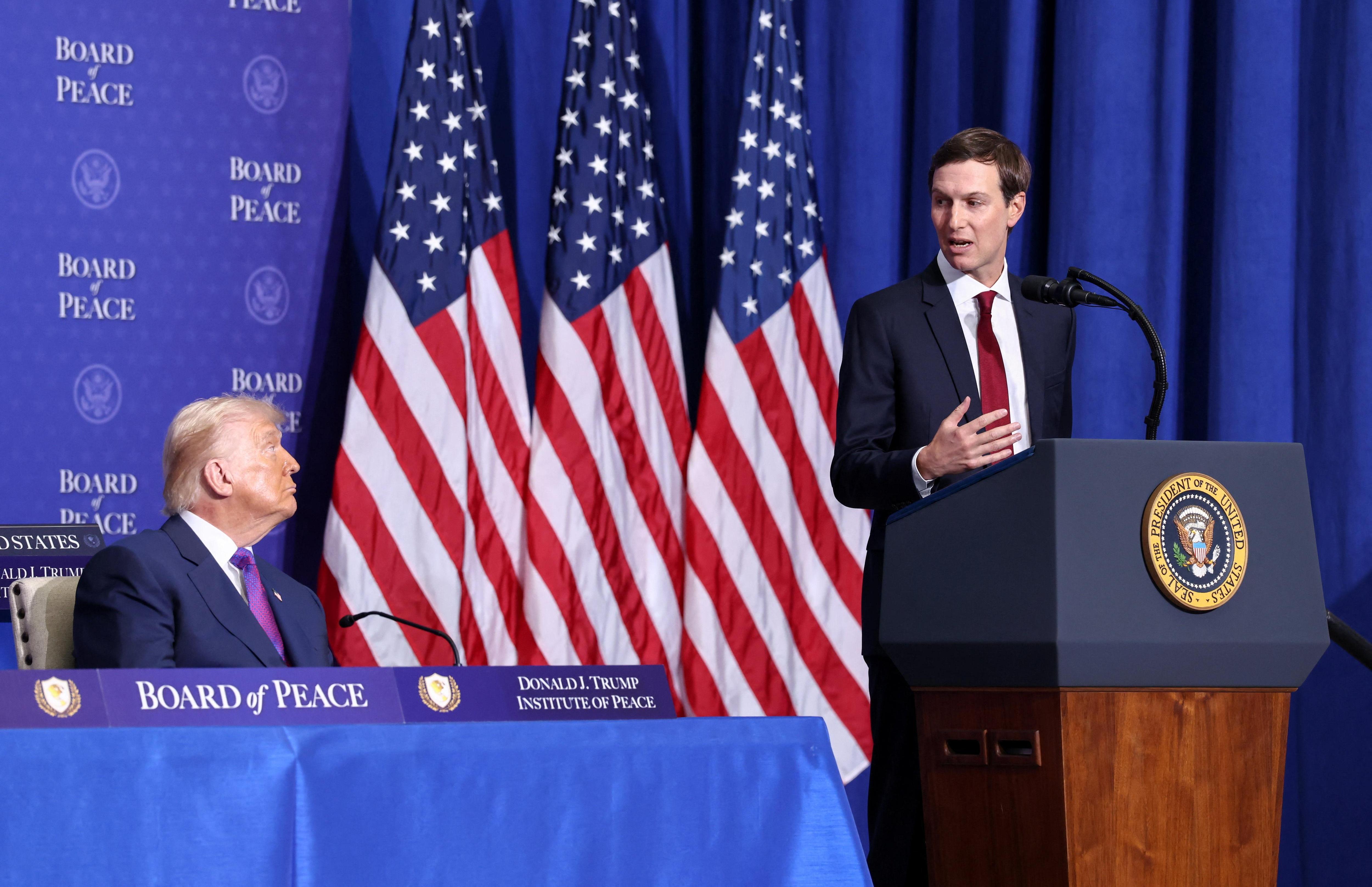
On Thursday, President Trump hosted the inaugural meeting of the Board of Peace, a body created by Trump to oversee the security and redevelopment of Gaza. His son-in-law Jared Kushner, who is on the founding Executive Board overseeing the Board of Peace, played down any notion that the people in the room would be profiting off Gaza’s redevelopment.
“I really want to thank the entire team that’s worked so hard at this. A lot of these people are volunteers, they’re doing this not for any personal gain. People are not personally profiting from this,” he said.
Of course, there is plenty of money to be made, directly or indirectly, by people sitting in that room and many more, including Kushner himself.
In fact, Kushner and other board members have advertised the investment opportunities in Gaza’s redevelopment.
At the World Economic Forum in Davos, Switzerland, Kushner unveiled a $30 billion “master plan” to replace historic sites and landmarks with data centers, industrial zones, residential towers, and seaside resorts. The president’s son-in-law went on to claim that Gaza’s redevelopment will offer “amazing investment opportunities” to the private sector.
Charles Dunne, a non-resident Senior Fellow at Arab Center Washington DC, writes that Kushner himself would be an “obvious conduit” for public and private money flowing into Gaza. His private equity firm, Affinity Partners, manages billions of dollars in investments from Saudi Arabia, the UAE, and Qatar. A Senate inquiry found that Kushner overcharges on fees despite failing to generate profit for investors, raising concerns that Affinity is set up to allow foreign governments to buy influence. “The apparent idea is to open Gaza to inflows of public and private money, principally from the Gulf states,” writes Dunne.
The White House has said the Board of Peace has raised around $17 billion for the Gaza Reconstruction and Development Fund, which is to be managed by the World Bank. Most importantly, the Board of Peace, which is chaired by Trump himself, will direct where the money goes. According to the organizational charter, Trump serves as chair in his personal capacity, meaning whoever succeeds him as president would still be under Trump’s authority.
Companies are already jockeying for contracts. This week, The Guardian reported that the Board of Peace issued a contract to build a 5,000-person military base for an international force tasked with protecting civilians and training “vetted Palestinian police forces.” It’s not clear who the contractor is.
In December, a leaked document revealed that U.S. officials were searching for a “Master Contractor” that would “earn a fair return” for trucking. A U.S. disaster response firm, Gothams LLC, submitted a plan to the White House that would guarantee the company 300% profits for work in Gaza. The company would move goods into Gaza in exchange for a fee, as well as a seven-year monopoly over trucking and logistics for the Board of Peace.
Administration officials and businesspeople affiliated with the Board have also promoted a new “Gaza supply system” which, according to a January slide deck, offers sovereign investors between 46% and 175% returns in the first year of investment.
“Everybody and their brother is trying to get a piece of this,” one long-time contractor told The Guardian. “People are treating this like another Iraq or Afghanistan. And they’re trying to get, you know, rich off of it.”
Israel’s representative on the Board of Peace, billionaire Yakir Gabay, said that Gaza’s coastline should be “developed as a new Mediterranean Riviera with 200 hotels and potential islands.” Gabay made his money largely through real estate, though he claims he will refrain from building hotels in Gaza himself.
Another member of the Executive Board, Marc Rowan, runs one of the world’s largest private equity firms, Apollo Global Management. Rowan touted the money to be made during yesterday’s meeting. “The coastline alone? 50 billion in value on a conservative basis,” he said. “The housing stock — more than $30 billion…The infrastructure — more than $30 billion.” Altogether, Rowan said, Gaza contains some $115 billion in real estate value, but “it just needs to be unlocked and financed.”
The dominance of private equity and real estate moguls on the Board, combined with a lack of transparency surrounding policies and timetables for Gaza’s reconstruction, raise concerns about abuse. Hugh Lovatt, a Senior Policy Fellow at the European Council on Foreign Relations, said that the role of businesspeople such as Rowan and Kushner is “completely at odds with what the Palestinians in Gaza need.”