

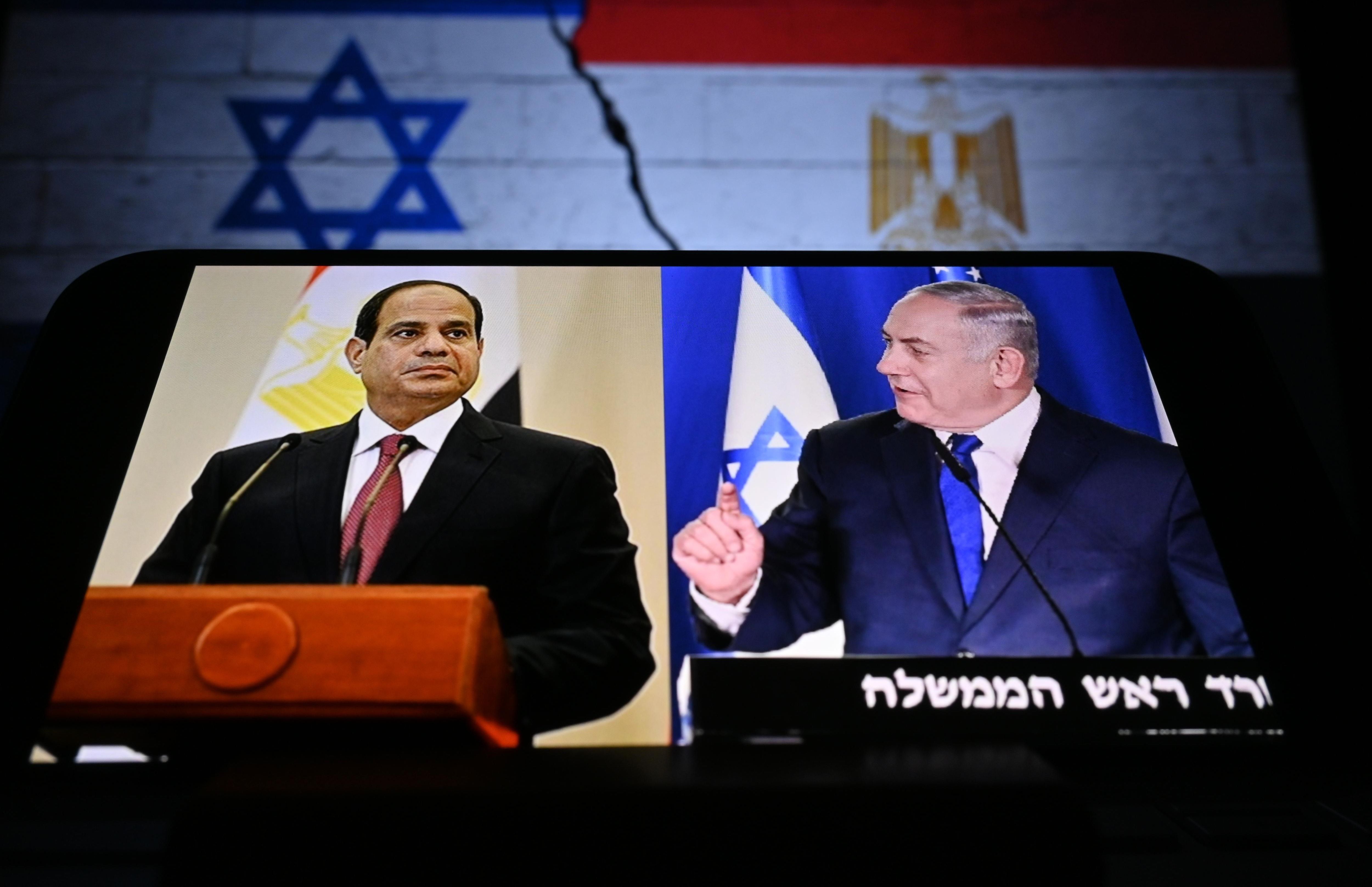
The Trump administration’s hopes of convening a summit between Israeli Prime Minister Benjamin Netanyahu and Egyptian President Abdel Fattah el-Sisi either in Cairo or Washington as early as the end of this month or early next are unlikely to materialize.
The centerpiece of the proposed summit is the lucrative expansion of natural gas exports worth an estimated $35 billion. This mega-deal will pump an additional 4 billion cubic meters annually into Egypt through 2040.
On Wednesday, in a video statement from Jerusalem, notably without the attendance of any Egyptian officials, Netanyahu announced his final approval of the deal. Flanked by Energy Minister Eli Cohen, he hailed the $35 billion agreement as a "historic" windfall that would cement Israel’s status as a "regional energy superpower." Egypt gave its quiet assent to the terms back in July and was quick to downplay the agreement after Netanyahu’s announcement, noting that the agreement is “purely commercial” devoid of any “political dimensions or understandings of any kind.”
Behind the scenes, the U.S. has been eager to use the momentum of the deal to stage a trilateral summit, with Trump's adviser and son-in-law Jared Kushner reportedly taking the lead. The fanfare is meant to serve as Netanyahu’s victory lap, proof that, despite two years of grinding war in Gaza, Israel’s regional standing remains intact.
But the setting of Wednesday's announcement was telling. There was no rose garden ceremony, no handshake in Sharm el-Sheikh. According to the Times of Israel, an Egyptian official explained days before that Sisi would not meet with Netayahu, not without a fundamental shift in Israel’s conduct. Mahmoud Musallam, a member of the Egyptian senate, gave the refusal a public face, noting that relations are “poor” and that a summit was “impossible.”
This situation comes as no surprise. While significant volumes of gas from Israel’s Tamar and Leviathan fields now flow to Egypt—helping to stabilize its precarious energy security— the smoking ruins of Gaza lie between them. The conflict has turned the 1979 peace treaty, long a cornerstone of Middle Eastern stability, into a stress test of the cold, transactional peace between the two regional powers.
Israeli officials, including Cohen, have played a chaotic game of brinkmanship over the last few months, backing out of signing the gas deal and publicly questioning the fairness of its commercial terms. The move prompted U.S. Energy Secretary Chris Wright to cancel a planned visit to Jerusalem in October in a huff.
But the commercial dispute was merely a symptom of a relationship at its nadir. Cairo refuses to accredit Israel’s designated ambassador, leaving its embassy headless for most of the past year. Direct communication between the presidential palace and the prime minister’s office has gone dead. All that remains is quiet, mutual resentment.
The official cited in the Times of Israel report was explicit. Sisi refuses to be a “prop” in Netanyahu’s political survival drama.
Indeed the Israeli premier’s position is perilous. In Gaza, the “total victory” he promised has yet to materialize; instead it has isolated the country diplomatically. In domestic courts, he faces longstanding bribery and corruption charges for which he recently took the extraordinary step of petitioning President Isaac Herzog for a pre-conviction pardon, arguing that the “security reality” and “national interest” justify his request for legal immunity.
Faced with these pressures, and with Israel heading into an election year, Netanyahu needs to look like a statesman. But Sisi has no intention of casting himself as the supporting actor who legitimizes the principal author of the devastation on his doorstep.
At the border between Egypt and Gaza, Israel demands that the Rafah crossing be opened in one direction, exit only, refusing to accept the entry or the return of Palestinians. Egypt refuses, seeing this as another attempt at displacing Gaza's population.
Egyptian Foreign Minister Badr Abdelatty has been vocal on the matter, accusing Israel of committing “genocide” and claiming that Israel is trying to engineer a demographic shift that Egypt will not accept. Meanwhile, Israeli officials accuse Egypt of turning a blind eye to weapons smuggling, effectively blaming Cairo for Hamas’s resilience.
Washington is desperate for a diplomatic breakthrough it could use to showcase progress on its Gaza peace efforts; it is so keen for a photo-op between leaders who haven’t met face to face since 2018.
The Trump administration evidently sees the Egypt-Israel axis as the only thing that could breathe life back into the Abraham Accords. It wants to generate momentum for a now U.N.- approved (and presumably Egyptian-led) "International Stabilization Force" to police the “day after”’ in Gaza, even while administration officials quietly fume about Israel’s ceasefire violations.
But the Trump team is misreading the room. It is forgetting the events of the Gaza Peace Summit in October, when President Trump had issued a last-minute invitation, only to watch the guest list disintegrate. Iraq’s prime minister threatened a boycott, while Turkish President Recep Tayyip Erdogan’s jet reportedly circled the Red Sea until he received assurances that Netanyahu would not show up.
Cairo, faced with an empty hall, rescinded Netanyahu’s invitation, while the latter’s office obligingly cited the Jewish holiday of Simchat Torah as the reason for his absence.
In short, a public meeting with Netanyahu is politically toxic for regional leaders. Their populations are still seething from the images of death, destruction and starvation coming out of Gaza over the last two years.
For Egypt, the $35 billion project and the billions of additional cubic meters of gas it brings is highly desired of course, but the reality is that Cairo also has leverage. The new deal, which envisages the expansion of the Leviathan field, would see Egypt act not just as a consumer, but as a hub for the liquification of Israeli gas at its Idku and Damietta plants for re-export to a gas-starved Europe.
This is what has driven Washington’s push to close the deal. For the White House, it’s a win on multiple fronts: Europe gains a non‑Russian energy lifeline, Chevron, a U.S. company, secures a lucrative and strategic contract, and, most optimistically, U.S. officials wager (as does Netanyahu) that deeper energy and economic integration could help cool regional tensions and bring Israel in from the cold.
But Egypt, since giving its quiet approval in July, has had the luxury of playing for time, filling the gap with Qatari LNG bought on the spot market (expensive, but politically safe) while it squeezes Netanyahu for concessions on Gaza.
The standoff embodies what analysts have for long described as a “cold peace” between the two. For decades, the relationship was maintained by security elites in the back rooms, insulated from the passions of the street, but the Gaza war has shattered that arrangement. Intelligence coordination continues, it has to, but the political buffer is gone.
Even routine security coordination is now mired in suspicion. Take Israel’s seizure (or “occupation” as one Egyptian official called it) last year of the Philadelphi Corridor, the roughly nine-mile stretch of land along the Gazan-Egyptian border that includes the Rafah crossing. That move was perceived by Egypt as a unilateral rewriting of the security arrangements that had held for forty years. Netanyahu, alongside Ambassador Yechiel Leiter, have in turn accused Egypt of treaty violations regarding troop levels in the Sinai Peninsula. Egypt dismisses this as deflection.
When neighbors start citing the fine print of 45-year-old treaties, it signals how little trust remains.
Sisi, consistent with the regional and international consensus, demands a political horizon for the Palestinians. He needs a Palestinian entity in Gaza that is stable enough to keep the border quiet and possible refugees on their side of the wire. Netanyahu’s government, still beholden to far-right parties that dream of the permanent displacement of the more than two million Gazans, offers no such horizon. As a result, the impasse hardens.
Yet, despite these tensions, the closure of the gas deal was inevitable, even before Netanyahu put pen to paper. The pipelines are already sunk deep in the Mediterranean, and the gas is already flowing. But the political theater Netanyahu, Trump and Kushner crave — the handshake, the smiles, the declaration of a new era — appears out of reach for now. Contracts will be signed by technocrats, while Sisi stays away and washes his hands of the whole affair.
- Egypt's energy gamble has left it beholden to Israel ›
- Why Egypt can't criticize Israel for at least another two decades ›