

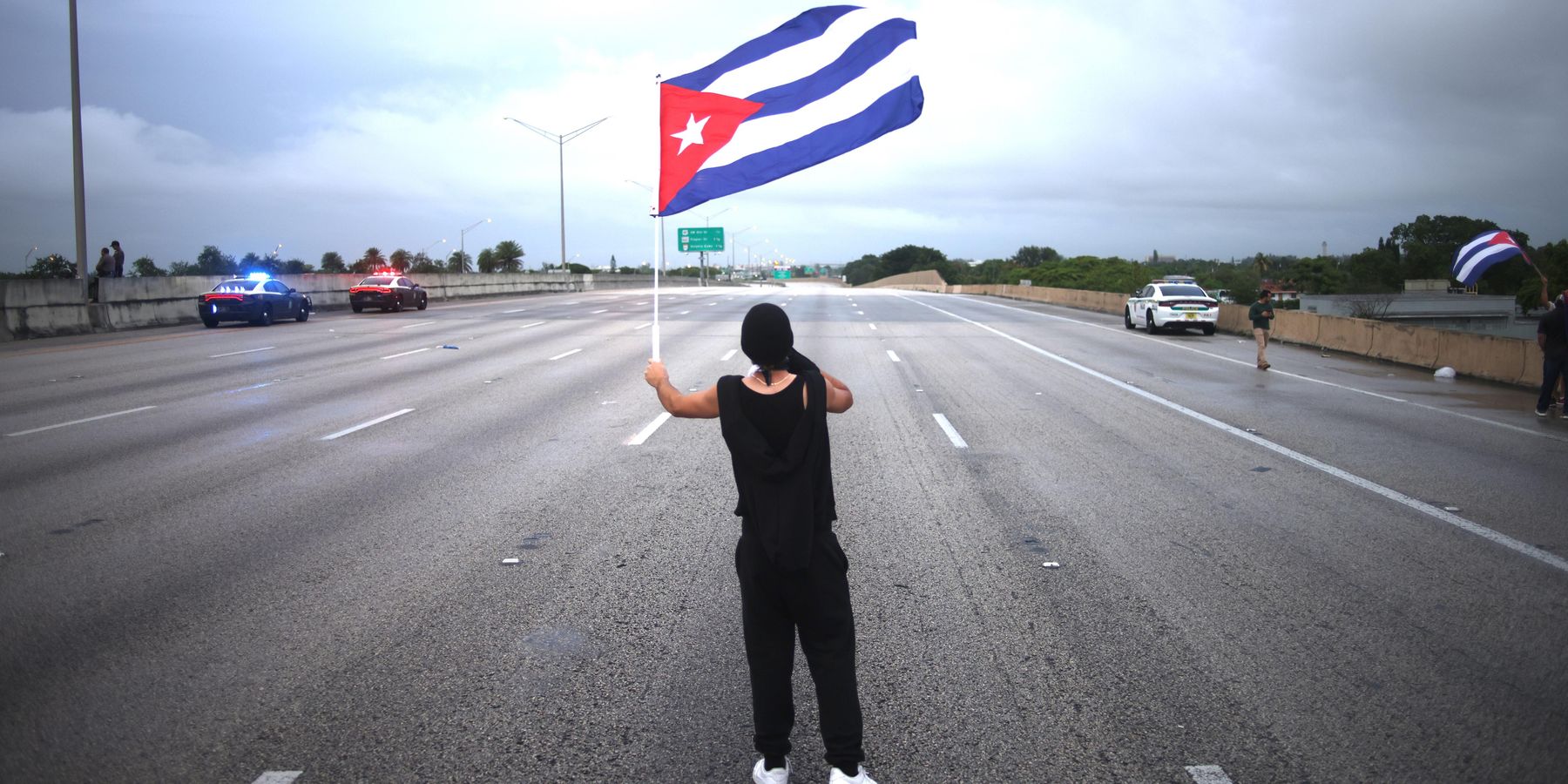
The passions of exile politics have long shaped South Florida. However, when local officials attempt to translate those passions into foreign policy, the result is not principled leadership — it is dangerous government overreach with significant national implications.
We see that in U.S. Cuba policy, and more urgently today, in Saturday's "take over" of Venezuela.
In Miami-Dade County, a distorted political culture has taken hold. Individuals convicted in U.S. courts for acts of anti-Castro terrorism are still celebrated as heroes by local officials and influential media voices. For decades, journalists — some of whom also served as contributors to the government-funded Radio Martí — treated these narratives as untouchable, dismissing legal and ethical constraints as inconveniences rather than guardrails.
This culture rests on a revisionist version of American history. President John F. Kennedy is portrayed locally as responsible for Fidel Castro’s survival: first, for not escalating the Bay of Pigs invasion after CIA-trained exiles were defeated, and later for refusing to bomb Cuba and further risking nuclear war during the Cuban Missile Crisis. In this telling, Cuban Americans are cast as victims of American betrayal, despite decades of extraordinary U.S. support for refugees and exiles — support that often exceeded, and in some cases stretched, international legal norms.
From this grievance narrative flows a radical conclusion: local officials should make their own U.S. foreign policy, particularly toward Cuba. That logic is not merely misguided. It is harmful to American national interests.
Miami-Dade County Tax Collector Dariel Fernández, for example, has recently embodied this impulse. Just before the year-end holiday season — when many Cuban Americans legally travel to Cuba or send remittances to support family members — Fernández launched a campaign threatening to revoke the right to do business in Miami-Dade County for companies he claims are engaged with the Cuban government. His personal political judgment, rather than the determinations of the U.S. Treasury Department’s Office of Foreign Assets Control, is treated as decisive.
This is not how the American government works.
Federalism is a cornerstone of the American republic, but it has limits. The Constitution assigns foreign policy — and the use of international sanctions — to the federal government. When local governments attempt to impose their own sanctions regimes, they do more than exceed their authority: they undermine the rule of law. Worse, they create a climate of intimidation in which Cuban Americans who favor engagement, families who send remittances, and businesses facilitating lawful travel face bureaucratic retaliation for exercising federally protected rights.
Sanctions themselves deserve scrutiny. Decades of empirical research shows that broad sanctions rarely achieve their stated political objectives, especially against entrenched regimes. Instead, they tend to entrench ruling elites, distort domestic economies, encourage black markets, and impose disproportionate costs on civilians. In the Cuban case, sanctions have not produced a democratic transition, but they have contributed to economic hardship, migration pressures, and family separation — outcomes that run counter to U.S. strategic and humanitarian interests.
Secondary sanctions against Cuba have generated a growing list of tensions with American allies, prompting some countries to adopt countermeasures or shift to alternative currencies as a response to perceived overreach in the restrictions on the use of the U.S. dollar. These developments ultimately undermine U.S. economic leverage and complicate international cooperation, producing outcomes that are counterproductive to American strategic and financial interests.
Extending this already ineffective tool from Washington to local governments does not make it smarter; it multiplies its failures.
This is not merely a political dispute; it is a legal and moral one. Local efforts to restrict travel and remittances interfere with federal authority and raise serious constitutional concerns, including violations of the First Amendment’s protections of speech and association. Preventing families from visiting loved ones or sending financial support inflicts real human suffering — suffering imposed not by law, but by political theater.
American history offers a different model. As Attorney General, Robert F. Kennedy wrote in a memorandum to then-Secretary of State Dean Rusk in 1963 that even during the Cold War, respect for legal process and individual liberty — including the freedom to travel — was not a weakness, but a strength. Today, lawsuits challenging local overreach on Cuba policy continue that tradition, reaffirming that American libertarian values — economic freedom, personal autonomy, and limits on government power — still matter.
One bad policy toward Cuba is already harmful. Two — one federal and another improvised at the local level — multiply the damage. They impose unnecessary economic and emotional costs on Cuban families while eroding America’s constitutional order.
In principle, Americans should be free to travel and send their money to whomever they choose. Governments — local or federal — should not act as political nannies deciding whether citizens may visit their country of origin. Sanctions are among the most serious tools of foreign policy, often described by scholars as an alternative form of warfare. If they are to be used at all, they should be designed, monitored, and enforced by accountable federal institutions — not improvised by local officials driven by unresolved political traumas, demagoguery, or decades-old grievances.
Fernandez already joined the Miami celebration about Nicolás Maduro’s recent capture, mentioning the episode as a symbolic accelerant for the pro-sanctions lobby. The Miami tax collector denounced New York Mayor Zoran Mandani's “ignorance” about Venezuelan affairs, and highlighted Trump’s image as a decisive leader in international coercion, one who should now be called to do to Cuban leaders what he did to Maduro: “Now the time has come for Cuba. They are the root of everything that has happened to Venezuela, Nicaragua, and now Colombia.”
The most radicalized sectors of the Cuban exile welcome Maduro’s capture with an instrumental view of both international law and the U.S. rule of law itself. Law is no longer understood as a binding framework for managing political conflict and promoting the public interest, but as a tactical asset — useful only insofar as it speeds an overriding political objective: the removal of Cuba’s government.
The policy implications are clear. Courts must clearly assert federal powers in designing, monitoring, and implementing international sanctions, dissuading factional, ethnic, or local agendas from advancing parallel foreign policies through informal pressure and subnational authorities. This is precisely the danger the Supreme Court sought to preempt in Zschernig v. Miller and later in American Insurance Association v. Garamendi, which held that even well-intentioned state or county initiatives cannot intrude on the federal government’s exclusive authority to speak and act for the nation abroad.
This debate matters far beyond Cuba. If county officials can weaponize local offices to pursue personal foreign-policy agendas today, other communities may face similar abuses tomorrow. The lesson should be clear: foreign policy can and should be debated vigorously — from the grassroots to the national level — but its adoption and implementation belong in Washington.
The rule of law must be respected, and moral obligations to real human beings must not be sacrificed for political spectacle. One bad policy toward Cuba is more than enough.