

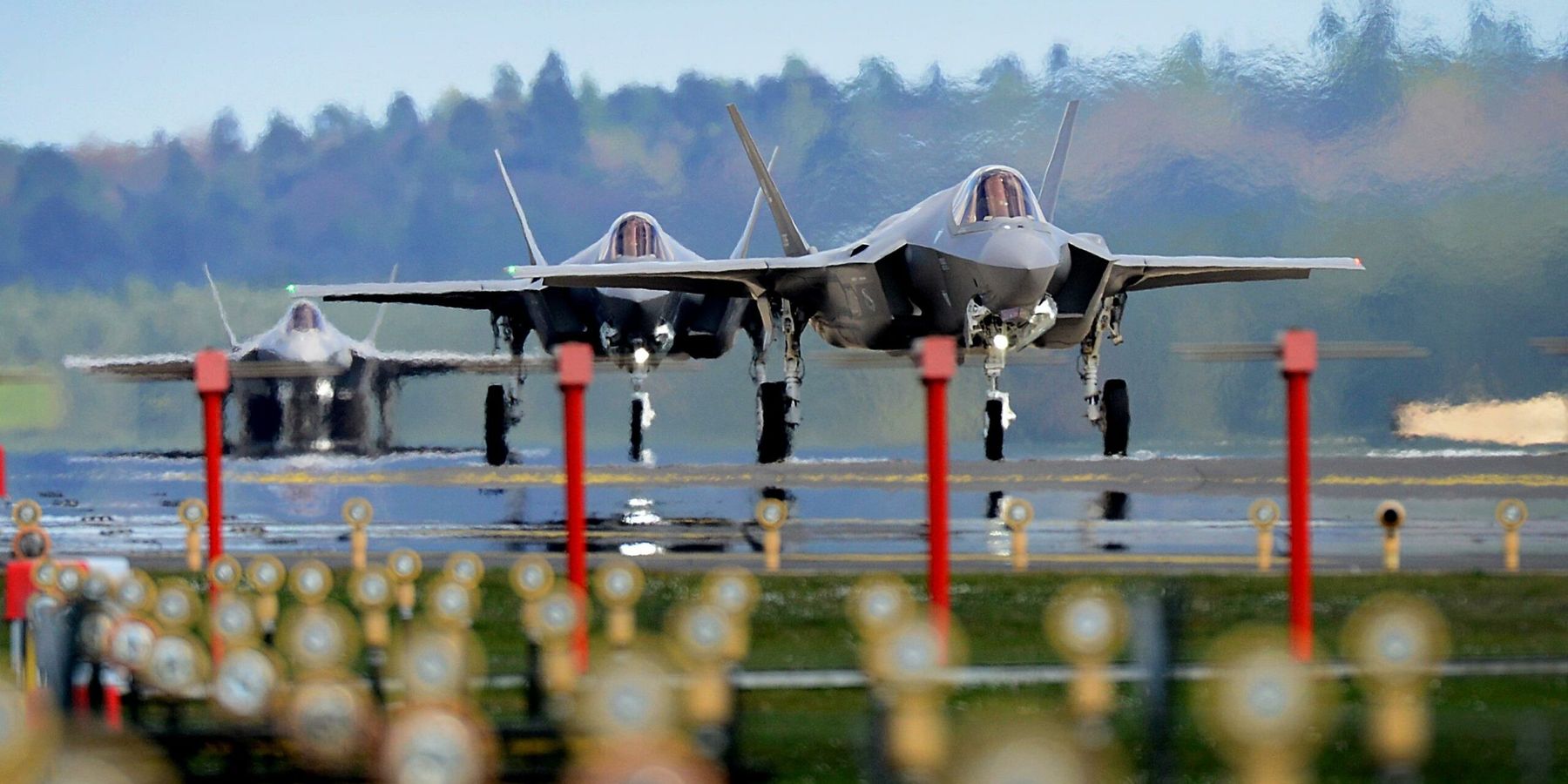
A new Government Accountability Office (GAO) report has found that Lockheed Martin and Pratt & Whitney, the primary contractors working on the F-35, made product deliveries 238 days late on average in 2024 — despite the program paying them hundreds of millions in performance incentive fees, which encourage completing tasks on-time.
By comparison, the same deliveries were 61 days late on average in 2023. But even then, the contractors’ lateness was chronic, if not absolute. Lockheed Martin delivered 110 aircraft in 2024 to the program — all late.
The report also found that Pratt & Whitney, which makes engines for the F-35, delivered 80 of 82 engines late for F-35 production during 2021 through 2022. All 89 engines were late in the 2022-2023 production period, as were all 66 delivered for 2023-2024.
Stunningly, Pratt & Whitney still earned 56%, 78% and 37% of the program’s performance incentive fees, which were offered to encourage on-time engine deliveries, for those production lots respectively. The DoD even financially penalized Pratt & Whitney for being late; the incentive fees it accrued offset that penalty.
The GAO also reported that the program's ongoing modernization effort, which would improve the fighter jets’ targeting, navigation, communications, and electronic warfare systems, is $6 billion over budget, and will be completed in 2031 — 5 years past its initial due date.
Ultimately, the GAO’s latest warnings of F-35 bloat are on par for the program’s course. The most expensive DoD project to date, the F-35’s repeated cost increases previously triggered a critical DoD review back in 2012, forcing the Pentagon to confirm the F-35 project was essential to national security, viable, and cost-effective for it to continue.
The program survived that review, but the new report shows that problems persist. The new GAO report recommends that DoD consider whether its production schedules for F-35, and its incentive fees given to contractors for it, are practical. And it asks the DoD to evaluate whether Lockheed Martin, in particular, can realistically deliver F-35 products in a timely manner.
Will the gravy train finally wreck?
Having monitored the F-35 program for over two decades, the GAO maintains the F-35 has specific capabilities, including its stealth technologies and sensor networking systems, that make it critical for the DoD’s tactical air portfolio, and thus for U.S. national security.
Contractor antics aside, however, other experts believe the gargantuan program has little to offer, essentially because the F-35 will never truly be mission-capable — despite being in service for a decade.
“The latest GAO report underscores once again that the F-35 is not now, and will never be, fully ready for combat,” William Hartung, senior research fellow at the Quincy Institute for Responsible Statecraft, told RS. “The program, which was touted at the outset as representing a ‘revolution in military procurement,’ was doomed from day one because its variants were meant to carry out a huge range of potential missions. It has done none of them well.”
To Hartung’s point, the GAO found in 2023 that the F-35 was only mission capable slightly over half the time.
“It’s time for the Pentagon to cut its losses and phase out the program now, before we waste billions of additional taxpayer dollars on a flawed plane that spends almost half its time in the hangar getting repaired,” Hartung told RS.
Ultimately, compounding concerns about the F-35 program’s chronic financial waste and overall viability have yet to blunt Washington’s interest in it. As matters stand, the Pentagon will continue to increase F-35 production until 2032. And while the president’s budget requested 47 F-35s for FY2026, significantly fewer than the FY2025 request for 68 F-35s, the Senate Armed Services Committee markup of the National Defense Authorization Act for FY2026 still authorized 10 more.
- Failing F-35 fighter grounded once again ›
- The F-35 fighter will now cost more than $2 trillion ›
- The military is babying F-35s to hide their true cost to taxpayers | Responsible Statecraft ›
- Contractors delivering F-35s with no radars and unfit for combat | Responsible Statecraft ›