

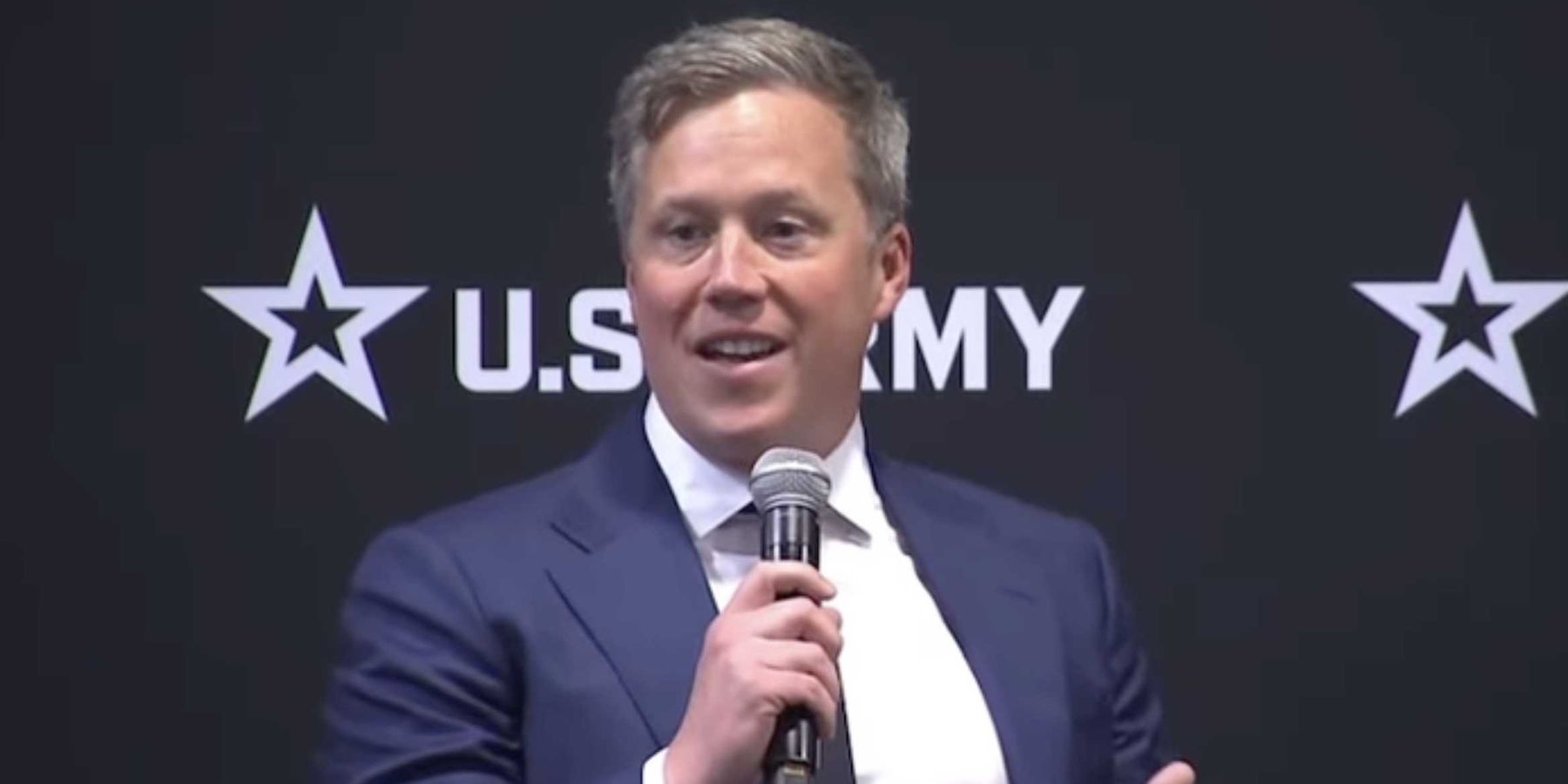
Army Secretary Dan Driscoll’s opening remarks at this year’s United States Army (AUSA) Annual Meeting & Exposition — that drones will “absolutely dominate warfare in the twenty-first century” — set the tone for a conference swarming with them.
Describing them as cheap, yet cutting-edge warfighting tools, Driscoll sold drones as a fundamental shift in how wars will be fought — and thus an essential asset to the Army of the future.
“If small arms defined the twentieth century, drones will define the twenty-first. They are the perfect convergence of artificial intelligence, advanced materials, batteries and propulsion systems, sensor fusion and much more,” Driscoll told attendees. “They will absolutely dominate warfare in the twenty-first century.”
Drones “are reshaping how humans inflict violence on each other at a pace never witnessed in human history. They are cheap, modular, precise, multi-role and scalable, and we will rapidly integrate them into our formations,” he said.
Driscoll’s words were music to industry’ ears at AUSA, where scores of tech-forward companies hungry for collaboration with the DoD promoted their state-of-the-art drones to these ends.
Of course the drones’s lethal capacities were at center stage. Elbit America’s display presented its Skystriker loitering munition as a “one-shot, one-kill system” and as a “high lethality warhead for a variety of targets.” A representative for DraganFly, meanwhile, stressed their drones’ ability to carry explosives. And General Atomics’ flyers depicted one of its models equipped and firing a laser weapon — the “High Energy Laser (HEL) Weapon System.”
Markedly absent from AUSA was any discussion about the ethical issues and risks surrounding integrating autonomy into weapons systems — even as experts warn that outsourcing humans’ role in critical wartime decisions to AI could depersonalize conflict, while making countries less conflict averse.
Instead, high-level speakers at the conference played up prospects for humans overseeing vastly larger numbers of drones in the near future.
“Today, we are individual operator, to individual drone. Not that far off [into the future, it will be] one operator, dozens — if not hundreds — of drones,” Vice Chief of Staff of the Army General James Mingus said at an AUSA fireside chat Tuesday.
“And those drones will be sensors. They'll be jammers, they'll be kinetic. There'll be a full suite of tools that are fully-automated, launched, pre-programmed: ‘go out, report back when you have accomplished your mission,’” he said, playing up their prospective autonomous capacities.
This year’s drone-dominated AUSA follows years of war in Ukraine, where the systems have proliferated as a cornerstone of combat — generating substantive interest abroad. To this end, Trump administration pushes for more drones include an executive order for “unleashing drone dominance,” which aims to bolster domestic production, while equipping Army units with “the lethal small drones the modern battlefield requires.”
To that end, Mingus told conference attendees the U.S. Army hopes to manufacture at least 10,000 drones per month by this time next year, if not more, via its SkyFoundry initiative aimed at scaling up cheap drone production.- The AI weapon army goes to Ohio ›
- Who is Dan Driscoll, suddenly at the center of Ukraine peace talks? | Responsible Statecraft ›
- Report: DoD shoots balloons with laser, causes airspace meltdown ›
- $240 million drone vanishes into thin air ›
- Militaries are drone-happy but populations are living in terror | Responsible Statecraft ›
- Fiber-optic drones show profound limits of 'cutting-edge' weapons | Responsible Statecraft ›