

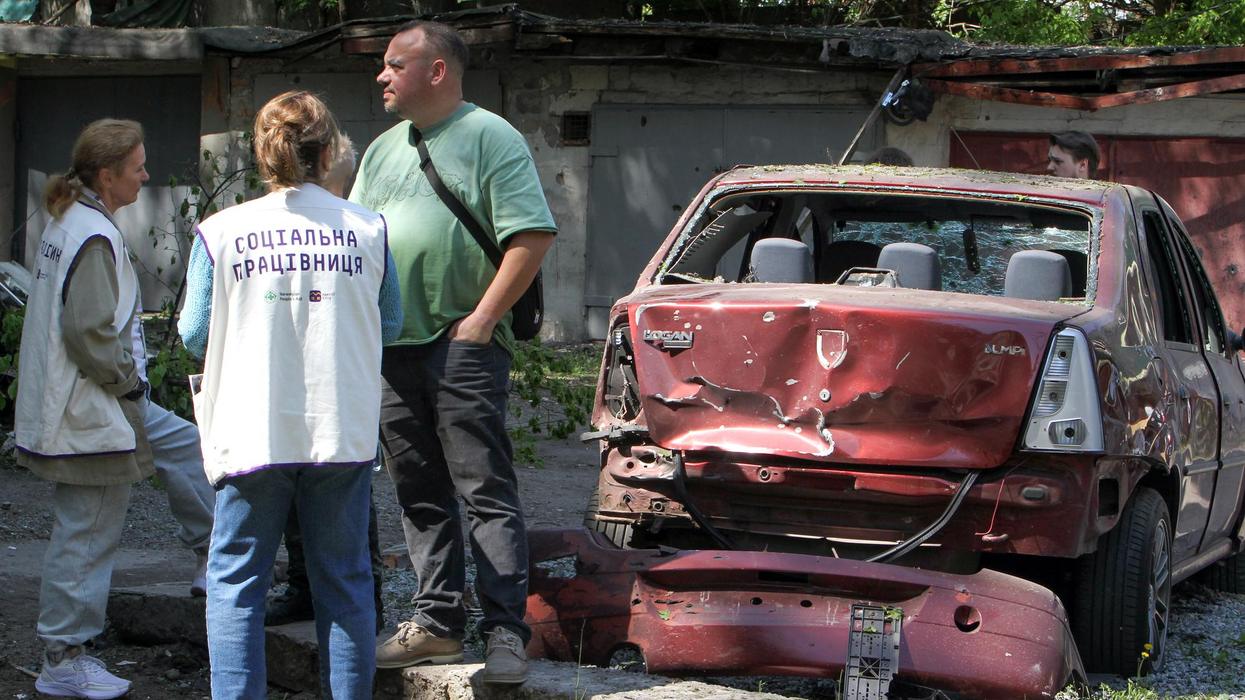
As drones dominate warfare in the Middle East, Ukraine, and beyond, civilians are caught in the crosshairs.
Hailing the machines as the future of war, the Pentagon is pouring funds into their development and procurement, as are other militaries around the world.
These drones are now becoming the weapon of choice around the world. Staggeringly, drone attacks in conflict settings rose 4,000% between 2020 and 2024. And they are increasingly harming noncombatants: drones accounted for 80% of civilian deaths in the war in Sudan early this year — killing at least 880 people.
Human rights experts and a drone specialist spoke with RS about the physical and emotional impacts militarized drones and counter-drone measures have on civilians — as well as the mounting challenges of attributing responsibility when the devices cause harm. To understand drones’ collateral impact, RS also spoke with four Ukrainian civilians about their own lived wartime experiences.
Ultimately, without meaningful efforts to manage drones' increasingly unchecked proliferation in conflict, the future of war stands to become all the more perilous for civilians.
The front line comes home
To begin with, the civilians RS spoke with stressed drones’ omnipresence in their everyday lives. They requested anonymity or shared only their first names to be published, to protect their safety.
“Military drones here are an almost daily occurrence,” said Elena, who lives in Luhansk — a border region of Ukraine, which Russia now largely controls. It has seen heavy fighting.
Drones make “a distinctive sound, as if an old motor scooter is driving right under your window,” she said. “But instead of passing by quickly, it can hover in the air for a long time. It’s very scary because you don’t know what the person controlling it intends to do.”
The civilians all associated drones with death. “The mere presence of drones…creates a sense of instability and insecurity,” an anonymous civilian said. “People have started reacting to any sound that resembles a drone, constantly checking the news.”
Russian drone attacks on civilians and soldiers have led some Ukrainian cities to put up nylon netting over roads and buildings, to block drones’ entry. In tandem, Ukrainian drone strikes in Russia have also frequently killed civilians.
As Elena told RS, a drone once cornered a friend’s son on his way home from school. “He’d been lying in the bushes for about an hour because a drone was flying very low over him,” Elena said. “He was too scared to even move, while it circled and circled above him.”
Along the border, the Ukrainian military has also been using drones to find men fleeing the country, trying to escape conscription.
Beyond Ukraine, Palestinians constantly face attacks and surveillance by Israeli drones.
Israel Defense Forces drones often follow civilians around Gaza, prompting many Palestinians to stay inside. During Israel’s war on Gaza, drones have routinely shot and bombed civilians. As Middle East Eye and Euro-Med Monitor both reported in 2024, IDF forces have even used drones to play sounds of crying babies — to draw Gazans out to attack them.
Second order harms
But if drones can endanger civilians, so, too, can efforts to intercept them.
“If you prevent [a drone] from achieving its mission, what you have is an armed drone that is not going where it was going to go,” said Laura Walker McDonald, a Senior Advisor on Emerging Technologies in Conflict at the International Committee of the Red Cross. There could be “shrapnel raining down, or… an armed drone crashing [or] exploding somewhere.”
Often, the fallout can severely damage residential areas below. While drone debris does not necessarily cause more damage than missile debris, there can be much more of it.
Downed drones may also have weapons attached to them. “Kids play with [fallen drones]...they think they look like toys,” McDonald explained. “They do look like toys. And they get hurt as a result.”
But as Molly Campbell, a drone expert at the Center for a New American Security, warns: “There's no way we can beautifully vaporize [an incoming] drone, and it just falls as fairy dust.”
“The damage that's being inflicted is collateral from the [drone] interception itself,” Campbell said. “But would you rather [the operator] didn't shoot it down?”
When drones cause harm, who's responsible?
In decades past, drone attacks could often be traced back to a few countries, like the U.S., which operated fewer and larger military drones. But Lauren Spink, a protection of civilians professional previously at the Center for Civilians in Conflict (CIVIC), warns that today’s widespread proliferation of small, cheap drones makes it harder to identify who is using them.
“In the eastern D.R.C. [Democratic Republic of the Congo], you've now got the government flying drones. You've got armed group M-23 flying drones. You've got private military security actors flying drones,” Spink said. “When a civilian is harmed, it's getting harder to point the finger at who was responsible, and to follow that through to accountability.”
Across the continent, foreign powers have armed warring parties in Sudan with drones, which have been used in attacks on civilians, health facilities, and other critical infrastructure. As Sophie Neiman observes in New Lines Magazine: “Drones have blurred responsibility in a war where both sides already operate with relative impunity.”
Meanwhile, it has become easy to modify small commercial drones to weaponize them — increasing the risk that the tech could fall into the wrong hands.
“The technology is moving faster than our ability to govern it, to manage it as an international community,” Spink said. “It is a terrifying future if we do not figure out how to better regulate and manage drones.”
Campbell told RS that the Missile Technology Control Regime (MTCR) — a voluntary export control scheme which limits the proliferation of missiles and adjacent technologies — is one measure that could help curb drone warfare’s worst harms.
Formed by the G-7 countries in 1987, the MTCR has applied its missile regulations to large drones militaries use. As Campbell tells RS, it “needs to be updated to [better account for how weapons] like loitering munitions [suicide drones] and smaller drones proliferate.”
But the U.S. is going the opposite direction. Last fall, the State Department decided to reinterpret the MTCR — loosening export controls to sell some larger, advanced drones to other countries.
- Defense contractors eye long-term profits from Ukraine war ›
- Army Secretary: Love the killer drone or be left behind ›
- Fiber-optic drones show profound limits of 'cutting-edge' weapons | Responsible Statecraft ›