

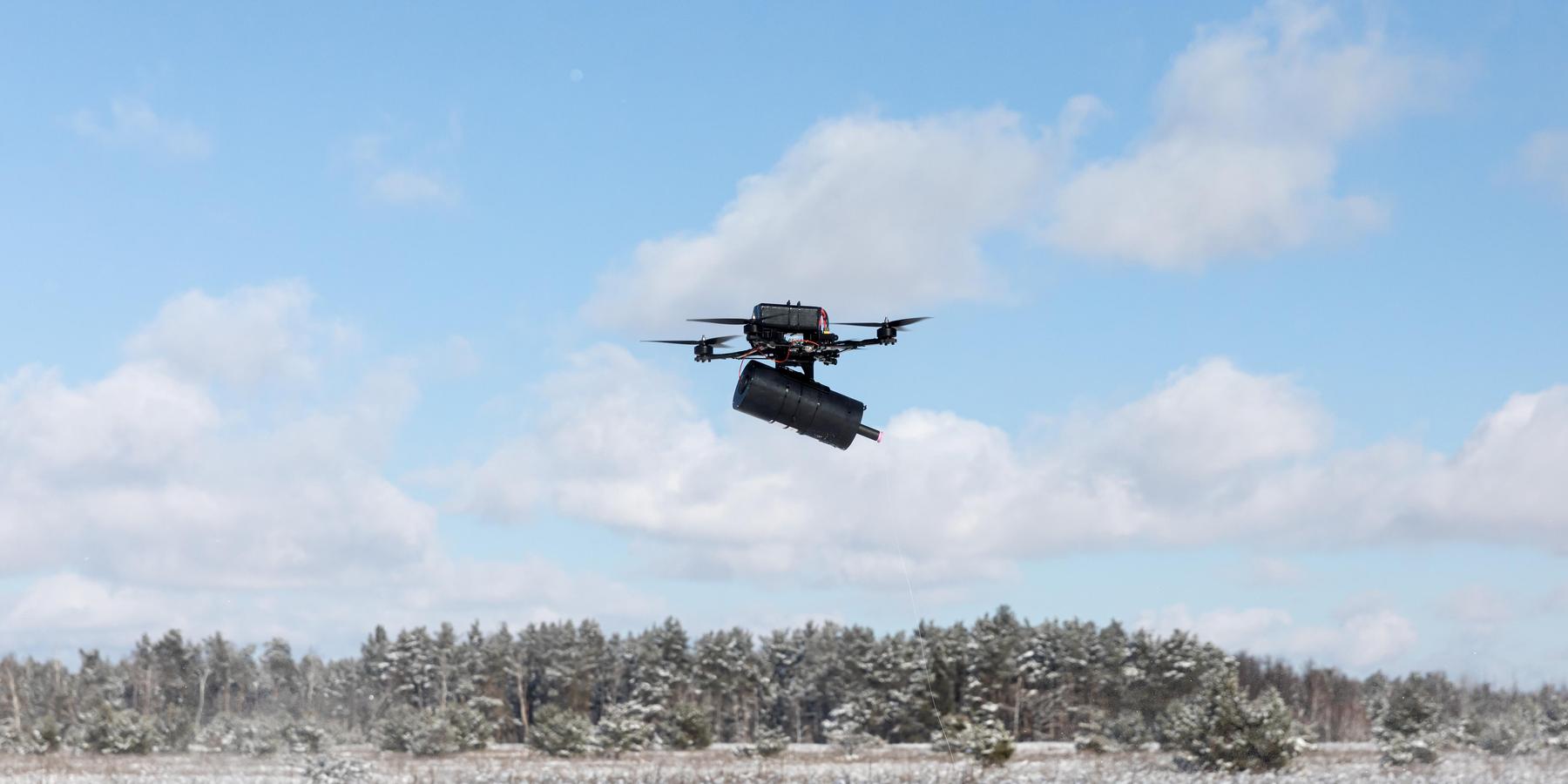
“Birds in Ukraine are building nests from drone cable.” The headline itself tells a story, but the subsequent article in The Sunday Times missed the true magnitude of what the story represents.
Almost from the beginning of the Ukraine war more than four years ago, the use of uncrewed drones has drawn significant attention. Observers were overwhelmed with articles declaring that “For Western Weapons, the Ukraine War Is a Beta Test,” or averring that “This drone-on-drone dogfight in Ukraine is a glimpse of the future of war.” The vast majority of such articles attempted to make the case that unmanned drones had fundamentally changed the character of war.
Ukrainian birds have shown that such bold pronouncements are a bit premature. In 2024, Russian troops began deploying small attack drones with cylindrical drums on their bottoms, which contain long spools of fiber-optic cable running back to their operators. The hard-wired connection ensures that the drones cannot be electronically jammed by the enemy.
The fact that both the Russians and Ukrainians have resorted to using fiber-optic drones clearly demonstrates that drones are not as threatening as their vendors claim. Transitioning from radio-controlled to wire-guided drones does not represent a great leap forward. Rather, it is an acknowledgement of the inherent vulnerability of remote-operated systems. The weakness of any uncrewed technology is the link back to the proverbial mothership. The filament-covered landscapes in Ukraine demonstrate how fragile those connections are.
While much touted at the beginning of the war as a game changer, drones are just the latest new weapon to reach the battlefield. History is rife with examples of new weapons disrupting the old military order until an inventor creates an effective countermeasure, or the weapon is adopted by militaries around the world and becomes just another tool in the arsenal. Knights in heavy armor on horseback dominated warfare for a brief historical moment until state capacity increased to the point where governments could institutionalize infantry formations capable of defeating their mounted foes.
When the first tanks lumbered over World War I battlefields, enemy soldiers were terrified by the behemoths. At first, the infantry had no means to defeat tanks. But, because war is the ultimate mother of invention, soon armies on both sides developed effective anti-tank weapons, and the tank became another ordinary weapon. Like every military innovation before it, drones will eventually complete the weapon countermeasure cycle.
The wider implication of the fiber-optic drones is what makes this case worth examining more closely. Defense policymakers around the world should carefully contemplate the devolution of drone technology in the Ukraine War because it casts doubt about the reliability of the technology they are currently developing.
Military futurists want to build a force consisting of cyber-physical weapons powered by artificial intelligence. They envision not only uncrewed aircraft but also unmanned naval vessels and ground vehicles. All of these systems rely on secure communications with the humans who ultimately command them. “Uncrewed ground vehicles are inherently data-intensive, with their autonomy and mission algorithms depending on continuous bandwidth,” writes one company grappling with the connectivity challenge.
The fundamental problem is that eventually the weapon-countermeasure cycle will come full circle with the digital battlefield. All wars are really nothing more than a conflict between two competing human wills. Because their very survival is at stake, the humans on both sides will find every advantage possible to prevail. Directly fighting the robot army the futurists envision will be costly. But defeating such a cyber-physical force will be a rather straightforward effort to disrupt the communications network at the center of its functionality.
The Russians and Ukrainians solved the connectivity challenge with fiber-optic cables, but that solution only works in limited circumstances. The Ukraine war has largely devolved into a static war of attrition over mere yards of territory. If the armies were making sweeping assaults across hundreds of miles, it would be impractical for the attacking force to launch thousands of drones each trailing 30 miles of filament. The wheel entanglements alone would stop the force dead in its tracks.
Even more impractical would be an F-35 operating with eight Collaborative Combat Aircraft. How would that scheme work if each uncrewed aircraft had to trail 100 miles worth of fiber-optic cables?
Companies developing such technology claim “loyal wingman” aircraft will use artificial intelligence to automatically switch to predetermined mission parameters in the event communications are lost. That may be adequate if the overall mission hasn’t changed, but if the enemy has the ability to disrupt the manned-unmanned system, the enemy probably also has the ability to force the manned pilot to alter his mission. Without the ability to communicate with the uncrewed aircraft, they will continue to fly a suddenly obsolete mission unconnected to the suddenly isolated pilot.
The appeal of building a military force that reduces the number of human beings on the front lines is obvious. But there are practical realities that must be considered when designing such a force. In wartime, full, unfettered control of the electromagnetic spectrum — the complete range of radio and other frequencies needed to wirelessly transmit data — is not assured. Military planners would be wise to assume the EM spectrum will be denied to them.
That is not to say the military should not continue to develop uncrewed technology. If it is possible to deploy such a system rather than putting a human being in harm’s way, then that should be the adopted course of action. But, as the Ukrainian birds have shown us, it would be foolish to mortgage our security future to easily disruptable technologies.
- Militaries are drone-happy but populations are living in terror ›
- Army Secretary: Love the killer drone or be left behind ›
- Washington must act to defuse the Baltic powder keg ›