

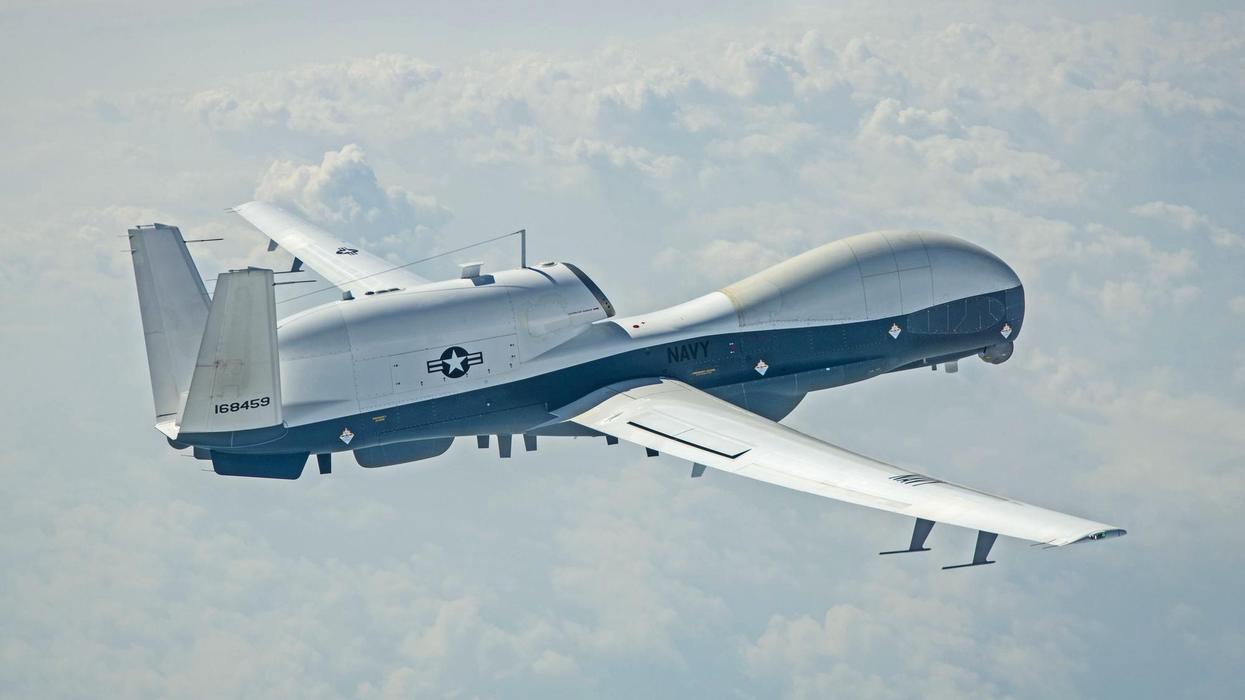
A $238 million drone mysteriously vanished during the war with Iran earlier this month — only for the Navy to later confirm it had crashed in a mishap. The episode marks the MQ-4C’s first major accident in active service, but raises concerns about its reliability in practice.
What went wrong?
On April 9th, an MQ-4C surveillance drone, which can intercept and interpret electronic signals (signals intelligence, or SIGINT), disappeared over the Persian Gulf. Before crashing, the drone emitted, or "squawked" a code 7700 alert — a distress signal for a general emergency. Some reports indicated it also squawked code 7400, meaning it lost communication with its controllers.
The Navy did not admit the drone crashed until several days later, and has not provided information about its location. The silence sparked fears about whether Iran attacked the Triton, or tried to “spoof” it — where it would have impersonated the drone’s controller in order to trick it into landing. Iranian forces successfully spoofed an RQ-170 Sentinel in 2011, duping it into landing in Iran, instead of its home base in Afghanistan.
Joe Buccino, a former CENTCOM communications director with knowledge of the situation, says the MQ-4C likely lost contact with the ground station managing it from afar.
Losing contact is “very rare — but I've seen it happen,” Buccino told RS. “If it was [spoofed] the drone would likely have flown confidently in the wrong direction and landed safely” instead of crashing.
However the drone met its fate, the Triton’s woes go beyond this mishap. A September 2025 Defense Department Inspector General report found that 20 MQ-4Cs were delivered to the Navy for use last year — despite known operational issues that “could prevent [it] from accomplishing missions.”
The public version of the report redacted the nature of these issues. It found, however, that the Navy deemed the Triton ready for early use, before it underwent the tests and evaluations that usually precede deployment. In response to the report, a official said that the Navy would correct the Triton's deficiencies, and carry out the needed assessments.
James Webb, a national security and political consultant who served in Iraq as a Marine infantryman, fears the Triton’s crash means it “wasn’t ready” for active service.
“It’s another ‘military industrial complex’ program that looked good on paper when it was designed,” Webb said. “But by the time they actually get something out there… it's just a total mess.”
Back in 2018, an MQ-4C made an emergency landing on its belly after experiencing a technical issue during a test-flight, causing significant damage to the drone.
Unmanned systems: more bang for buck?
Ironically, the Triton was originally marketed as an affordable system. But technical issues and production delays bloated its price-tag, from an already steep $187 million in gross unit cost per drone in 2016, to an eye-watering $238 million for FY2024. That renders one MQ-4C nearly seven times the cost of the $36 million EP-3E — the manned reconnaissance aircraft it replaces.
Jumping ship in response, the Navy slashed its planned fleet by 60% — from 70 aircraft, to just 27 in its FY 2024 budget estimate.
“Part of the appeal of uncrewed systems is that they are supposed to be less expensive than the manned option. That's one reason uncrewed systems are deemed ‘attritable,’” Dan Grazier, director of the National Security Reform Program at the Stimson Center, told RS. “If that isn't the case, then it appears as though the shift to uncrewed systems is just another national security establishment grift.”
The U.S. has lost military assets worth billions of dollars since the start of its war on Iran in late February. That includes at least 24 American MQ-9 reaper drones, worth more than $3 billion alone.
- US military promises 'hellscape' of drone swarming in future China war ›
- Army Secretary: Love the killer drone or be left behind ›
- The Iran war flushed $1.3 billion of Reaper drones down the drain ›