

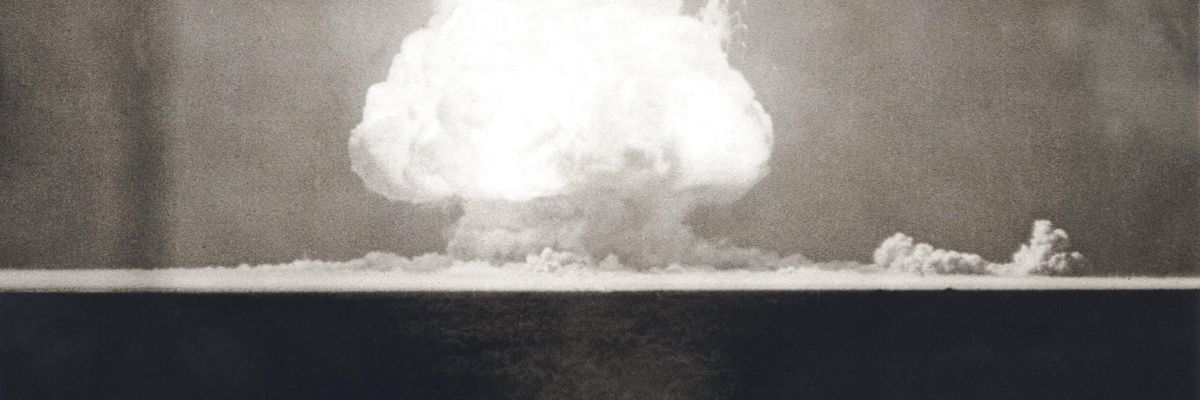
On July 16, 1945, the world ended. Or at least it seemed that way to residents of the Tularosa Basin in New Mexico.
Unbeknownst to local civilians, J. Robert Oppenheimer had chosen their backyard as the proving ground for the world’s first nuclear weapon. The explosion, which U.S. officials publicly claimed to be an accident at a local ammunition depot, tore through the morning sky, leaving a 40,000-foot-tall cloud of radioactive debris that would cake the surrounding area with dust for days on end.
Tina Cordova, whose hometown of Tularosa lies just 45 miles from ground zero, remembers her grandmother’s stories about wiping that infernal dust off every nook and cranny of her childhood home. No one knew what had happened quite yet, but they figured it must have been something special. After all, a local paper reported that the explosion was so bright that a blind woman had actually seen it.
When the initial shock wore off, the 40,000 locals who lived within 50 miles of ground zero returned to their daily lives. They drank from cisterns full of radioactive debris, ate beef from cattle that had grazed on the dust for weeks on end, and breathed air full of tiny plutonium particles. Only later would the real impact become clear.
Bernice Gutierrez, born just eight days before Oppenheimer’s “Trinity Test,” moved from a small town near the blast site to Albuquerque when she was 2 years old. Cancer followed her like a specter. Her great grandfather died of stomach cancer in the early 1950s. She lost cousins to leukemia and pancreatic cancer. Her oldest son died in 2020 after a bout with a “pre-leukemia” blood disorder. In total, 21 members of Gutierrez’s family have had cancer, and seven have died from it.
“We don’t ask ourselves if we’re gonna get cancer,” Gutierrez told RS. “We ask ourselves when, because it just never ends.”
“Oppenheimer” — the latest film from famed director Christopher Nolan — is a three-hour-long exploration of the “dilettante, womanizer, Communist sympathizer,” and world-historic genius behind the ultimate weapon. The movie, based on the book “American Prometheus,” delves deeply into Oppenheimer’s psyche, from his struggles as a young student at Cambridge to his profound melancholy over the world he helped create.
Yet nowhere in the film will viewers find an acknowledgement of the first victims of the nuclear era. Indeed, the movie repeats the myth that the bomb site was in a desolate area with “nothing for 40 miles in either direction.” This was not for lack of effort, according to Cordova, who leads an activist group called the Tularosa Basin Downwinders Consortium. (“Downwinders” refers to those who live in the fallout zone of nuclear tests.)
When Nolan’s team got to New Mexico to film, Cordova and her team published an op-ed in the local newspaper that called on the Oppenheimer crew to “grapple with the consequences of confronting the truth of our stories, of our history.” When that didn’t work, she reached out to the production through Kai Bird, the journalist who co-wrote American Prometheus, in an attempt to get a meeting. She received a flat “no.”
Cordova says she was “aggravated, angry, and disappointed” that the filmmakers had come to New Mexico to shoot the movie (and rake in state-funded tax breaks) but showed little interest in engaging with locals affected by Oppenheimer’s work. “Tens of millions of people are going to flock to theaters to see this movie, and a lot of them have never been exposed to this history,” she added. A short mention at the end of the movie could have changed that, Cordova argues. (Universal Pictures, which produced the film, did not respond to a request for comment from RS.)
And her concerns are not just about recognition. In 1990, Congress passed the Radiation Exposure Compensation Act, which gave insurance and lump-sum payments to the people affected by decades of nuclear testing at the Nevada Test Site. RECA payouts to date total more than $2.5 billion. But New Mexican downwinders were not included in the original law or a broader version of it passed in 2000, a fact that former New Mexico Governor Bill Richardson attributes to a simple lack of awareness about their plight.
Cordova and her team have lobbied for years for an expanded version of RECA that would include New Mexican downwinders and some previously ineligible uranium miners, many of whom had little knowledge of just how dangerous their work was. A bipartisan group of lawmakers introduced a RECA expansion bill earlier this month.
“Imagine having radioactive waste fall down like dirty snow on your homes and communities causing cancer and disease,” said Rep. Teresa Leger Fernandez (D-N.M.), who sponsored the bill in the House, in a statement. “Then think about the despair when you learn that the U.S. government compensated other communities exposed to radiation during the nuclear testing program but not yours.”
Lawmakers have introduced similar proposals several times in recent years, but, with limited public awareness behind their efforts, the proposal has never quite gotten enough support in Congress to pass.
“It’s an inconvenient truth,” Cordova said. “People just don’t want to reflect on the fact that American citizens were bombed at Trinity.”
Born in 1947 in Alamogordo, New Mexico, John Greenwood grew up a short distance from the Trinity Test site. Years of radiation exposure caught up with him in 2008, when he was first diagnosed with colon cancer.
Greenwood and his family spent four years fighting for his life. Their insurance covered 80 percent of costs, but the remaining 20 percent added up quickly given that a single chemotherapy treatment could cost $100,000. Other expenses fell by the wayside. One after another, utilities companies cut off their electricity and phone lines. Their car was repossessed.
But Laura Greenwood, John’s wife, knew their only option was to keep going. “I can’t tell you how stressful it was,” she remembered. “You go to bed crying every night wondering what you’re going to do the next day.”
John passed away in 2012, just six months after learning that the cancer had metastasized to his liver. He was the thirteenth member of his family to die from cancer since the Trinity Test.
Greenwood’s story highlights the devastating economic impact that years of health problems have had on downwinders. This, in part, is why RECA expansion has struggled to get off the ground in Congress, according to Laura. Many lawmakers argue behind closed doors that it would simply be too expensive to compensate downwinders and cover future medical costs related to radiation exposure.
Advocates of RECA expansion also have limited data to back up their claims of a link between the test and later cancers, which they blame in part on government secrecy surrounding the event. “The specter of endless lawsuits haunted the military, and most of the authorities simply wanted to put the whole test and its after-effects out of sight and mind,” according to a Centers for Disease Control and Prevention report on the history of the Los Alamos National Laboratory.
A years-long study from the National Cancer Institute found that “no firm estimates can be established” of how many cancer cases came from the test due to limited radiation data from Oppenheimer’s team and a lack of reliable information on cancer rates and daily habits in rural New Mexico at the time. Sen. Ben Ray Lujan (D-N.M.), who supports RECA expansion, called the NCI research “limited” when it was released.
But one impact of the test is clear. In the months after the explosion, the entire state of New Mexico saw an unprecedented spike in infant mortality, with 56 percent more New Mexican babies dying during live births in 1945 than in 1944. That number went back down in 1946 and has never reached such high levels since, a statistical anomaly with a 0.0001 percent chance of being caused by natural conditions, according to the Bulletin of the Atomic Scientists.
To Nolan’s credit, “Oppenheimer” includes affecting scenes in which the scientist wrestles with the pain wrought by his life’s work. While it leaves out some notable parts of the history, the film offers a powerful and largely accurate account of Oppenheimer’s quest to build — and later try to contain — the ultimate weapon, according to Stephen Schwartz, an expert on the history of nuclear weapons and a non-resident senior fellow with the Bulletin of the Atomic Scientists.
“I don't think it glorifies nuclear weapons at all, which was the concern that some people had,” Schwartz told RS. Viewers will leave with “a better understanding of why he did what he did and all the complications that ensued,” he added. “I hope that it sparks many conversations.”
But Cordova sees the lack of engagement with downwinders as a major missed opportunity. She remembered back in 2018, when the Santa Fe Opera put on a production of “Dr. Atomic,” an opera about the lead-up to the Trinity Test. When Peter Sellars, who wrote the show’s libretto, found out about the problems faced by downwinders, he invited Cordova and her team to talk about their experiences on stage before each performance.
At a climactic moment of the show, Sellars portrayed a general arguing with scientists over whether to warn locals about the blast as a group of downwinders quietly watched on from the other side of the stage. “History is about what’s happening to people you’ve never met,” Sellars told RS. “Their bodies are carrying the traces of what you did.”
Sellars says the engagement with locals affected by the blast — most of whom were Latinos or native New Mexicans — helped make the show a hit. “The show was sold out, and the talks were packed,” he remembered.
Despite her lack of luck with the Oppenheimer team, Cordova remains optimistic. She hopes the movie will encourage people to learn more about the impacts of nuclear tests and boost support for her cause. “Every movement that has ever been started has a tipping point,” she said. “This movie could [have been] that tipping point. And it still might be that tipping point.”
- Hawley, Lujan urge payments for Americans harmed by nuclear tests - Responsible Statecraft ›
- 40 years after ‘The Day After’ - Responsible Statecraft ›
- Compensation for victims of US nuke tests stripped from NDAA - Responsible Statecraft ›
- Senate passes bill to compensate victims of US nuke tests | Responsible Statecraft ›