

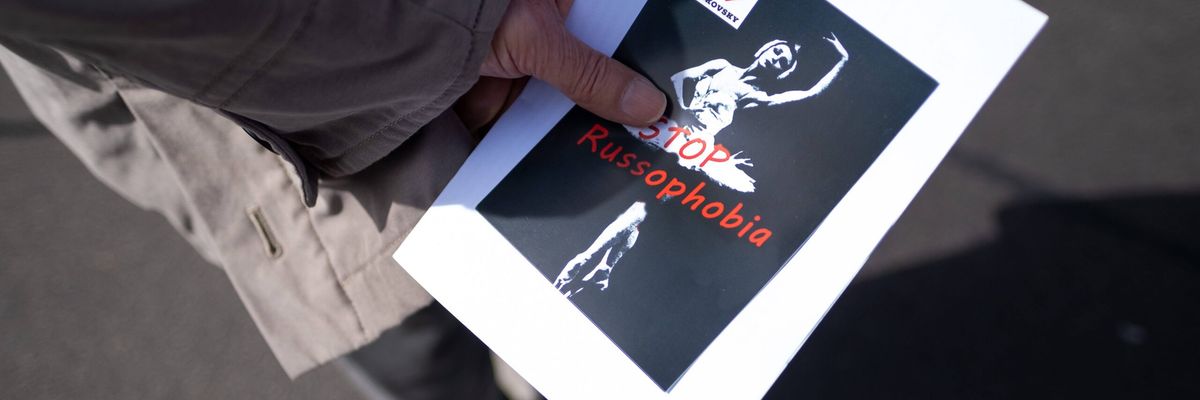
A deeply sinister and dangerous tendency has made its appearance in Western writing about the war in Ukraine. This is the extension of hatred for the Putin regime and its crimes to the entire Russian people, the Russian national tradition, and Russian culture. This tendency is of course bitterly familiar from the history of hostile propaganda, but precisely for that reason we should have learned to shun it.
The banning of Russian cultural events and calls for the “decolonization” of Russian literature and Russian studies recall the propaganda of all sides during the First World War, which did so much to embitter that war and make its peaceful resolution all but impossible.
The latest manifestation of this has been the successful pressure on American author Elizabeth Gilbert to cancel the publication of her latest book, not because it is in any way pro-Putin or pro-war, but merely because it is set in Russia. In another recent case, Masha Gessen, the U.S.-based Russian political émigré, fierce Putin critic and strong opponent of the Russian invasion, felt obliged to resign from the board of PEN America, created as a union of writers to defend free expression, after it barred two Russian writers — themselves emigres who had denounced the war. The Chair of the Foreign Affairs Committee of the British parliament, Tom Tugendhat, has called for the expulsion of all Russian citizens from Britain, irrespective of their legal residency. The Czech president has referenced approvingly the internment of Japanese Americans during World War II.
Demonization of this sort is morally wrong in itself; it is generally intellectually wrong in its details; it is incompatible with liberal internationalism; it betrays pluralist democracy in Ukraine; it is disastrous for the future peace of Europe; it fuels the paranoia and violent self-righteous extremism that has done so much damage to U.S. policy over the years; and, by helping to block moves towards a reasonable settlement of the conflict, it increases the dangers to the United States, Europe, the world, and Ukraine itself that stem from a continuation of the war. Perhaps craziest of all, while the people who express such feelings about Russia claim to be opposing the Putin regime, their actions and writings in fact provide better domestic propaganda for Putin than he himself could ever have devised.
A particularly egregious example of this sort of chauvinism was written last week by Peter Pomerantsev, whose Russian-speaking family emigrated from Soviet Ukraine when he was a baby, and who now lives in Britain. This article is worth paying attention to both for the wider tendency that it represents, and for where it appeared — in the British liberal newspaper The Guardian. It is fair to say that The Guardian would never have published this kind of hate-filled attack on an entire people if it were directed at any other people but the Russians, and, if it had appeared elsewhere, The Guardian would have (correctly) denounced it as racism.
Pomerantsev takes his cue from the destruction of the Kakhovka Dam, which he automatically blames on Russia — despite the fact that, as Kelley Vlahos pointed out in Responsible Statecraft, it remains completely unproven who blew up the dam, and the results could chiefly benefit either the Ukrainian or the Russian side. Adding a whole litany of exaggerated or wholly invented Russian atrocities, he uses this to declare that:
“Beneath the veneer of Russian military ‘tactics,’ you see the stupid leer of destruction for the sake of it…In Russia’s wars the very senselessness seems to be the sense…To Russian genocide add ecocide.”
He references Ukrainian literary critic Tetiana Ogarkova:
“In her rewording of Fyodor Dostoevsky’s Russian classic novel Crime and Punishment, a novel about a murderer who kills simply because he can, Ogarkova calls Russia a culture where you have ‘crime without punishment, and punishment without crime.’ The powerful murder with impunity; the victims are punished for no reason.”
Does “literary critic” Ogarkova really think that Dostoyevsky approved of Raskolnikov’s crime, and did not show him being justly punished for it? Or is she relying on a belief that her Western audience will be willing to hate Russian authors without having read them?
Pomerantsev follows this up with an almost unbelievable passage:
“Ogarkova and Yermolenko note the difference between Hitler and Stalin: while Nazis had some rules about who they punished (non-Aryans; communists) in Stalin’s terror anyone could be a victim at any moment. Random violence runs through Russian history.”
This is the same old nauseating hypocrisy. They are nationalists; we are patriots. Their bombing of civilians reflects a blind urge to destruction rooted in their national character, ours is either purely accidental or an unfortunate part of a just struggle. Their torture of suspected enemies is due to their innate collective savagery. Ours is “not who we are.”
This is a classic example of what psychologists call the “fundamental attribution error” — the tendency to rationalize our own transgressions as the product of difficult circumstances, while explaining the sins of others as the result of their malevolent nature.
In attributing Russian atrocities in Ukraine to permanent, quasi-racial aspects of the Russian national character, these writers seek to present Russia as uniquely mad and evil; whereas in fact the crimes committed by Russia during the Ukraine War have also been committed by several Western states in modern wars, the United States among them. Some were indeed wholly gratuitous. Others, as General Sherman reminded us, are innate to war itself. Pomerantsev and his like do not need to be professional historians to know that. They could simply watch the film “The Battle of Algiers,” or any good film about the Vietnam War.
Those who have attributed this to unique features of American and European traditional culture and called for the whole of that culture to be junked as a result, have been rightly rejected by majority opinion in these countries. Would anyone with an atom of decency or common sense suggest that we should not read Herman Melville and Nathaniel Hawthorne because the U.S. military bombed civilians in Vietnam and illegally invaded Iraq?
It might be noted by the way that at the height of the Cold War, Hollywood produced films of “War and Peace” and “Dr. Zhivago,” and Soviet cinema produced fine versions of “Hamlet” and “King Lear.”
Eruptions like Pomerantsev’s in The Guardian can be attributed to blind but understandable anger at Russia’s invasion and the destruction it has caused. However, they also have very practical and disastrous results. They not merely discourage the search for a compromise peace today, but by presenting Russia as permanently evil, they suggest that any future peaceful co-existence with any future Russian state will be morally wrong, and therefore should be permanently impossible.
In his great work “The Treason of the Intellectuals” (La Trahison des Clercs), written in the aftermath of the First World War, Julien Benda denounced the willingness of too many liberal intellectuals to succumb — whether from emotion or opportunism — to political and especially national hatred; and he warned, all too presciently, that this fostering of hatred could lead to still greater disasters in the years to come. He predicted that the 20th Century “will properly be called the century of the intellectual organization of political hatred.”
We should take care that our descendants, if there are any, do not say that of the present century.