

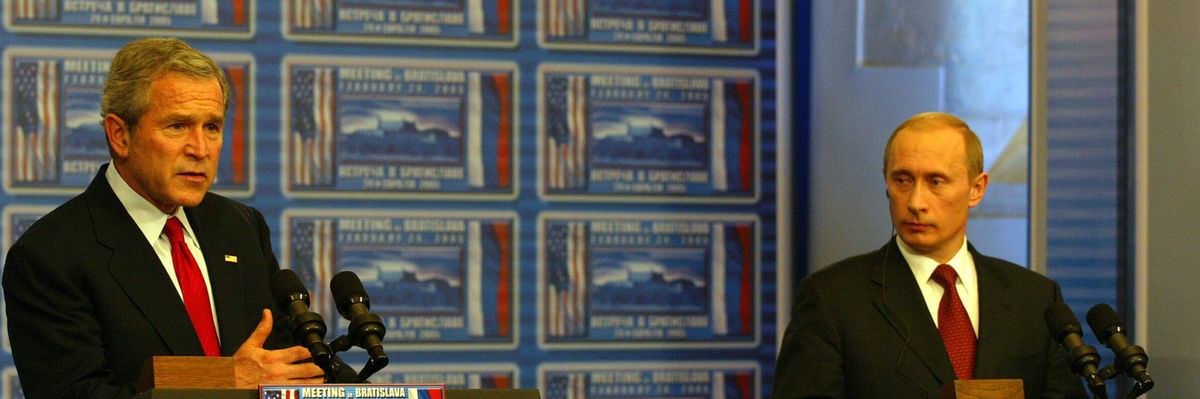
The 20th anniversary of the U.S. invasion of Iraq has spurred reflection on the far-reaching geopolitical fallout of the war. But one facet has gone largely undiscussed: its contribution to deteriorating U.S.-Russia relations that have brought the countries to the brink of war today, as laid out in U.S. diplomatic cables released by WikiLeaks in 2010.
By the end of 2002, the relationship was at an inflection point. Russian president Vladimir Putin had spent significant political capital on an attempt at rapprochement with George W. Bush’s administration. “No Russian leader since Peter the Great has cast his lot as much with the West as Putin has,” observed then-Senate Foreign Relations Committee Chairman Joe Biden at the time.
The evidence was there. The Kremlin had closed Soviet-era bases, allowed U.S. forces to invade Afghanistan from Central Asia, and accepted further NATO enlargement and Bush’s withdrawal from the Anti-Ballistic Missile Treaty. Although Putin had “given the United States most everything it could want [...and] made concessions on strategic issues once unthinkable for a Kremlin ruler,” the Washington Post reported, he had “been able to show few tangible benefits to justify his policy to domestic skeptics,” including the lifting of Cold-War era U.S. restrictions on trade with Russia.
This was the context in which Bush began pushing for the invasion. Kremlin officials were reportedly primarily concerned with what a war would mean for Russia’s ability to collect the nearly $8 billion it was owed by Iraq due to its eight-year war with Iran, and the cables corroborate that version of events. “Putin expressed to [Italian Prime Minister Silvio] Berlusconi his concern about the possibility of a U.S. military action in Iraq, noting that Russia wants to be able to collect on Iraq’s heavy bilateral debt,” an April 2002 cable reads. “Putin stressed the need to use the UN to deal with Iraq.” The matter of the $40 billion trade deal with Iraq that Moscow was set to sign, as well as Russian business interests in Iraqi oil fields, also loomed large.
Indeed, Putin at times suggested he might be more flexible on his objections to the use of U.S. military force if it might later serve Russia’s interests. “Putin stressed that if the U.S. and other countries were given a green light to deal with their problem in Iraq, he should have similar acquiescence for dealing with his terrorist problem in Chechnya and Georgia,” one October 2002 cable records Putin as telling Berlusconi. The press had earlier reported on the Kremlin toying with an “Iraq-for-Georgia” tradeoff.
But it’s clear other concerns were also involved. In a later meeting with Berlusconi that came as Bush was pressing for a tougher UN Security Council resolution on weapons inspections — which, according to the UK’s Chilcot Report, was merely a strategy to legitimize an invasion Bush was committed to launching no matter what — Putin “made clear” that “Russia had gone as far as it could go” in the language it could support.
“The Russian president identified two red lines that he could not cross,” states an October 2002 cable. “A UNSC [UN Security Council] resolution that contained an automatic trigger for the use of military force if Iraq failed to meet all of its obligations, and acceptance of unilateral resort to force by the U.S. without ‘international legitimacy’ (i.e. UN sanction).”
Following Secretary of State Colin Powell’s infamous February 2003 address to the Security Council, Russian Foreign Minister Igor Ivanov, while calling on Baghdad to fully cooperate with inspectors, stressed the need for a political settlement and emphasized that the situation could only be resolved through international cooperation through the Security Council and in compliance with the UN Charter.
That this should be the case is hardly surprising. Significantly weakened by the Soviet Union’s collapse and the economic shock therapy it underwent in the 1990s, Russia had a direct interest in a global system that relied on multilateralism and international law instead of on the unilateral use of power by the remaining superpower. Kremlin officials had just gotten an unpleasant taste of what that might mean for them with the U.S. bombing — without the Security Council’s authorization — of Serbia, a campaign that led the otherwise ardently pro-Western Boris Yeltsin to protest in outrage and suspend cooperation with NATO (which Putin swiftly reversed a year later).
Whatever the exact mix of motivations, Putin’s government unsuccessfully teamed up with war-skeptical U.S. allies France and Germany to try to prevent the war. From December 2001 until the invasion’s eve, Putin repeatedly warned Bush in public and in private that expanding the war on terror to Iraq would be a mistake and that the “problem” of Iraq should be resolved through the UN and weapons inspections instead of unilateral military force. Putin said he would use his veto power, if necessary, to block any potential UN authorization of force.
Though he briefly wavered under U.S. pressure, what may ultimately have kept Putin in line with European opponents of the war is the Bush administration’s lack of reciprocation to his overtures. Russian trade with Europe dwarfed its trade with the United States, which maintained the restrictions Moscow had sought to end, and Putin had little to point to in convincing a Russian foreign policy establishment that opposed joining the war that a break with powers like Germany and France was worth the benefit of aligning with Washington’s unpopular invasion.
A March 19, 2003, cable outlines an “anticlimactic” end to the Security Council debate on the invasion, its author describing how most members “defensively postured about the relevance and significance of both the Council and, more broadly, the United Nations.”
“We remembered 9/11 and were there for you — but no linkage with Iraq,” was how the cable summarized Ivanov’s speech, which stressed that inspections were working and should continue, that a “comprehensive settlement” must be worked out through the UN, and that “no prior council decisions authorized the use of force outside the UN Charter or approved the violent overthrow of the leadership of a sovereign state.”
Bush’s decision to invade anyway didn’t precipitate an immediate collapse of U.S.-Russia relations. One September 2003 cable describes Putin’s consideration of deploying Russian troops to Iraq under U.S. command as an example of his still “pro-Western” views, while another cable sent a month later documents then-State Department official John Bolton’s belief that “that the U.S. and Russia had overcome pre-war disagreements.”
But numerous cables point to the bitter taste the episode left for the Russian side. “While 9/11 precipitated unparalleled cooperation, Iraq and other events had eroded this relationship,” Russian Security Council Secretary Ivanov told U.S. Ambassador to Russia (and current CIA director) William Burns in 2006. “The Germans did not hear much that was new from the Russians during the talks [in Siberia over Iran],” Burns was told later that year. “Moscow's position was still shaped largely by its ‘Iraq experience,’ with Russia fearing that action in the UN Security Council would create a slippery slope leading to the use of force.”
As late as 2009, a roundtable of Russian analysts emphasized to a congressional delegation their “deep displeasure” with the U.S. government and noted “that the war in Iraq played a large part in souring Putin on wanting to be a ‘member of the club’ of forward-leaning countries by demonstrating that if a country had enough power it could do what it wanted and ignore international opinion.”
U.S. officials were told Russian resentment over the war went far beyond Kremlin hardliners. “Anti-American sentiment is growing in Russia and U.S. moral authority, which is a key component of the relationship, is slipping,” former Yeltsin official Anatoly Chubais warned in 2006. “Those who criticize the U.S. argue that rhetoric on democracy building and actions in Iraq do not coincide. These arguments are resonating with the population and could bring U.S. critics to power.”
Grigory Yavlinsky, chairman of the liberal opposition Yabloko party, bitterly admonished U.S. officials interested in encouraging democracy in Russia to “‘leave Russia alone’ and, alluding to Iraq and Abu Ghraib, ‘put its own house in order,’” according to a February 2007 cable. “For nationalists, he said, the U.S. was a hostile force; for liberals, it was discredited due to Iraq, Kosovo, and NATO,” a 2008 cable recounts Kremlin adviser Vyacheslav Nikonov as saying, echoing liberal Putin critic Boris Nemtsov’s verdict on U.S. democracy promotion: that “Russians don't welcome U.S. commentary, against the backdrop of an unpopular war in Iraq” and a host of other issues.
Yet the cables also hold lessons for Russian officials today, as they remain mired in their own illegal war that is — from unilateral force to faulty intelligence — remarkably similar to Bush’s. “No modern problem can have a military solution,” Russian foreign minister Sergei Lavrov, who still holds the post today, told his French counterpart in 2007 in response to saber-rattling over Iran. Putin’s own words to the Russian Federal Assembly, recorded in a May 2006 cable, are even more prophetic: “It is known that the use of force rarely brings the hoped-for results, and its consequences at times are more terrible than the original threat.”