

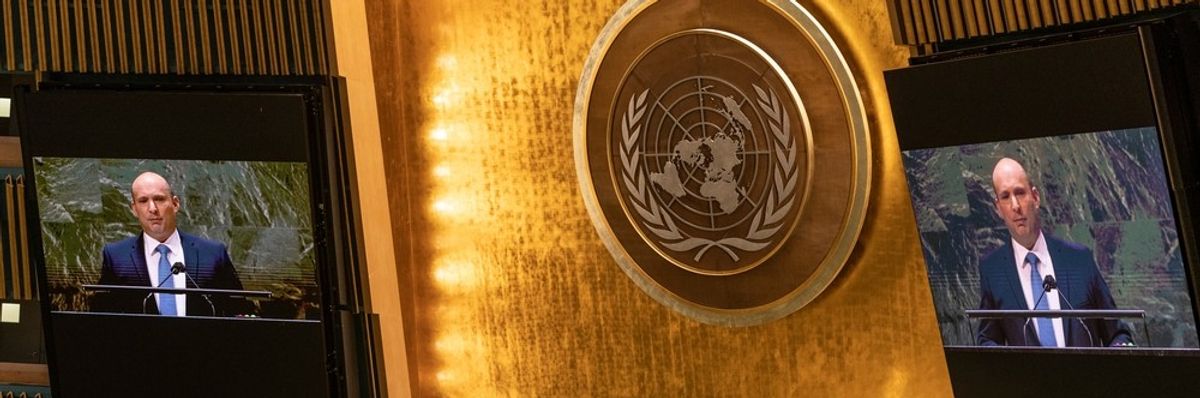
Speeches by the heads of government of Iran and Israel at the United Nations General Assembly this year illustrate two very different ways a regime’s international rival might fit into its strategy.
Iranian President Ebrahim Raisi, in a speech of about 2,000 words, made only one brief mention of what he called the “occupier Zionist regime” — two sentences about what it has done to women and children in the occupied territories and how its blockade has turned the Gaza Strip into the “biggest prison in the world,” followed by an appeal to hold a referendum “with the participation of all Palestinians of all religions and ethnicities including Muslims, Christians and Jews.”
In contrast, Israeli Prime Minister Naftali Bennett devoted nearly one-third of a slightly longer speech to castigating Iran and blaming it for seemingly everything that is wrong in the Middle East. Bennett said that Iran “seeks to dominate” a region throughout which it “has spread its carnage and destruction.” He voiced alarm about Iran’s growing nuclear activities — without mentioning, of course, how this growth resulted directly from a U.S. administration’s reneging on a multilateral agreement that Iran had been observing.
Bennett went back more than three decades to expound on “death commissions” that the Iranian regime has used to “murder its own people,” a crime that he says President Raisi has “celebrated.” Bennett’s speech went on and on in this same tone.
These two presentations were representative of the Iranian and Israeli speeches in other recent General Assembly sessions, as well as of most other statements in which each of these regimes has commented about the other. The little that Raisi’s predecessor, Hassan Rouhani, said about Israel in his appearances before the General Assembly was similar to Raisi’s statement. Bennett’s predecessor, Benjamin Netanyahu, took second place to no one in delivering an unceasing cascade of enmity-filled rhetoric about Iran.
The transcript record is inconsistent with the theme, often voiced by Israel and some of its American supporters (and most often sourced, if at all, to poorly translated comments by former Iranian president Mahmoud Ahmedinejad) of Iran supposedly threatening to “exterminate” Israel or “wipe it off the map.” If a meter measuring hatred could be applied to rhetoric coming from the governments of Iran and Israel, it would show ill will in both directions but the preponderance of it coming from Israel and directed against Iran.
That is all the truer of explicit threats of attack, such as the chief of the Israeli general staff recently declaring that Israel has “accelerated” plans for attacking Iran, followed by allocation of $1.5 billion for such a military strike. The Israeli threats need to be taken seriously in view of Israel’s status as the most militarily potent state in the region and its record of attacking other countries more than any other state in the region has, a record that it continues to compile.
Even just as a matter of rhetoric and not of military attack, Israel’s posture toward Iran is one of the clearest examples of a regime using confrontation as a centerpiece of national strategy. Confrontation in this sense doesn’t mean exerting pressure on an adversary in the hope of somehow changing its behavior or otherwise altering relations with the adversary. Instead, it means using for other purposes the tension and enmity associated with confrontation. It means viewing confrontation as something not to be overcome or avoided but instead to be sustained, as an instrument of statecraft.
The purposes that stoking confrontation with Iran serve for the Israeli government include shifting blame away from Israel for any instability or other ills in the Middle East. They include diverting international attention from Israeli policies and behavior that Israeli leaders would rather not talk about, especially relating to the occupation of Palestinian territory. Whenever such topics come up, the customary Israeli response is, “But the real problem in the Middle East is Iran…” By undermining any U.S. diplomacy with Iran, Israel also hopes to prevent any U.S.-Iranian rapprochement and to continue to present itself as America’s only true friend in the Middle East.
Other states have used a strategy of confrontation for other purposes. Whipping up animosity toward a foreign adversary has long been a familiar way of bolstering domestic support for a regime that faces political challenges for unrelated reasons. This may have been a factor in past hostile rhetoric from the young de facto ruler of Saudi Arabia, Crown Prince Mohammed bin Salman, as he threatened to take war to Iran, while he simultaneously was trying to cement his own authoritarian rule at home.
The North Korean regime of Kim Jong-un has periodically used weapons tests or other actions to create tension and confrontation with essentially the whole world community, both to rally support from an impoverished population and to get international attention and aid.
The United States must resist getting drawn into whatever game a confrontation-stoking regime is playing. Washington should remember that the purposes the game is serving are not U.S. interests and may conflict with U.S. interests, even if the game-player presents itself as a U.S. ally.
The extent to which the United States can discourage a regime from playing the game at all varies from case to case. It is difficult to envision Kim’s regime, for example, giving up its attention-getting brand of misbehavior, which has become a staple of North Korean statecraft. Israel also is unlikely to back away from its heavy reliance on the Iran-as-bête-noire card, short of a fundamental revision of Israeli policy toward the conflict with the Palestinians, which in turn would require fundamental change in American politics as it relates to policy toward Israel.
In the meantime, the United States must not allow Israel or anyone else to cripple its ability to conduct its own confrontation-dampening diplomacy, with Iran or anyone else.
Saudi Arabia is an example where less sweeping change in U.S. policy already has provided motivation to back away from the confrontation game. This year Mohammed bin Salman has softened his rhetoric about Iran, and tension-reducing talks between Riyadh and Tehran, partly mediated by Iraq, have shown signs of progress. A major factor that led to this Saudi turnabout was the Biden administration’s ending of the previous no-strings-attached, and even enthusiastic, U.S. backing of Saudi Arabia’s confrontational stance toward Iran.
Iranian leaders have at times talked up foreign threats partly for domestic political purposes, but the new Saudi attitude has met a receptive Iranian audience. Both of these two Persian Gulf powers realize that their well-being is better safeguarded by stability and normal relations in their region than by tension and the threat of war. Iran had already advanced its own regional peace initiative.
In the Middle East as elsewhere, dialogue and de-escalation of tensions are almost always better for U.S. interests than confrontation and threats of war. De-escalation makes possible prosperity-enhancing commerce, reduces the opportunity for extremists to exploit conflicts, and reduces the chance of the United States becoming ensnared in regional wars.
What goes for relations at the regional level applies as well at the global level to the relations and strategy of the United States itself. Although the exploitation of foreign confrontation for domestic political purposes is certainly not unknown in the United States, a strategy of confrontation toward other great powers considered to be adversaries is today more a function of habit—a residue of thinking formed during four decades of waging a Cold War against the Soviet Union. That habit was hard to break during the latter days of the Cold War itself, when some of Ronald Reagan’s subordinates such as Caspar Weinberger and William Casey seemed willing to wage that war forever even as their boss and Mikhail Gorbachev were looking for ways to end it.
The same habits are now shaping much discourse about relations with Russia and especially China. As Daniel Larison notes, the United States may be sliding into a cold war with China partly because of the mistaken belief that such a confrontation is inevitable. Old habits die hard, and some of those habits are bad.