

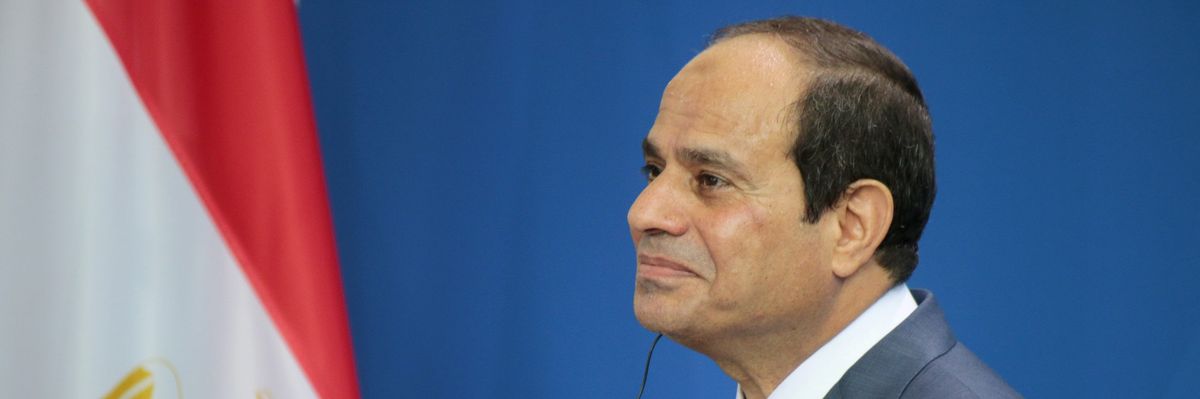
Like other authoritarian regimes around the globe, the government in Egypt is exploiting the COVID-19 pandemic. Under the guise of fighting the coronavirus, it is cracking down on critics and imposing more restrictions on personal freedoms. Egypt’s repressive regime, led by General Abdel-Fattah el-Sisi, has taken several political measures over the last two months ostensibly to control the outbreak of the disease. These actions will have a long-term impact on Egypt’s political life that goes beyond the coronavirus crisis. Externally, Sisi is employing the pandemic as a way to score political points and improve his regime’s image on the international stage. Since the global outbreak of COVID-19, Egypt has dispatched medical shipments to a number of countries including the United States, the United Kingdom, China, and Italy. The irony of sending these supplies out of the country while Egypt itself is grappling with fighting the coronavirus is striking. In fact, Egypt’s politicization and exploitation of the coronavirus pandemic cannot be overlooked and should be examined closely.
Egypt’s COVID-19
Egypt’s mishandling of the coronavirus crisis comes as no surprise. After a few weeks of denial and dismissal of reports on the spread of the virus, the government began to acknowledge the increasing presence of COVID-19 in the country and took actions in order to contain its spread. However, these procedures seem to be neither working nor effective. On May 12, Egypt’s daily cases of COVID-19 were 347, raising the total number to 10,093, with 544 deaths.
In fact, this number could have been lower if the government had provided the needed medical support and assistance to medical professionals and hospitals. Importantly, worrisome reports indicate that several confirmed cases of COVID-19 have been found among doctors and nurses, which complicates the situation and affects the country’s capacity to fight the disease. According to the World Health Organization, these health care workers account for around 13 percent of Egypt’s coronavirus infections. For example, in early April, Egypt’s National Cancer Center, the country’s main cancer facility, witnessed an outbreak of COVID-19 in which at least 17 doctors and nurses reportedly tested positive. Furthermore, Nagila Hospital, which was assigned for quarantining COVID-19 cases, had to halt new admissions because according to Mada Masr, half of the hospital’s 79 staff members were diagnosed with COVID-19, and two of them reportedly died of its complications.
The lack of protection for medical cadres in Egypt has resulted in a crisis between Egypt’s Health Ministry and the Doctors Syndicate in which the latter accuses the former of not taking measures to protect doctors and nurses treating patients with COVID-19. In addition, nurses and medical workers at Mansoura Health Insurance Hospital began a strike to protest the Health Ministry’s refusal to test them for the coronavirus. The World Health Organization has called upon Egypt to conduct more coronavirus tests and to apply more protective measures. As an example of the government’s utter failure in containing the virus, Egypt’s Prime Minister Mostafa Madbouly announced what he dubs a “coexistence plan” with the pandemic. According to the plan, restrictions on such places as shops and restaurants will be eased and the country will be gradually reopened to go back to normal—a policy that will likely exacerbate the crisis and put more pressure on the country’s weak health care system.
Repression amid the Coronavirus Crisis
Egypt is treating COVID-19 as a political threat. The regime fears the spread of the coronavirus, coupled with the ineffective and feeble health care system, could lead to a new cycle of unrest and upheaval. Therefore, it clamps down on individuals who criticize the government’s response to the coronavirus. Over the past few weeks, Egypt’s security forces have arrested several young activists who criticized the government’s policies in tackling the COVID-19 crisis, accusing them of spreading “rumors and fabricated news on social media about the spread of the coronavirus in the country.” In addition, according to a statement issued by Human Rights Watch, at least two women with no known political affiliation were abducted and then disappeared, along with seven children, because of their critical remarks of the government’s measures in responding to the coronavirus outbreak. The children were later conditionally released.
Furthermore, on April 28, Sisi extended the state of emergency for another three months. Egyptians have been living under a state of emergency and this is the eleventh time it is renewed since April 2017, after terrorist attacks on two churches in Tanta and Alexandria that left approximately 45 people dead. Nevertheless, the most visible and dangerous political exploitation of the coronavirus comes with the recent amendments of the Emergency Law (Law 162 of 1958) that were ratified by Sisi on May 7th. These amendments will increase the power of the president and the military over civilians who might violate the law. According to a statement signed by nine human rights organizations, these amendments will “solidify the president and the military’s control over the judiciary” and expand the Military Prosecution’s jurisdiction to investigate civilians. They also “give the president the power to authorize the Military Prosecution to investigate crimes that violate the Emergency Law (Article 4).”
The Politics of Medical Aid
Over the past few months, Egypt has sent several shipments filled with medical supplies such as masks, gowns, anesthesia drugs and antibiotics, body bags, testing swabs, and the like to China, Italy, the United Kingdom, and the United States. However, considering Egypt’s needs, the medical assistance to these countries did not arise from generosity or solidarity with their COVID-19 crises. Rather, it reflects the shrewd and opportunistic character of President Sisi, who is clearly exploiting this pandemic in order to score political points and improve his image in the international arena. Three of the recipient countries of Egypt’s medical assistance (the US, UK, and China) are strategic allies on which Sisi’s repressive regime can rely while a fourth, Italy, has legal problems with Egypt over the case of an Italian citizen who was murdered there in 2016.
Washington is a key ally to Cairo and President Trump is a strong backer of Sisi, having once called him glibly “my favorite dictator.” Sisi’s shipment of medical supplies to the United States, which landed at the Joint Base Andrews in Maryland on April 21, was a smart gesture and strategic move that came amid one of America’s worst medical and economic crises in decades. Sisi’s propaganda arms have amplified the assistance to the United States and portrayed it as a historical move that shows “Egypt’s global leadership and capabilities.” It is noteworthy that Egypt is a major recipient of US foreign aid, getting more than $1 billion annually since 1979. Indeed, Sisi gained the praise and the compliments he was seeking from American officials. The State Department tweeted in Arabic to express gratitude to “President Sisi and the Egyptian people for their generous support to the American people.” Likewise did the National Security Council and the US ambassador to Egypt, Jonathan Cohen, who posted his message of gratitude in a video recording.
Similarly, the United Kingdom is a key political, economic, and military ally to Egypt. Both countries have enhanced their bilateral relationship over the past few years during which British investments in Egypt reached over $5 billion, particularly in the energy and oil industry. Egypt is also a major importer of British arms and military sales. According to Action on Armed Violence, an advocacy group that seeks to reduce the impact of armed violence around the world, the number of approved licenses for arms sales from the United Kingdom to Egypt has risen steadily over the past few years. Between 2008 and 2017 alone, there was a 750-percent increase in licenses given to Egypt, from 63 to 535. In addition, in 2015, London approved some $134 million of military arms exports to Cairo. Therefore, providing medical assistance to the United Kingdom during its hard-hitting coronavirus crisis will not only strengthen the Sisi regime’s relationship with London but also would portend some important payback in the longer term.
As for China, for which Egypt was among the first countries to show support and solidarity in its coronavirus crisis, the political and economic gains are remarkable. First, China is Egypt’s largest trading partner with a volume of bilateral trade of $10.58 billion during the first 10 months of 2019. Second, China is one of the largest foreign investors in most of the major projects undertaken by Sisi, which he uses to promote himself. The most important of them are the new administrative capital, Suez Canal Axis, and city of El-Alamein in addition to expanded power lines, such as the electrified train route “Al-Salam ‑ Administrative Capital ‑ 10th” with an investment of $1.2 billion from AFIC, a Chinese company. There are also Chinese investments in technology and in the service, agricultural, and tourism sectors. Third, China is one of Egypt’s major creditors, representing around 3.5 percent of Egypt’s all-time high foreign debt of over $112 billion. Therefore, sending medical supplies to China can ultimately translate into big rewards for Sisi’s regime.
On Italy, the stakes are higher. Sisi has a complex and problematic relationship with the current Italian government because of the case of Giulio Regeni, the doctoral student at the University of Cambridge doing field research in Cairo who was allegedly brutally tortured and murdered by Sisi’s security forces in 2016. Regeni’s case has damaged the bilateral relationship between Egypt and Italy over the past four years and created troubles for Sisi’s regime. Until now, Egypt has failed to provide compelling evidence on who killed Regeni and no one has been charged or held accountable for his death. Last December, the Italian prosecutor officially accused Egypt of deliberately trying to mislead the investigation. Furthermore, Regeni’s case has had impact on the collaboration between Egypt and Italy in regard to Libya; the two countries support different Libyan factions and have adopted divergent views on how to end the civil war and resolve the conflict. By sending two cargo planes filled with medical equipment to Italy, Sisi believed that he could change Italy’s position on the Regeni case and the conflict in Libya. This plainly reflected the president’s opportunism and moral bankruptcy.
Noticeably, Egypt has not sent medical aid to its regional allies and backers, particularly Saudi Arabia and the United Arab Emirates, which are on the list of countries with the highest numbers of coronavirus cases in the Arab world, with over 42,000 and 19,000, respectively. In addition, both countries are facing economic hurdles, especially Saudi Arabia, because of the coronavirus challenges and the decline in oil prices. Finally, the optics of his moves show that Sisi cares more about the health care of his western allies than of his Arab counterparts, which can be counterproductive to his immediate concerns about the economic well-being of his country.
To be sure, the Egyptian regime appears to be interested in mollifying international criticism of its repressive policies and increased control of Egyptian society. Sisi’s control of domestic conditions and the Egyptian opposition has been complete since his coup in 2013. To him, what matters are relations with western benefactors and allies who are in a good position to help him garner the legitimacy he so lacks among his own people.
This article has been republished with permission from the Arab Center Washington DC.