

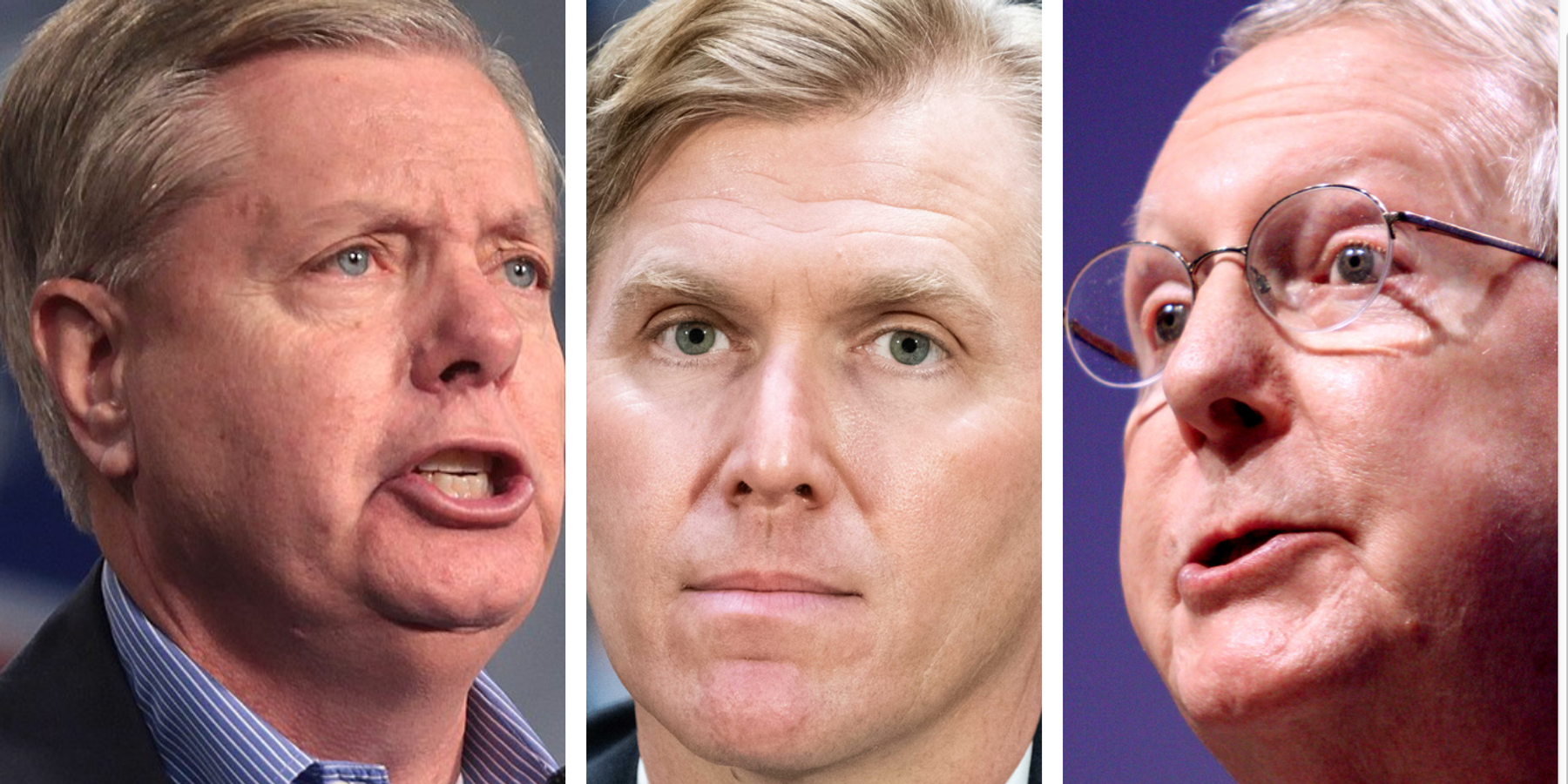
When reports surfaced in early July that Donald Trump’s administration would be pausing some U.S. aid to Ukraine, it didn’t take long for the knives to come out.
Anonymous officials inside the administration, as well as critics on Capitol Hill who disagreed with the policy, pointed the finger at Elbridge Colby, the Pentagon’s top policy official and a longtime advocate of refocusing U.S. military power to the Pacific.
“He is pissing off just about everyone I know inside the administration,” one anonymous official told Politico, describing Colby as a driving force behind what they saw as a dangerously narrow foreign policy vision.
Another former U.S. official, reacting to Colby’s moves recalled hearing from a State Department colleague: “Who is this fucking guy?” The piece also looks back to past moves from Colby that apparently surprised others in the administration, including undertaking a review of the Biden-era security pact between Australia, the United Kingdom, and the United States; telling the UK to focus on European security rather than sending aircraft to the Pacific; and telling allies such as Japan to increase their defense budget.
The piece, which in its headline refers to the DOD policy chief as “rogue,” relies almost entirely on anonymous sources.
A Wall Street Journal editorial called the pause “a hostile act that favors Vladimir Putin,” attributing it squarely to Colby and accusing him of “demonstrating weakness that invites more war.”
While Washington media has often lumped Colby in with the MAGA movement’s restrainer camp — with some critics even calling his views akin to “isolationist” — the label does not quite fit. Instead, Colby has long argued that U.S. national security policy should focus on deterring China, even if that means reducing military commitments in Europe or the Middle East. His critics see that as a retreat; his allies argue it's overdue triage. But he has nonetheless become the flashpoint in the latest drama inside Trump’s foreign policy team.
“His crime was the most heinous one can commit in the eyes of the U.S. establishment: halting weapons shipments to Ukraine,” James Carden, a writer and former adviser to the U.S. State Department, tells RS. “He is the target, but only because he crossed that reddest of red lines.”
Shortly after the news broke, Trump reversed the pause and publicly claimed he had no idea who had authorized it, a move that only intensified scrutiny of his national security team. This was only the latest flare-up in the ongoing push-and-pull between realists inside Trump’s orbit and more traditionally hawkish Republicans. The balance between the two camps has shifted repeatedly in the administration’s first six months in office. Just weeks before the Ukraine pause, Trump had joined Israel’s war and authorized a series of strikes on Iran’s nuclear infrastructure, seen as a win for the hawkish faction.
The president has since promised more military assistance to Ukraine and threatened Russian President Vladimir Putin with aggressive secondary sanctions if Moscow and Kyiv do not agree to a ceasefire within 50 days.
“May was the zenith for restrainers,” says Curt Mills, executive director of The American Conservative magazine. Trump had fired national security adviser Mike Waltz, delivered an “astonishing” speech discrediting the neoconservative legacy while in the Middle East, opened up diplomatic negotiations with Tehran, and halted American attacks on Houthis. Then came the so-called 12-day war. “It’s been a pretty crappy 45 days,” says Mills.
Hawks have moved quickly to capitalize on this apparent momentum. They have seized on the perceived success of the Iran strikes to frame the operation as a vindication of hard power and urging Trump to stay on offense. “On the Republican side, the hawks are so slavish,” Mills tells RS. “It appeals to Trump’s vanity. They’ll just say anything.”
These interventionists have greeted these new developments with glee. In The Washington Post, columnist and American Enterprise Institute fellow Marc Thiessen celebrates that restrainers are “a tiny minority” within the Republican party.
“Indeed, the only thing as satisfying as watching Trump exercise bold American leadership on the world stage over the past six months has been watching the isolationists realize that Trump is not one of them,” he writes.
Hawkish opponents of Trump’s like Bill Kristol and John Bolton offered slightly more measured approvals of the president’s decision to bomb Iran.
The pressure campaign to convince Trump and his administration to embrace certain hawkish instincts is now spreading to other theaters. After POLITICO reported that the Pentagon’s brief pause was driven by concerns from Colby over dwindling munitions stockpiles, Sen. Mitch McConnell (R-Ky.) responded with a pointed public statement. While crediting Trump for resuming aid, he blasted “the self-indulgent policymaking of restrainers — from Ukraine to AUKUS,” which have “so often required the President to clean up his staff’s messes.”
During Colby’s confirmation hearing, McConnell warned that his policies could amount to “geostrategic self-harm.” The former majority leader was ultimately the only GOP Senator to oppose Colby’s nomination.
“I think the pro-war, pro-intervention forces from within and without government are waging a media campaign against Colby because they know it works,” Carden says. “Trump has folded again and again in the face of demands for a war on Iran; for an attack on Syria; for full-throated support for Israel and Netanyahu; and for more arms to Ukraine. Trump is not a committed restrainer in any sense.”
Hawkish Senators like Lindsey Graham (R-S.C.) have celebrated Trump’s sudden tough talk on Putin, saying that the president will sign off on his punishing sanctions bill if Congress approves it.
Elsewhere, Sen. Marco Rubio and his allies have reportedly sidelined presidential envoy Ric Grenell on Venezuela — where Grenell had shown openness to diplomacy with Caracas — in an effort to steer policy back toward pressure on the regime.
International developments and domestic pressure campaigns have coincided with tension inside the administration. Earlier this year, Secretary of Defense Pete Hegseth fired three close advisors on allegations of leaking that were never substantiated. “This all exists in the context of Hegseth’s operation, which is defined by incompetence mixed with panic,” Mills tells RS.
As a result of the shrinking circle around Hegseth and the reorganization of Trump’s national security team that added interim national security adviser to Rubio’s list of titles, the inter-agency process in the administration appears to have authentically broken down.
Amid the broader dysfunction, dissenting views on foreign policy have found themselves gradually sidelined as decisions are shaped by pressure from both inside and outside the White House.
“I have serious policy differences with Colby, including the decision to halt arms to Ukraine,” wrote former Bernie Sanders foreign policy advisor Matt Duss on X. “But we should all be clear that this is an effort by the nat sec establishment to discipline a policymaker who breaks from DC groupthink, which we need more of.”
Efforts to combat this groupthink have been challenged from all directions, sources tell RS, including career officials who are resistant to change, powerful members of Congress, and, increasingly, the President himself.
“I don’t think he fundamentally wants a war. Trump has changed a million times,” Mills tells RS. But in recent weeks, the people who seem to have his ear are those urging him to double down on force projection in the Middle East and maintain an aggressive posture toward Russia.