

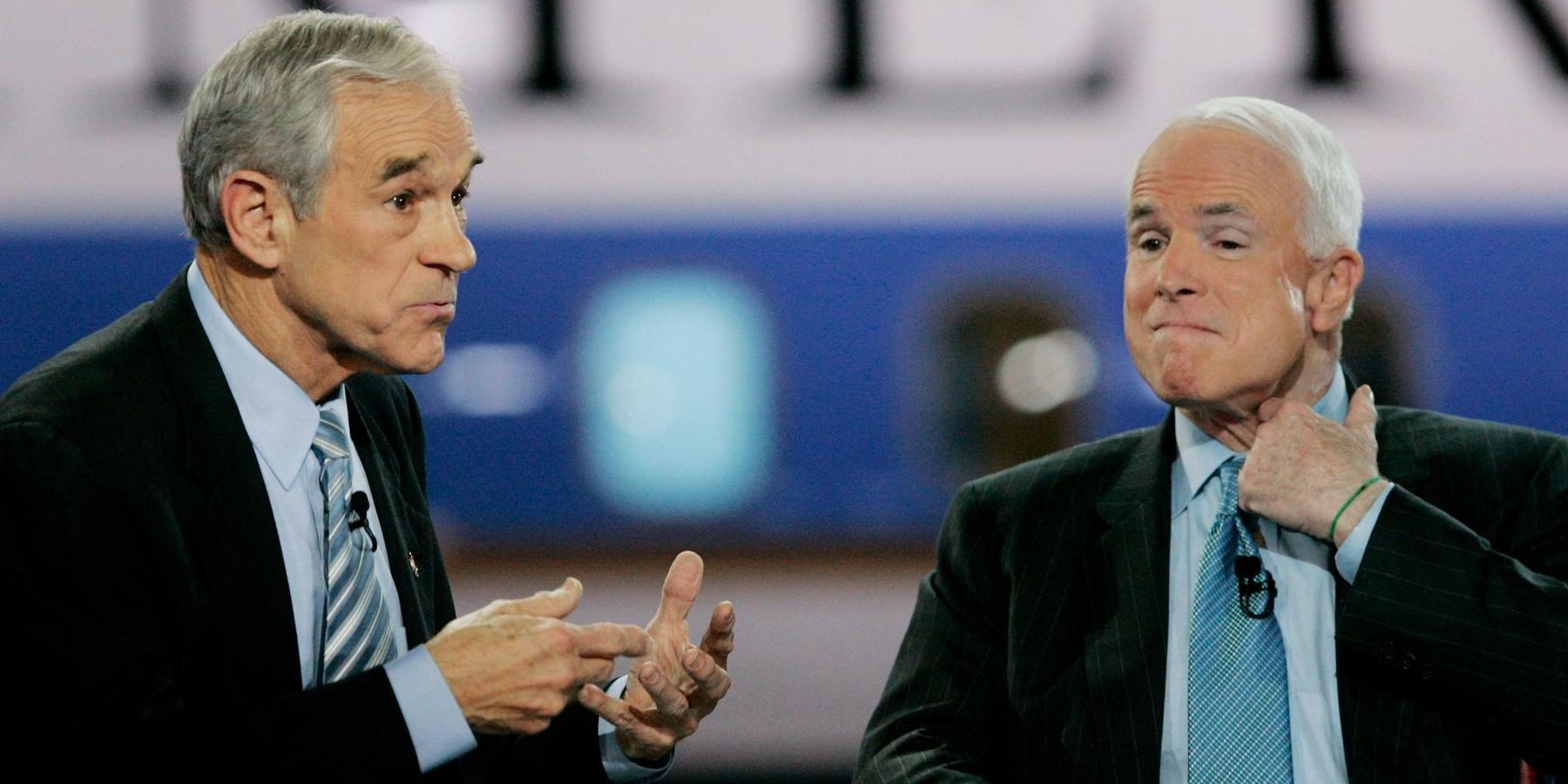
Ron Paul is turning 90 on August 20. At 72, he was a revolutionary.
Today, there is a raucous foreign policy debate within the Republican Party. Populist, realist and libertarian “America First” Republicans argue against endless wars and for fiscal responsibility, while holdover hawks continue to insist on a robust U.S. hand and military presence anywhere they can get it, no matter the cost.
In 2008, there was no debate. While broad public opinion had soured on the Iraq War and President George W. Bush’s approval reached historic lows, the GOP of that era had spent nearly a decade marinating in blind support for militarism, the PATRIOT Act, and torture in the name of “counterterrorism."
War was who Republicans were. It wasn’t a question. It was GOP identity. Sen. John McCain became the 2008 GOP presidential nominee based on that identity, and lost.
Throughout the 2008 Republican presidential primaries, Congressman Ron Paul tried to warn his party that America’s interventionist foreign policy had not only been a disaster in Iraq and Afghanistan, but was bad for America in general — and Republicans in particular.
They couldn’t hear it. Like clockwork, each time Paul criticized U.S. foreign policy during the debates, Republicans accused him of siding with the enemy. After explaining how perpetual American intervention created tension abroad that led to 9/11, Fox News moderator Chris Wallace said to Paul, "You're saying we should take our marching orders from al Qaeda?"
Paul replied, citing the need for a congressional declaration of war, "No, I'm saying we should take our marching orders from the Constitution!"
The other candidates all laughed at Paul. Telling Republicans to tone down the warmongering in 2008 was like telling Sydney Sweeney to lighten up on sex appeal in 2025.
Paul did not win the nomination, but became arguably the most influential GOP candidate in that election precisely because he was the only Republican arguing for a more restrained foreign policy. He became one of the most popular candidates, in terms of raw grassroots support, based on his staunch antiwar message, drawing thousands of supporters to his rallies, disproportionately young.
Paul’s popularity exploded due to one particular debate. As Jim Antle observed at The American Conservative weeks before Paul retired from Congress in early 2013, “On May 15, 2007, the Republican contenders debated in Columbia, South Carolina. Paul argued that American intervention in the Middle East — bombings, sanctions, and efforts to destabilize foreign governments — helped turn local populations and their co-religionists against us, to the point that they would contemplate terrorist attacks like those on 9/11.”
“Are you suggesting we invited the 9/11 attacks, sir?” asked the Fox News moderator.
“Paul had said nothing of the sort,” Antle continued, “but neither did he react to the implication behind the question as forcefully as he might have. Giuliani pounced. ‘That’s an extraordinary statement, as somebody who lived through the attack of Sept. 11, that we invited the attack because we were attacking Iraq,’ he said. ‘I don’t think I’ve ever heard that before, and I’ve heard some pretty absurd explanations for September 11.’”
The audience erupted. After the applause died down Giuliani demanded that Paul take back what he said, “I would ask the congressman to withdraw that comment and tell us he didn’t really mean that.”
That’s when Ron Paul doubled down. He detailed the CIA term “blowback” as an explanation for 9/11, an argument that Bush-Cheney, neocon propaganda-soaked audience definitely did not want to hear and resented Paul for making it.
But after years of foreign policy failure in the Middle East, certain kinds of Republicans were open to Paul’s message. Many independents were drawn to his campaign. Paul also attracted a significant number of progressives (Paul later said he would put his longtime friend, progressive Democrat Congressman Dennish Kucinich in his cabinet). For the Paul faithful, it was all about the ideas.
At the time of Paul and Giuliani’s heated exchange, Rudy was considered the frontrunner and Ron was the gadfly. By the time the 2008 election was over, Paul would receive one million primary votes, more than Giuliani who dropped out. In 2012, Paul doubled that number to two million. The nominees in both cycles, McCain and later, Mitt Romney, both ran and lost on Bush-style neoconservative foreign policy agendas.
The next Republican actually elected president ran on ‘America First’ foreign policy platform that promised to end “endless wars” and even went so far as to claim George W. Bush “lied” America into the Iraq War. He sounded like Ron Paul.
Has Donald Trump always lived up to his antiwar rhetoric? Not even close.
Did he change the foreign policy conversation in the Republican Party? Undeniably.
Today, your typical, red-meat, rightwing Republican might talk about foreign policy in ways that seem closer to Paul than McCain or Romney. Conservatives can denounce foreign intervention and aid and those conversations now fit comfortably on the right. Whereas Paul’s Republican detractors used to love to smear him as siding with terrorists, hawks, neocons, and Democrats who reflexively accuse Trump of being “Putin’s puppet” are immediately suspect to MAGA members. That trick just doesn’t work anymore with most of the Republican base.
Trump ran for president within a post Bush-Cheney GOP that didn’t know what it stood for anymore other than being against Barack Obama. It quickly came to stand for Trump, whatever that might have meant in any given moment, but that upheaval did usher in a radical rethinking of Republican foreign policy.
Paul ran for president when war was the Republican religion, undeniable and unassailable, in which heretics were to be excommunicated. Later, it was so many neocons who would actually jump ship.
What Republican foreign policy is in 2025 is a very different conversation than it was in 2008. Donald Trump might have upended that consensus, but 17 years ago Ron Paul became the first candidate to so fearlessly question it, leading to more challenges and changing even more minds ever since.
- They were right: Marginalized antiwar lawmakers now get due ›
- The Capitol Hill Republicans against US war with Iran ›