
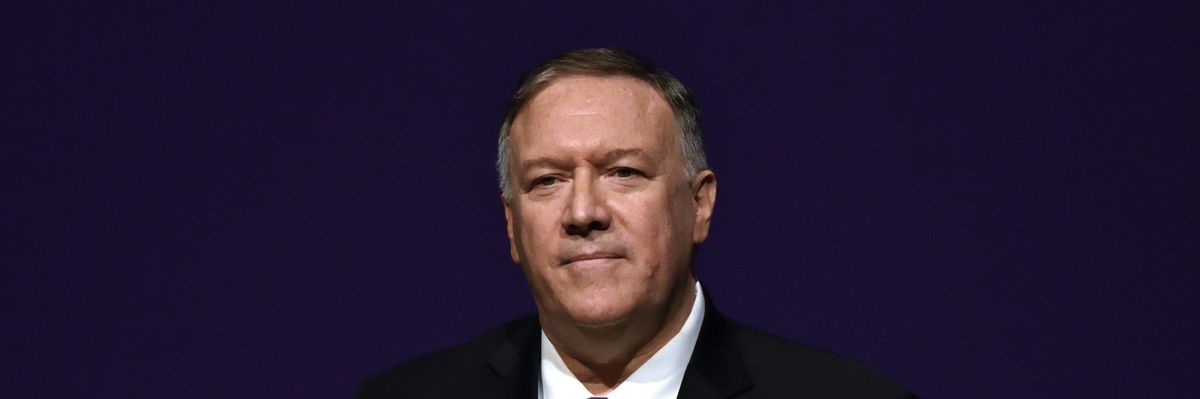
U.S. Secretary of State Mike Pompeo says the Trump administration’s foreign policy is based on restraint and realism. But U.S. foreign policy actions across the world suggest a lack of understanding for what the concept means in practice.
Restraint values diplomatic engagement over military coercion and domination. so don’t be fooled by Pompeo’s hollow language. The latest video from the Quincy Institute explains:
Click here for more on Pomepo hijacking "restraint" from Quincy Institute Non-Resident Fellow Stephen Walt.
Dear RS readers: It has been an extraordinary year and our editing team has been working overtime to make sure
that we are covering the current conflicts with quality, fresh analysis that doesn’t cleave to the mainstream
orthodoxy or take official Washington and the commentariat at face value. Our staff reporters, experts, and
outside writers offer top-notch, independent work, daily.
Please consider making a tax-exempt, year-end contribution to Responsible Statecraftso that we can continue this quality coverage
— which you will find nowhere else —
into 2026. Happy Holidays!
Khody Akhavi is Senior Video Producer at the Quincy Institute. Previously he was Head of Video for Al-Monitor and covered the White House for Al Jazeera English, as well as produced films for the network’s flagship investigative unit.
For months, foreign policy analysts have tried reading the tea leaves to understand the U.S. government’s rationale for menacing Venezuela. Trump didn’t leave much for the imagination during a press conference about the U.S. January 3 operation that captured Venezuelan President Nicolas Maduro.
“You know, they stole our oil. We built that whole industry there. And they just took it over like we were nothing. And we had a president that decided not to do anything about it. So we did something about it,” Trump said during a press conference about the operation on Saturday.
It’s not about the drugs —or democracy. In Trump’s telling — at least at that moment — this operation was about oil.
Even before the dust settles, some investors are already responding to this call for foreign investment in the oil industry. A former Chevron executive, Ali Moshiri, told the Financial Times that he is raising $2 billion for Venezuelan oil projects already. “I’ve had a dozen calls over the past 24 hours from potential investors. Interest in Venezuela has gone from zero to 99 per cent,” Moshiri told FT. His firm, Amos Global Energy Management, has already identified Venezuelan assets to invest in.
Charles Myers, chairman of consulting firm Signum Global Advisors, told the Wall Street Journal he is planning a trip to Venezuela in March along with some 20 other hedge funds and asset managers from the finance, energy, and defense sectors. “There is a huge amount of interest in Venezuela reconstruction opportunities,” said Myers.
Venezuela has the world’s largest oil reserves, though underinvestment and sanctions have left the energy infrastructure in poor condition. Plus, Venezuela's reserves are also mostly extra-heavy crude, making it an expensive endeavor to extract. Francisco Monaldi, director of Latin American energy policy at Rice University's Baker Institute for Public Policy, estimated it could require $10 billion per year over the next decade.
To incentivize interest, the Trump administration has been telling oil companies that they could be compensated by the U.S. government for their rigs, pipelines, and other seized properties, if they go back into Venezuela and invest. “A tremendous amount of money will have to be spent, and the oil companies will spend it, and then they’ll get reimbursed by us or through revenue,” Trump said during an NBC interview. U.S. Energy Secretary Chris Wright will meet with representatives of Chevron, ConocoPhillips, and Exxon later this week.
The companies eligible for reimbursement of seized assets could include Exxon and ConocoPhillips, which have long claimed they are owed billions of dollars in compensation from Venezuela over assets seized in 2007 by Maduro’s predecessor, Hugo Chavez. ConocoPhillips and Exxon are seeking $8 billion and $1.6 billion respectively, though Venezuela has consistently refused to pay. With Maduro gone, those companies may have a higher chance of recovering that money if they go back into Venezuela and renegotiate joint ventures with the government. Exxon and ConocoPhillips’ stocks both jumped more than 2% on Monday.
It’s not immediately clear what Delcy Rodriguez, the de facto new president, will do to facilitate American investment. “She's essentially willing to do what we think is necessary to make Venezuela great again,” Trump said to reporters. Rodriguez is credited with helping expand Venezuela’s oil production, impressing Trump administration officials along the way.
Rodriguez has a close relationship with private industry such as Chevron, the only major American company currently operating in Venezuela. Because Chevron is already on the ground and has a close relationship with Rodriguez, the Houston company’s stock is seen as an obvious winner. Chevron’s stock jumped 5% on Monday.
Refiners could also profit from the change in leadership, as more Venezuelan oil reaches American refineries. Marathon and Valero jumped 6% and 9% respectively on Monday.
But it’s Paul Singer, a major Trump donor, who is set to be one of the biggest winners. Singer’s investment firm, Elliot Investment Management, bought Citgo, a subsidiary of Venezuela’s state-run oil company for the bargain price of $5.9 billion. The sale of Citgo to Singer’s firm in November, amid the build-up of military forces in the South Caribbean, was forced by a Delaware court after Venezuela defaulted on its bond payments.
Singer is also a major Trump donor, having donated $5 million to Trump’s super PAC and $1 million to defeat one of Trump’s fiercest Republican critics, Rep. Thomas Massie (R-Ky.). Singer has been called a “vulture” for his tactic of buying up distressed assets, sometimes assisted by longtime ally Secretary of State Marco Rubio. In 2016, then-Senator Rubio pressured Argentina into a payment of $4.6 billion to Singer and other creditors to settle debt they had bought, according to journalist Greg Pallast.
Many oil companies and investors are no doubt concerned about Venezuela’s volatility, the daunting task of extracting heavy crude oil, and the high overhead costs of investment. But not everyone is deterred. Just days out from Maduro’s capture, others are already looking at Venezuela as a boon for their bottom line.
keep readingShow less
Top photo credit: A woman walks past the bas-relief "Suvorov soldiers in battle", in the course of Russia-Ukraine conflict in the city of Kherson, Russian-controlled Ukraine October 31, 2022. REUTERS/Alexander Ermochenko
The Ukraine war has, since its outset, been fertile ground for a particular kind of intellectual axe grinding, with establishment actors rushing to launder their abysmal policy record by projecting its many failures and conceits onto others.
The go-to method for this sleight of hand, as exhibited by its most adept practitioners, is to flail away at a set of ideas clumsily bundled together under the banner of “realism.”
There is, of course, no monolithic “realist” approach to the Ukraine war or any other issue. Any analysis, as in the case of Andrew Chakhoyan’s recent piece, "How foreign policy realists lost touch with reality on Russia," which takes aim at “the realism of scholars like John Mearsheimer, Samuel Charap and Stephen Walt” as if these scholars share a unitary set of policy positions, is already off to a bad start.
But there is a set of problems raised here that merits careful consideration. The first and most serious among them centers on the issue of NATO enlargement and Russian threat perceptions. “Sequencing matters,” Chakhoyan writes. “NATO didn't expand — countries formerly occupied by Russia stampeded toward it the moment they could. If America sought to menace Moscow, why has Ukraine spent a decade begging for membership while Washington hemmed and hawed? In fact, NATO threatens the Kremlin only as a deadbolt threatens a criminal.”
Realism, as a values-free toolkit for analyzing and projecting outcomes, does not assign blame — it simply seeks to understand why things occur the way they do. A realist reading of the dynamic between NATO and Russia, if it’s of any help to anyone, is this: Russia, in all its historical incarnations, perceives a pacing, centuries-long security challenge from Western states.
This perception ebbs and flows depending on a large set of variables that includes an increase in Western offensive capabilities that can potentially accompany NATO enlargement. “Potentially” is the key operative word, as the accession of a strategically insignificant country like Montenegro, or a country like Sweden that was already tightly integrated into Western security structures, naturally will not be perceived with the same alarm as the potential accession of Ukraine, which everyone recognizes would drastically alter the balance of forces and security dynamics in the region.
Ukraine of course does not have to join NATO for this shift to occur. It can offer to host NATO assets on its territory and to integrate into NATO’s security infrastructure without benefiting from the alliance’s Article V collective defense provision, and that, too, is seen by Russia as posing an unacceptable threat.
Russia, at various points since the end of the Cold War, has taken steps that many realists would describe as trying to balance against this perceived threat. This can include military action, as in the case of Georgia in 2008 and Ukraine in 2014 and 2022, but also hybrid measures like the ones employed toward Moldova with the conflict over the pro-Russian breakaway state of Transnistria.
In all cases, Russia has exhibited a clear overarching objective. It seeks to deny, deter, and preempt expansion of Western security structures in the post-Soviet space — put more simply, to balance against NATO. Realists tend to believe that we cannot develop an effective policy toward Russia and Eurasia unless we understand this dynamic, but that is not at all the same as blaming NATO for Russia’s decision to invade Ukraine in 2022.
Realists fail to see, Chakhoyan argues, that Russia will go on to attack NATO countries if it is not defeated in this war, thus risking a larger conflict. “If we follow the realists’ advice and let Moscow have its way, then NATO’s Article 5 will be promptly tested. America and Europe will then face a choice: send troops to fight Russia directly, or watch the security architecture that delivered 70 years of peace collapse in real time,” he writes. Not only does this run counter to recent U.S. and European intelligence assessments, but it makes no sense in the context of Russia’s established NATO strategy.
What’s really at stake here is not an academic discussion on the merits of realism. Rather, this is part of a series of attacks intended to derail the White House peace initiative and to convince President Trump to return a failed Biden-era policy of enabling Ukraine’s war effort with no viable strategic end point.
Realism’s discontents insist there should be no rewards for aggression, but this claim rings hollow in the face of all the costs and setbacks suffered by Russia since 2022. The war has not been “rewarding” in the slightest, especially if one considers the steep opportunity cost of everything Russia could have achieved over the past four years if it didn’t go all in on prosecuting the most dangerous and destructive war in Europe since 1945.
Nor is there any basis for the long-discredited theory that pursuing a settlement in Ukraine gives other countries a green light to pursue wars of aggression across the world. The idea that China will base its decision to invade Taiwan on something as strategically recondite as who controls the remaining fifteen percent of one region in eastern Ukraine — and not, say, the balance of forces in the Pacific theater — is hardly deserving of sober commentary.
The Trump administration has gone to great lengths to soften the scope of Ukrainian concessions, in part by reframing the settlement as part of a larger framework deal between Russia and the U.S., but the fact remains that a negotiated settlement must contain points that are attractive to both parties in order to be implemented. This is no way a “reward” for Russia’s actions but simply the price of ending the war on the best possible terms for Kyiv and the West.
One need not be a realist to see that the alternative– enabling the indefinite continuation of an attrition war that Ukraine is slowly losing — is vastly worse for everyone.
Realism got the Ukraine war right, and the Trump administration, if it follows through on its realist instincts, stands on the cusp of securing a durable end to the carnage that advances U.S. interests and strengthens Europe’s security architecture.
keep readingShow less
Top image credit: Chisinau, Moldova - April 24, 2025: EU High Representative for Foreign Affairs and Security Policy Kaja Kallas during press conference with Moldovan President Maia Sandu (not seen) in Chisinau. Dan Morar via shutterstock.com
When Russia invaded Ukraine, the EU high representative for foreign affairs Kaja Kallas said that “sovereignty, territorial integrity and discrediting aggression as a tool of statecraft are crucial principles that must be upheld in case of Ukraine and globally.”
These were not mere words. The EU has adopted no less than 19 packages of sanctions against the aggressor — Russia — and allocated almost $200 billion in aid since 2022.
Surely one would expect, then, the EU to condemn the U.S. unilateral attack on Venezuela in early days of 2026, resulting in an abduction of its leader Nicolás Maduro? Yet, nothing of the sort happened. In fact, the EU has already demonstrated its selective approach to the international legality when it failed to condemn its violations in Gaza half as vociferously as it did in Ukraine, shredding Europe’s credibility in the Global South and among many European citizens as well.
Instead, the EU's response to President Trump’s attack on Venezuela was a masterpiece of evasion. European leaders issued vague carbon-copy statements committing to, above all, “closely monitoring the situation” in Venezuela. This “collective monitoring” may be the largest and most passive mission in the bloc’s history.
This lamentable spectacle included the German Chancellor Friedrich Merz asserting that the legal circumstances of the U.S. action were “complex.” His Greek counterpart Kyriakos Mitsotakis went even further, dismissing legal questions as untimely — a reckless stance for a leader locked in long-simmering sovereignty disputes with Turkey.
As a result of these contortions, Kallas produced a tepid statement on behalf of 26 EU states which somehow managed to avoid rejecting the U.S. attack on Venezuela as a primary cause of the “crisis.” Instead it appeared to endorse the Trump administration’s case for war with references to Maduro’s illegitimacy, drug trafficking and transnational organized crime despite U.S. national intelligence’s conclusion that Maduro did not have any operational role in running drug cartels.
Yet it would be a mistake to assume that this position (or rather, lack of it) speaks for all European states and, much less, populations. Hungary opted out as even the thinnest veiled criticisms of the U.S. actions proved too much for its Prime Minister Viktor Orban, a close Trump’s ally.
On the other side, Spain, in a move of significant diplomatic defiance, signed a separate statement with Mexico, Brazil, Colombia, Chile, and Uruguay. It expressed “a clear rejection of the unilateral military actions against Venezuela” (stopping short, however, of explicitly mentioning the United States) and, notably, concern about any intent of an external appropriation of sovereign natural and strategic resources, a clear reference to Trump’s talk about “taking Venezuela’s oil.”
The internal EU fracture over the response is perhaps even more telling. While the EU’s elites seem to be going out of their way not to anger Trump, there is also a growing rejection of this form of vassalage, on both political right and left.
Nowhere is this political realignment more potent than in France, the EU’s pre-eminent strategic power. President Emmanuel Macron, the self-styled champion of a “European strategic autonomy,” has de-facto endorsed the U.S. operation, choosing to emphasize Maduro’s lack of legitimacy.
In stark contrast Marine Le Pen and Jordan Bardella, the leaders of the right-wing National Rally, have stood up robustly for the principle of sovereignty and international law, condemning the operation as a dangerous overreach — as did the left-wing France Unbowed.
Notably, the former prime minister and foreign minister Dominique De Villepin, a Gaullist conservative who famously opposed the Iraq war at the U.N. Security Council in 2003, was equally scathing in his indictment of Macron’s position. He lambasted the French president for not seeming to realize that both Ukraine and Venezuela are “inter-connected.” He said that failing to stand up against the U.S. attack on Venezuela and “on what happens in the Middle East” (in reference to Israel’s wars) weakens the EU case on Ukraine.
De Villepin is right: Macron’s position looks even more awkward given that the new U.S. national security strategy chastisesEurope by treating the liberal, centrist forces he represents as adversaries while backing his nationalist opponents.
Yet it is those putative Trump’s allies on the nationalist right who now criticize his actions. Macron’s submission to Washington enabled the Le Pen-Bardella camp to claim the mantle of true defenders of national dignity and sovereignty. The National Rally already tops the polls in France. The Venezuela debacle could further help to break the Atlanticist hold on the Élysée.
And then there is a Greenland corollary to the whole story. In the wake of the Venezuela operation, Katie Miller, the wife of the White House deputy chief of staff for policy Stephen Miller, posted on X a picture of Greenland, a Danish territory, covered by the American flag with a comment “soon.” This was deemed alarming enough for the Danish Prime Minister Mette Frederiksen to issue a strong rebuke. It doesn’t seem, however, to have impressed Trump, who promised to “deal” with Greenland in “two months.”
The question is what really the EU can do to deter the U.S., except issue more statements of concern? Having outsourced its security to the U.S., defined the Ukraine war as existential to its own future and refused to seek autonomous diplomatic solutions, the EU is now utterly dependent on the U.S. whims and — because of its position on Gaza and now Venezuela —devoid of any international sympathy.
In fact, if the U.S. did invade Greenland, the EU would likely simply issue another statement with generic concern. Some, like the president of Latvia, already suggested that the (unspecified, and arguably non-existent) “legitimate security needs of the U.S.” have to be addressed in a “direct dialogue” between the U.S. and Denmark.
He shouldn’t be surprised then if, at some point, other European leaders advise him to solve Latvia’s differences with Russia in a “direct dialogue with Moscow, taking into account Russia’s security needs.” This is how vassalage leads not only to Europe’s increasing irrelevance on the global stage, but now directly endangers NATO and EU’s own internal cohesion.
The EU now stands at a precipice. Going forward, it can continue down the path of “selective principles,” further consolidating into an entity whose word carries little weight beyond its echo chamber. Or, it can seize this moment to move from vassalage to leadership, which sometimes implies an ability to say “no” to a powerful ally. The precedents set out by the reactions to the attack on Caracas are not at all encouraging.
keep readingShow less
Want more of our stories on Google?
Click here to make us a Preferred Source.
Subscribe now to our weekly round-up and don't miss a beat with your favorite RS contributors and reporters, as well as staff analysis, opinion, and news promoting a positive, non-partisan vision of U.S. foreign policy.