

The impeachment of the president of the United States! Surely such a mega-historic event would reverberate for weeks or months, leaving in its wake no end of consequences, large and small. Wouldn’t it? Shouldn’t it?
Truth to tell, the word historic does get tossed around rather loosely these days. Just about anything that happens at the White House, for example, is deemed historic. Watch the cable news networks and you’ll hear the term employed regularly to describe everything from Oval Office addresses to Rose Garden pronouncements to press conferences in which foreign dignitaries listen passively while their presidential host pontificates about subjects that have nothing to do with them and everything to do with him.
Of course, almost all of these are carefully scripted performances that are devoid of authenticity. In short, they’re fraudulent. The politicians who participate in such performances know that it’s all a sham. So, too, do the reporters and commentators paid to “interpret” the news. So, too, does any semi-attentive, semi-informed citizen.
Yet on it goes, day in, day out, as politicians, journalists, and ordinary folk collaborate in manufacturing, propagating, and consuming a vast panoply of staged incidents, which together comprise what Americans choose to treat as the very stuff of contemporary history. “Pseudo-events” was the term that historian Daniel Boorstin coined to describe them in his classic 1961 book The Image: A Guide to Pseudo-Events in America. The accumulation of such incidents creates a make-believe world. As Boorstin put it, they give rise to a “thicket of unreality that stands between us and the facts of life.”
As substitutes for reality, pseudo-events, he claimed, breed “extravagant expectations” that can never be met, with disappointment, confusion, and anger among the inevitable results. Writing decades before the advent of CNN, Fox News, Google, Facebook, and Twitter, Boorstin observed that “we are deceived and obstructed by the very machines we make to enlarge our vision.” So it was back then during the presidency of John F. Kennedy, a master of pseudo-events in the still relatively early days of television. And so our world remains today during the presidency of Donald Trump who achieved high office by unmasking the extravagant post-Cold War/sole superpower/indispensable nation/end of history expectations of the political class, only to weave his own in their place.
As Trump so skillfully demonstrates, even as they deceive, pseudo-events also seduce, inducing what Boorstin referred to as a form of “national self-hypnosis.” With enough wishful thinking, reality becomes entirely optional. So the thousands of Trump loyalists attending MAGA rallies implicitly attest as they count on their hero to make their dreams come true and their nightmares go away.
Yet when it comes to extravagant expectations, few pseudo-events can match the recently completed presidential impeachment and trial. Even before his inauguration, the multitudes who despise Donald Trump longed to see him thrown out of office. To ensure the survival of the Republic, Trump’s removal needed to happen. And when the impeachment process did finally begin to unfold, feverish reporters and commentators could find little else to talk about. With the integrity of the Constitution itself said to be at stake, the enduringly historic significance of each day’s developments appeared self-evident. Or so we were told anyway.
Yet while all parties involved dutifully recited their prescribed lines -- no one with greater relish than Donald Trump himself -- the final outcome was never in doubt. The Republican Senate was no more likely to convict the president than he was to play golf without cheating. So no sooner did the Senate let Trump off the hook than the fever broke. In an instant, the farcical nature of the entire process became blindingly apparent. Rarely has the gap between hype and actual historical substance been so vast.
The effort to oust the president from office had unleashed a tidal wave of angst, anxiety, anger, and hope. Yet a mere handful of weeks after its conclusion, the impeachment of Donald Trump retains about as much salience as the impeachment of Andrew Johnson, which concluded in 1868.
What does the instantaneous deflation of this ostensibly historic event signify? Among other things, it shows that we still live in the world of pseudo-events that Boorstin described nearly 60 years ago. The American susceptibility to contrived and scripted versions of reality persists, revealing an emptiness at the core of our national politics. Arguably, in our age of social media, that emptiness is greater still. To look past the pseudo-events staged to capture our attention is to confront a void.
Pseudo-events gone wrong
Yet in this dismal situation, flickering bits of truth occasionally do appear in moments when pseudo-events inadvertently expose realities they are meant to conceal. Boorstin posited that “pseudo-events produce more pseudo-events.” While that might be broadly correct, let me offer a caveat: given the right conditions, pseudo-events can also be self-subverting, their cumulative absurdity undermining their cumulative authority. Every now and then, in other words, we get the sneaking suspicion that much of what in Washington gets advertised as historic just might be a load of bullshit.
As it happens, the season of Trump’s impeachment offered three encouraging instances of a prominent pseudo-event being exposed as delightfully bogus: the Iowa Caucus, the State of the Union Address, and the National Prayer Breakfast.
According to custom, every four years the Iowa Caucus initiates what is said to be a fair, methodical, and democratic process of selecting the presidential nominees of the two principal political parties. According to custom and in accordance with a constitutional requirement, the State of the Union Address offers presidents an annual opportunity to appear before Congress and the American people to assess the nation’s condition and describe administration plans for the year ahead. Pursuant to a tradition dating from the early years of the Cold War, the National Prayer Breakfast, held annually in Washington, invites members of the political establishment to bear witness to the assertion that we remain a people “under God,” united in all our wondrous diversity by a shared faith in the Almighty.
This year all three went haywire, each in a different way, but together hinting at the vulnerability of other pseudo-events assumed to be fixed and permanent. By offering a peek at previously hidden truths, the trio of usually forgettable events just might merit celebration.
First, on February 3rd, came the long-awaited Iowa Caucus. Commentators grasping for something to write about in advance of caucus night entertained themselves by lamenting the fact that the Hawkeye State is too darn white, implying, in effect, that Iowans aren’t sufficiently American. As it happened, the problem turned out to be not a lack of diversity, but a staggering lack of competence, as the state’s Democratic Party thoroughly botched the one and only event that allows Iowa to claim a modicum of national political significance. To tally caucus results, it employed an ill-tested and deficient smartphone app created by party insiders who were clearly out of their depth.
The result was an epic cockup, a pseudo-event exposed as political burlesque. The people of Iowa had spoken -- the people defined in this instance as registered Democrats who bothered to show up -- but no one quite knew what they had said. By the time the counting and recounting were over, the results no longer mattered. Iowa was supposed to set in motion an orderly sorting-out process for the party and its candidates. Instead, it sowed confusion and then more confusion. Yet in doing so, the foul-up in Iowa suggested that maybe, just maybe, the entire process of selecting presidential candidates is in need of a complete overhaul, with the present quadrennial circus replaced by an approach that might yield an outcome more expeditiously, while wasting less money and, yes, also taking diversity into account.
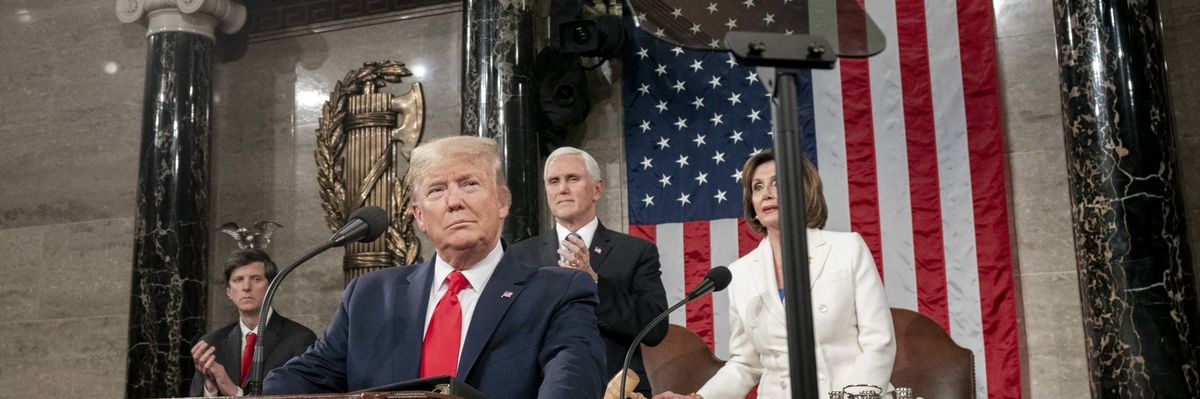
Next, on February 4th, came the State of the Union Address. Resplendent with ritual and ceremony, this event certainly deserves an honored place in the pseudo-event Hall of Fame. This year’s performance was no exception. President Trump bragged shamelessly about his administration’s many accomplishments, planted compliant live mannequins in the gallery of the House of Representatives to curry favor with various constituencies -- hatemongering radio host Rush Limbaugh received the Medal of Freedom from the First Lady! -- even as he otherwise kept pretty much to the model employed by every president since Ronald Reagan. It was, in other words, a pseudo-event par excellence.
The sole revelatory moment came just after Trump finished speaking. In an endearing and entirely salutary gesture, House Speaker Nancy Pelosi, standing behind the president, promptly rendered her verdict on the entire occasion. Like a thoroughly miffed schoolteacher rejecting unsatisfactory homework from a delinquent pupil, she tore the text of Trump’s remarks in two. In effect, Pelosi thereby announced that the entire evening had consisted of pure, unadulterated nonsense, as indeed it had and as has every other State of the Union Address in recent memory.
Blessings upon Speaker Pelosi. Next year, we must hope that she will skip the occasion entirely as not worthy of her time. Other members of Congress, preferably from both parties, may then follow her example, finding better things to do. Within a few years, presidents could find themselves speaking in an empty chamber. The networks will then lose interest. At that juncture, the practice that prevailed from the early days of the Republic until the administration of Woodrow Wilson might be restored: every year or so, presidents can simply send a letter to Congress ruminating about the state of the nation, with members choosing to attend to or ignore it as it pleases them. And the nation’s calendar will therefore be purged altogether of one prominent pseudo-event.
The National Prayer Breakfast, which occurred on February 6th, completes our trifecta of recent pseudo-events gone unexpectedly awry. Here the credit belongs entirely to President Trump who used his time at the dais during this nominally religious event as an opportunity to whine about the “terrible ordeal” he had just endured at the hands of “some very dishonest and corrupt people.” Alluding specifically to Pelosi (and perhaps with Mitt Romney also in mind), Trump denounced his critics as hypocrites. “I don’t like people who use their faith as justification for doing what they know is wrong,” he said. “Nor do I like people who say, ‘I pray for you,’ when they know that that’s not so.”
Jesus might have forgiven his tormentors, but Donald Trump, a self-described Christian, is not given to following the Lord’s example. So instead of an occasion for faux displays of brotherly ecumenism, this year’s National Prayer Breakfast became one more exhibition of petty partisanship -- relieving the rest of us (and the media) of any further need to pretend that it ever possessed anything approximating a serious religious motivation.
So if only in an ironic sense, the first week of February 2020 did end up qualifying as a genuinely historic occasion. Granted, those who claim the authority to instruct the rest of us on what deserves that encomium missed its true significance. They had wasted no time in moving on to the next pseudo-event, this one in New Hampshire. Yet over the course of a handful of days, Americans had been granted a glimpse of the reality that pseudo-events are designed to camouflage.
A few more such glimpses and something like “the facts of life” to which Boorstin alluded so long ago might become impossible to hide any longer. Imagine: No more bullshit. In these dark and discouraging times, aren’t we at least entitled to such a hope?
This article has been republished with permission from TomDispatch.