

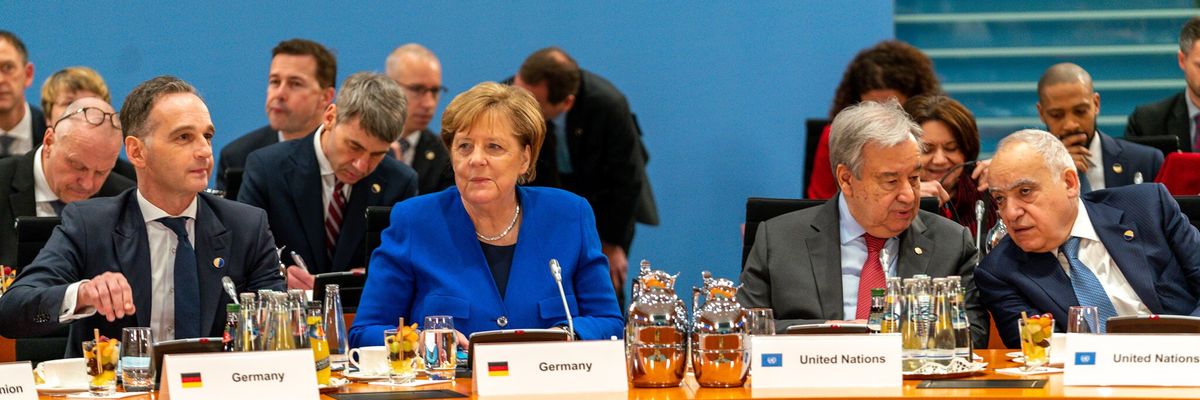
There was one great merit to the 19 January Berlin conference, the latest high-level attempt to de-escalate the nine-month conflict between forces loyal to Libya’s internationally recognised government in Tripoli and those led by Field Marshal Khalifa Haftar. It took place. While failing to produce a ceasefire agreement, it succeeded in bringing together international stakeholders, many of whom have fuelled the war. It also got them to restate core principles, notably the commitment to ending a conflict that has caused over 3,000 deaths and displaced 200,000 Tripoli residents. The next overdue step is for the UN Security Council to pass a resolution calling for an immediate cessation of hostilities and a return to UN-backed, Libyan-led negotiations. But then comes the far larger challenge of turning words into action. Libyan factions and their foreign allies will need to put aside maximalist ambitions and stop seeking on the battlefield what they cannot obtain at the negotiating table. Resuming fighting would turn each side’s stated goal – restoring the Libyan state, for Haftar backers, and ensuring a democratic Libya, for those rallying behind Tripoli – into a chimera, while deepening the population’s suffering.
The conference unquestionably was a step forward. Representatives of the U.S., EU, UK, France, Russia, China, Italy, Germany, Turkey, Egypt, the United Arab Emirates (UAE), Algeria and Congo-Brazzaville, as well as the UN, Arab League and African Union, endorsed a 55-point declaration that commits the signatories to supporting three main goals: “to redouble their efforts for a sustained suspension of hostilities, de-escalation and a permanent ceasefire”; to “unequivocally and fully respect and implement” the UN arms embargo; and to support UN-backed negotiations with military, political and financial tracks. Haftar and Faiez Serraj, prime minister of the Tripoli-based government, were both in Berlin. Neither officially attended the summit or signed the final declaration, but both reportedly agreed to appoint representatives to a joint military commission scheduled to meet in Geneva in late January to discuss a possible ceasefire. That was a change of mind for Haftar, who only days earlier had refused to appoint representatives during a 13 January meeting in Moscow.
Still, translating these various pledges into concrete action will be no easy task. For some signatories, it will mean sharply altering their current stance. The UAE, Egypt and Russia – Haftar supporters – and Turkey, which backs the Tripoli government, will need to stop arms deliveries to Libyan factions and instead press their allies to agree to a ceasefire in UN-led negotiations.
Too, the warring sides have put forward different conditions for reaching a ceasefire. The Tripoli government continues to demand that Haftar’s forces withdraw completely from western Libya as a prerequisite. But Haftar has no intention of retreating from Tripoli’s outskirts, let alone leaving the west. On the sidelines of the Berlin summit he reportedly told foreign leaders that a ceasefire depended on three conditions: the surrender of Tripoli government forces, progress in forming a new government and resolution of outstanding financial disputes. In Haftar’s mind, in other words, the war will stop only if and when negotiations produce tangible outcomes in his favour. Chances are therefore slim that the military commission to which he and Serraj agreed to send representatives will agree on a ceasefire.
Kickstarting a political negotiating track likewise will be fraught with difficulties. The UN intends to begin talks in January to form a new unity government that would replace the internationally recognised cabinet headed by Serraj and unify the country’s institutions, split in two since 2014. To this end, the UN has invited Libya’s rival legislatures – the Tripoli-based High State Council, elected in 2012, and the Tobruk-based House of Representatives, elected in 2014, and which backs Haftar’s campaign – to send thirteen representatives each. These will join fourteen others appointed by the UN in the negotiations. But although politicians in Tripoli originally agreed to take part, they now suggest that they will abstain as long as Haftar’s forces remain outside the capital. As for the House, its president, Aghila Saleh, apparently believes that he can nominate representatives from among the 50 parliamentarians loyal to him (and to Haftar), rather than opening the selection procedure to all House members, including the majority supportive of Tripoli, as the UN wants.
Added to this problem are two others that could frustrate the Berlin conference’s stated goals. First is that pro-Haftar tribal groups have shut down almost all of Libya’s oil terminals and oil fields. The closure began just before the conference and, in the subsequent 48 hours, crude oil production plummeted from 1.2 million barrels per day to fewer than one hundred. This action almost certainly was meant to remind foreign states that Haftar retains control over the country’s oil and gas facilities, which generate almost all the country’s income, even as he enjoys no access to the revenues, which accrue to his Tripoli rivals. His message: the conflict must be resolved in a manner that reflects the actual power balance on the ground, which he views as being squarely in his favour. The Tripoli government saw the closure – and the subsequent absence of foreign criticism – as both a provocation and an unequivocal sign that foreign states are complacent about Haftar’s ambitions. Tellingly, the Berlin conference featured no condemnation of the closures; in subsequent days, a handful of Western states made only timid calls to reverse the measure on humanitarian and financial grounds.
The second issue involves the continued flow of weapons into Libya from the two sides’ foreign backers. Local authorities confirm that dozens of Turkish military officers and up to 2,000 pro-Turkish Syrian fighters have arrived in Tripoli, and that Turkish officers have also installed significant aerial defences in the capital in the wake of the Turkish parliament’s early January authorisation. Turkish officials argue that these deployments aim to create conditions for a ceasefire by rebalancing power on the ground. But they could produce precisely the reverse. While several officials in Tripoli believe that Turkish support could help them launch a counteroffensive, Arab tribes across Libya responded by redoubling their support for Haftar, calling for jihad to thwart Turkey’s “colonial ambitions.” Predictably, Turkey’s increased involvement has provoked the ire of several Arab states, not least Egypt and the UAE, who already back Haftar and view Ankara as a regional rival, heightening prospects of a full-fledged proxy war.
Berlin aside, and against this backdrop, there is a real risk that the war around Tripoli will soon restart, with each side blaming the other for the resumption of hostilities. That may not be apparent in the coming days as a tenuous truce could well hold, despite limited clashes. But Haftar and his backers will continue to demand that the Serraj government capitulate or accept a political roadmap on their terms; the Serraj government will insist that Haftar withdraw his troops from Tripoli’s environs; the UN will struggle to proceed with a political dialogue in which the two rival assemblies are equally represented; and the war, unfortunately, could resume.
To avoid this scenario, a first step would be for the Security Council to rapidly turn the Berlin declaration into a binding resolution calling for a cessation of hostilities and the launch of multi-track negotiations. Signatories should bolster monitoring and enforcement of the arms embargo through more frequent reporting by the UN Panel of Experts assisting the UN sanctions committee as well as reinvigoration of the EU’s maritime Operation Sophia so that it can deploy ships in the Mediterranean (it currently has none) to interdict embargoed arms headed for Libya. Turkey, Egypt, Russia and the UAE should halt any weapons shipment over land or by air while halting all military and logistical activities on the ground. Finally, Libyan factions should accept that ending this war will require all sides to accept less than what they wish for.
If local and foreign actors fail to follow through on promises made in Berlin with concrete action, the fragile progress made thus far will quickly become a distant memory. Libyans, whichever side they may take, will pay the price.
This article was republished with permission from The International Crisis Group.