
Follow us on social

google cta
Reps. Lee, Pocan introduce bill that would trim defense budget by $100 billion

Reps. Lee, Pocan introduce bill that would trim defense budget by $100 billion

People over Pentagon Act would represent largest single-year cut in DoD history

North America
google cta
google cta

Reps Barbara Lee (D-Calif.) and Mark Pocan (D-Wis.) today re-introduced the People over Pentagon Act, a bill that, if approved, would result in the largest single-year DoD budget cut – by $100 billion – in recent memory.

The bill, which was first introduced last June with 22 Democratic co-sponsors, has never been voted on. The two representatives have also offered a number of other bills aimed at trimming defense spending in recent years.  

The Act acknowledges that “many of the most urgent threats to the national security of the United States are not military in nature;” and therefore “the budget of the Department of Defense should be reduced and the associated savings should be reallocated.” The bill also explicitly protects certain provisions in the defense budget, such as the Defense Health Program and military personnel accounts, from cuts, maintaining spending in these programs at the same levels as last fiscal year. 

Instead, the bill will target other areas of massive spending, including funds that go to big arms-manufacturing companies; the current FY 2023 budget alone provides approximately $452 billion to contractors. If passed, the Act could create approximately $1.3 trillion in savings over the next decade, according to 2022 estimates by the Congressional Budget Office. 

“By cutting $100 billion from the defense budget, this bill prioritizes urgent needs like healthcare, education, and infrastructure over padding the pockets of defense contractors,” Pocan said in a statement. “More defense spending does not guarantee safety, but it does guarantee that the military-industrial complex will continue to get richer. We can no longer afford to put these corporate interests over the needs of the American people. It's time to invest in our communities and make meaningful change that reflects our nation’s priorities."

The Pentagon budget continues to grow despite its inability to pass an audit, which it failed for a fifth consecutive time last year. The introduction of this bill comes two weeks after Politico reported that President Joe Biden was preparing to ask Congress for the largest Pentagon budget ever in Fiscal Year 2024. Last December, Congress appropriated $858 billion in national defense funding—$817 billion of which was for the Pentagon – almost $50 billion more than the Biden administration had initially requested and an all-time high in defense spending. The administration’s request for next year  is set to be released on March 9. 

The Act’s co-sponsors call for prioritizing domestic needs over funding weapons systems. “Year after year, this country pours billions into our already-astronomical defense budget without stopping to question whether the additional funding is actually making us safer,” said Lee in a press release. “We know that a large portion of these taxpayer dollars are used to pad the pockets of the military industrial complex, fund outdated technology, or are simply mismanaged.” The Congresswoman further argues that appropriating these funds elsewhere “could do so much good: it could power every household in the US with solar energy; hire one million elementary school teachers amid a worsening teacher shortage; provide free tuition for 2 out of 3 public college students; or cover medical care for 7 million veterans.”


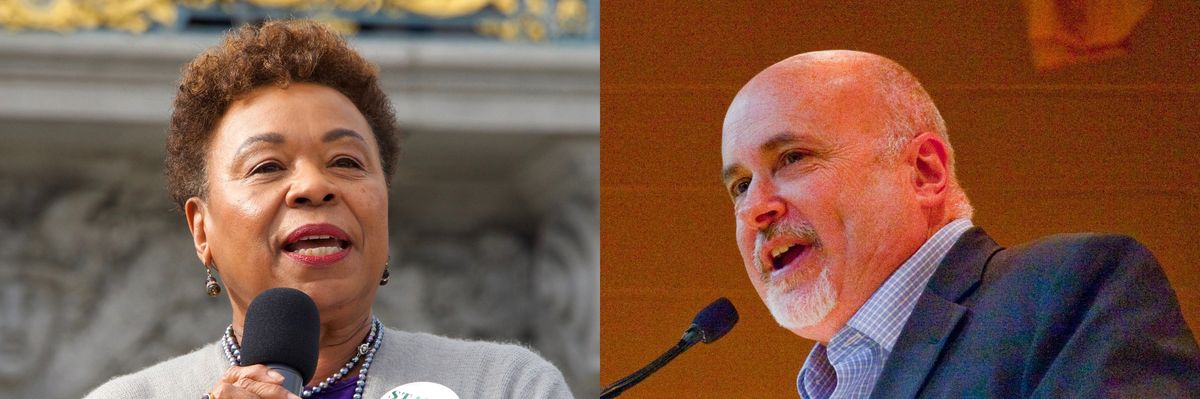
Barbara Lee (Photo: Sheila Fitzgerald via shutterstock.com) and Mark Pocan (Photo: Charles Edward Miller)|Photo: Charles Edward Miller|Barbara Lee (Photo: Sheila Fitzgerald via shutterstock.com) and Mark Pocan (Photo: Charles Edward Miller)
google cta
North America
Trump and Lindsey Graham
Top photo credit: U.S. President Donald Trump, with Secretary of Commerce Howard Lutnick and Senator Lindsey Graham (R-SC), speaks to reporters aboard Air Force One en route from Florida to Joint Base Andrews, Maryland, U.S., January 4, 2026. REUTERS/Jonathan Ernst

Does MAGA want Trump to ‘make regime change great again’?

Washington Politics

“We must abandon the failed policy of nation building and regime change that Hillary Clinton pushed in Iraq, Libya, Egypt and Syria,” then-candidate Donald Trump said in his acceptance speech at the Republican National Convention in 2016.

This wasn’t the first time he eschewed the foreign policies of his predecessors: “We’re not looking for regime change,” he said of Iran and North Korea during a press conference in 2019. “We’ve learned that lesson a long time ago.”

keep readingShow less
Toxic exposures US military bases
Military Base Toxic Exposure Map (Courtesy of Hill & Ponton)

Mapping toxic exposure on US military bases. Hint: There's a lot.

Military Industrial Complex

Toxic exposure during military service rarely behaves like a battlefield injury.

It does not arrive with a single moment of trauma or a clear line between cause and effect. Instead, it accumulates quietly over years. By the time symptoms appear, many veterans have already changed duty stations, left the military, moved across state lines, or lost access to the documents that might have made those connections easier to prove.

keep readingShow less
Iraq War memorial wall
Top photo credit: 506th Expeditionary Security Forces Squadron, paints names Nov. 25, 2009, on Kirkuk's memorial wall, located at the Leroy Webster DV pad on base. The memorial wall holds the names of all the servicemembers who lost their lives during Operation Iraqi Freedom since the start of the campaign in 2003. (Courtesy Photo | Airman 1st Class Tanja Kambel)

Trump’s quest to kick America's ‘Iraq War syndrome’

Latin America

American forces invaded Panama in 1989 to capture Manuel Noriega, a former U.S. ally whose rule over Panama was marred by drug trafficking, corruption and human rights abuses.

But experts point to another, perhaps just as critical goal: to cure the American public of “Vietnam syndrome,” which has been described as a national malaise and aversion of foreign interventions in the wake of the failed Vietnam War.

keep readingShow less
google cta
Want more of our stories on Google?
Click here to make us a Preferred Source.

LATEST

QIOSK

Newsletter

Subscribe now to our weekly round-up and don't miss a beat with your favorite RS contributors and reporters, as well as staff analysis, opinion, and news promoting a positive, non-partisan vision of U.S. foreign policy.