

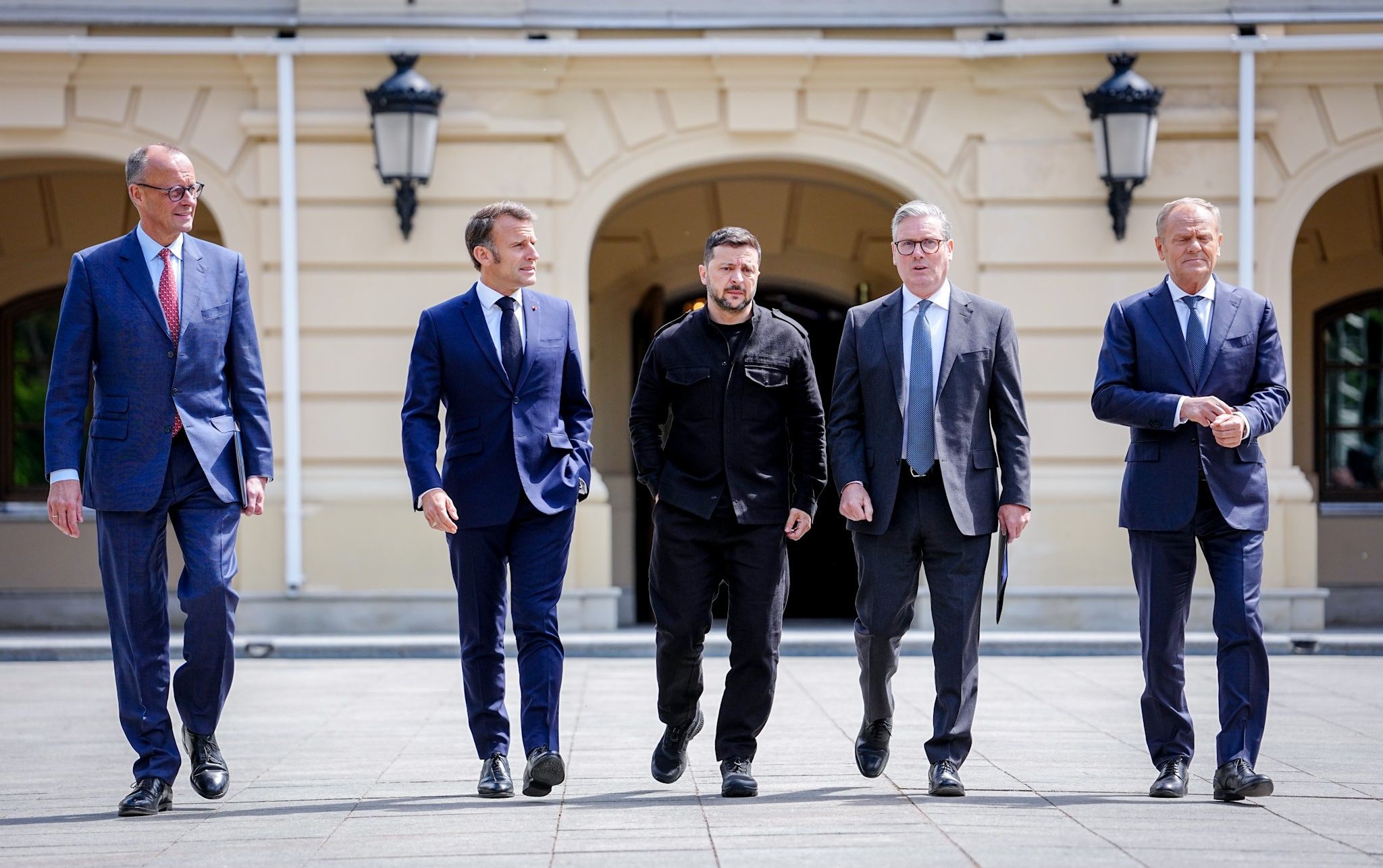
After last week’s meeting of the “coalition of the willing” in Paris, 26 countries have supposedly agreed to contribute — in some fashion — to a military force that would be deployed on Ukrainian soil after hostilities have concluded.
Three weeks prior, at the Anchorage leaders’ summit press conference, Russian President Vladimir Putin noted that Ukraine’s security should be ensured as part of any negotiated settlement. But Russian officials have continued to reiterate that this cannot take the form of Western combat forces stationed in Ukraine. In the wake of last week’s meeting, Putin has upped the ante by declaring that any such troops would be legitimate targets for the Russian military.
The question remains why European leaders persist with plans that, if implemented, risk putting them directly at war with the world’s largest nuclear power. The answer appears concerning.
One possibility is the credibility of Russian pronouncements. Putin engaged in nuclear signalling earlier in this war — most notably when the full-scale invasion was launched and again after facing military setbacks in the autumn of 2022. Although such signals may have succeeded in deterring the West from intervening directly in the war, the perception that Western countries could transgress supposed Russian red lines without incurring a nuclear response may have diminished the deterrent power of subsequent threats.
Another is the West’s longstanding normative approach to questions of security in Europe since the end of the Cold War. This view, expressed just days ago by NATO Secretary General Mark Rutte, insists that Moscow can have no veto over Kyiv’s sovereign right to accept foreign troops on its soil. The right of states to choose their own security arrangements freely, a principle outlined in the Charter of Paris that marked the de facto end of the Cold War, is often cited in support of this worldview.
Of course, the citing of principles at one another did little to stop Russia from taking matters into its own hands in February 2022. Previous efforts to deny Russia a veto on principle, such as the 2008 NATO Bucharest summit at which Ukraine and Georgia were invited to join the alliance, foreshadowed Russia’s invasion of Georgia just months later. Staunch defenders of the “right to choose” also conveniently ignore the principle of indivisible security, also found in the Paris Charter, asserting that no state should take measures to increase its own security at the expense of another state’s security. They also de-emphasize the fact that Ukraine’s eventual NATO membership is primarily a matter for existing NATO members, and not Kyiv, to decide.
These considerations aside, what is the strategic thinking behind the European approach?
Despite proposals to the contrary by some, any reassurance force would only be deployed to Ukraine after the war has ended. So unless plans currently under consideration are meant to be a mere opening salvo in negotiations with Moscow, insisting that a Western military presence on Ukrainian soil will emerge as soon as a ceasefire takes hold provides Russia with every incentive to continue fighting to prevent such an outcome from materializing. Therefore, continued insistence that such a force will take shape in the face of repeated Russian objections suggests that European calls for a ceasefire are not entirely genuine.
Indeed, European leaders did not voice their support for ending the war before Donald Trump assumed office — they only began doing so once Trump had cajoled Ukrainian President Volodymyr Zelensky into calling for a 30-day unconditional ceasefire, leaving them with little option but to fall in line given Europe’s heavy dependence on the U.S. for its security. (Since Russia will never accept an unconditional ceasefire before its political objectives have been met, calling for one also serves the tactical purpose of painting Moscow — not altogether unfairly, of course — as the main obstacle to peace.)
With these facts in mind, European calls for a ceasefire appear to be rooted not in conviction but rather convenience. The real purpose of the coalition’s ongoing plans for a postwar troop deployment to Ukraine may be to sabotage the possibility of successfully negotiating an end to the war. This would fit with other aspects of the current European approach, for example threatening more sanctions against Russia but not putting forward any realistic offer of sanctions relief as an incentive.
This conclusion should not be surprising. Although Ukraine may be gradually losing on the battlefield, today’s European elite largely believes that a “bad deal” to end the war would be worse than the war continuing.
Perhaps Europeans believe that Ukraine will be able to hold the line long enough for Russian casualties to mount and the Russian economy to melt. Or perhaps they fear the perceived loss of status that may flow from a climbdown and compromise peace with Russia. More cynically, even if Russia breaks through Ukrainian lines, this could strengthen European unity and finally get European publics on board for higher defense spending — and Moscow will not be able to rule a restive Ukraine in any event.
European leaders should think twice before doubling down on this logic. The recently announced memorandum of understanding on the Power of Siberia 2 pipeline, if implemented, could consolidate Russia’s pivot to China over the long term by shipping gas from Western Siberia which might otherwise have been destined for European markets. Besides the risks of military escalation, a prolonged war and the attendant rupture in economic relations between Russia and the rest of Europe could breed strategic consequences that are not yet set in stone — and would best be avoided.
Russia will be an adversary of the collective West for the foreseeable future. But succeeding in a multipolar world requires creating the strategic space to engage with all power poles at least to some degree. A world of rigid blocs need not be a self-fulfilling prophecy — and would undermine the survival of a “rules-based international order” to a much greater extent than deferring disagreements over Ukraine’s territorial integrity and beginning the arduous task of rebuilding a shared sense of security in Europe.
- The flimsy UK, France, Ukraine 'peace plan' discussed Sunday ›
- Ukraine and Europe can't afford to refuse Trump's peace plan ›
- Europeans shouldn't throw out the truck with the diesel deal | Responsible Statecraft ›