

As tensions with China escalate on earth amid tariff woes and naval clashes, lawmakers in Capitol Hill are pushing for them to escalate further — in space, perhaps even militarily.
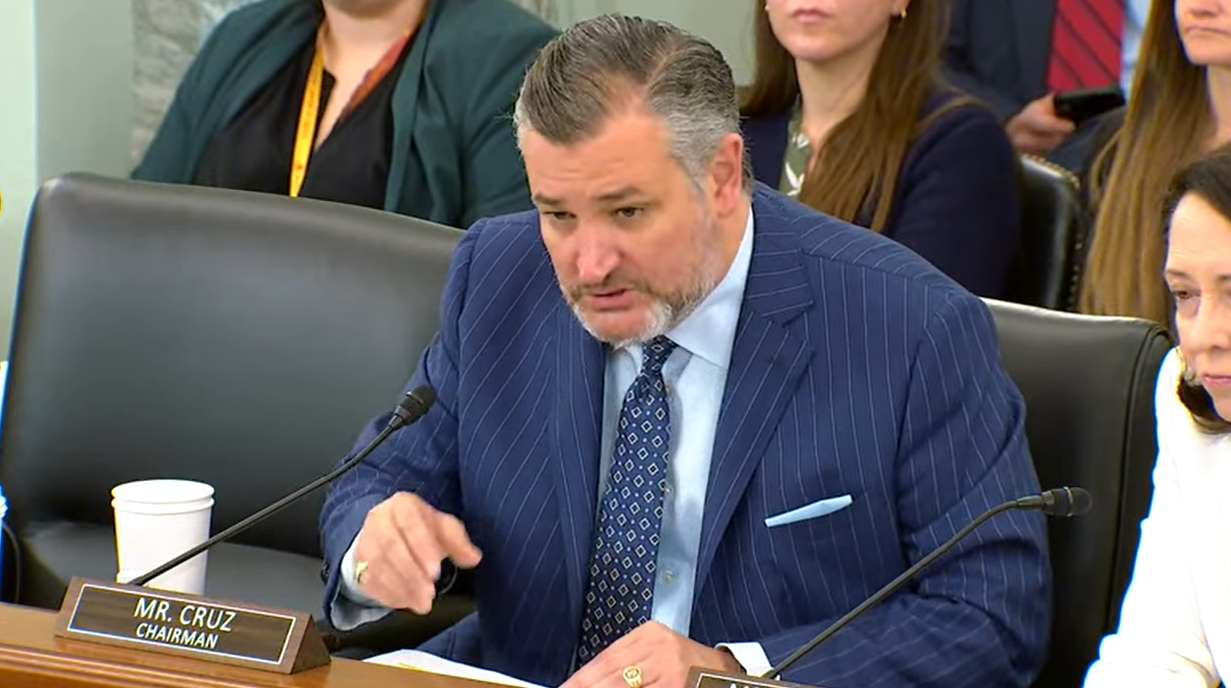
Indeed, lawmakers and witnesses alike fearmongered about China’s space activities at a U.S. Senate Committee on Commerce, Science, and Transportation hearing Wednesday entitled “There’s a Bad Moon on the Rise: Why Congress and NASA Must Thwart China in the Space Race.”
Certainly, China has made moves to explore and utilize space. It has plans to carry out multiple space missions this year, and more than 30 by mid-century. Working with Russia, it also aims to build a lunar space base by 2035.
China has also tested anti-satellite missiles in space: they stress these tests ensure defensive capacities; at the same time, the U.S. claims Beijing has been testing weapons. Nevertheless, Chinese officials frequently speak out against the weaponization of space, stressing the realm must be shared.
But witnesses at Wednesday’s hearing, which included lawmakers, but also representatives from the commercial space and defense industries, and NASA, described China’s advances in space as an inherent threat. They portrayed space domination as a necessity for Washington, rather than a tenuous bid for power over a domain generally understood to be free for all countries to explore and use peacefully.
“If our adversaries achieve dominant space capabilities, it would pose a profound risk to America. This is not just about exploration. The choices we make now will determine whether the United States leads in space or cedes it to an authoritarian regime,” Sen. Ted Cruz (R.-Texas), a self-proclaimed China hawk, said.
“China would love to go dominate the communication system between space and the moon. That’s what they’re already working on,” Sen. Maria Cantwell (D-Wash.) likewise claimed. “We can’t allow that to happen.”
Witness Mr. Michael Gold, former-NASA official-turned executive at Redwire, a space-focused defense tech company, was only eager to stoke lawmakers’ fears to these ends. Here, he stressed U.S. space dominance over China was crucial for access to space-based resources, and for geopolitical posturing key to maintaining might on earth.
“The countries and companies that control the moon will control the Earth…Rare earth elements, helium three, we need to be able to extract these resources [present there],” he said. "If China lands on the moon, we’ll see tremendous benefits to China geopolitically, where our allies turn to them: not only for space exploration, but for national security agreements, for trade agreements.”
Along similar lines, another witness, Allen Cutler, President and Chief Executive Officer of the Coalition for Deep Space Exploration, said China wanted to control some of the moon. He urged that without further U.S. space exploration efforts, “We risk ceding the moon to China, a nation working diligently to land before we return [to the moon], and looking to establish control over key lunar regions and resources.
“Their intent is clear,” he added. “Their progress is real, and time is not on our side. This is a race that the United States cannot afford to lose.”
And witnesses were sure to get their two cents in on China’s supposed warfighting capabilities in the domain: they portrayed them as a threat, even while alleging China simply copied already-existing U.S. spacefighting capabilities.
“From a purely military perspective, what we have seen China do over basically the last couple decades is look at what we've done in space for our war fighters…they have developed capabilities to deprive us of our space assets, and [that’s] why they have built and deployed space weapons,” Lieutenant General John Shaw, Former Deputy Commander of the U.S. Space Command.
China “built their own space capabilities, mirroring ours, to enable their warfighting,” he said.
Rather than meaningfully ponder how to diplomatically engage adversarial nations regarding space, speakers responded to the threats witnesses say China poses by calling for measures that might further militarize the domain.
To this end, Shaw said the DoD could coordinate with NASA to better understand, or even monitor, the lunar-orbital environment surrounding earth, thus bolstering its presence in that realm. “If there's a national need to do it, why not have the Department of Defense perhaps be part of that solution, and develop the capabilities it's going to ultimately need anyway?,” he asked.
Meanwhile, Sen. Tim Sheehy (R-Minn.), advocated for the controversial Golden Dome project, which would carry out Israel’s Iron Dome missile defense system concept in the U.S., and might be based partially in space. He also called to bolster other defense-forward space architecture, like interceptors, which can target missiles.
“We're incredibly vulnerable from our communications and navigation-based orbital infrastructure,” Sheehy said. “It’s best as we look at Golden Dome, and space-based interceptors…we need to make sure we're hardening our space infrastructure, because it's pretty vulnerable.”