

Today, there is no all-out war, no peace, and no light at the end of the Strait of Hormuz. The Trump administration’s crack at transforming Iran is drifting along in the Persian Gulf, as on-again, off-again negotiations fail to resolve a conflict that has roiled the global economy while the president’s approval ratings plunge.
Meanwhile, the Gaza Peace Plan is sinking, too, leaving ordinary Palestinians in a state of abject misery amid the rubble and tent cities of Gaza, cowering from Israeli air strikes that have killed more than 1,200 people since a “ceasefire” went into effect in Oct. 2025.
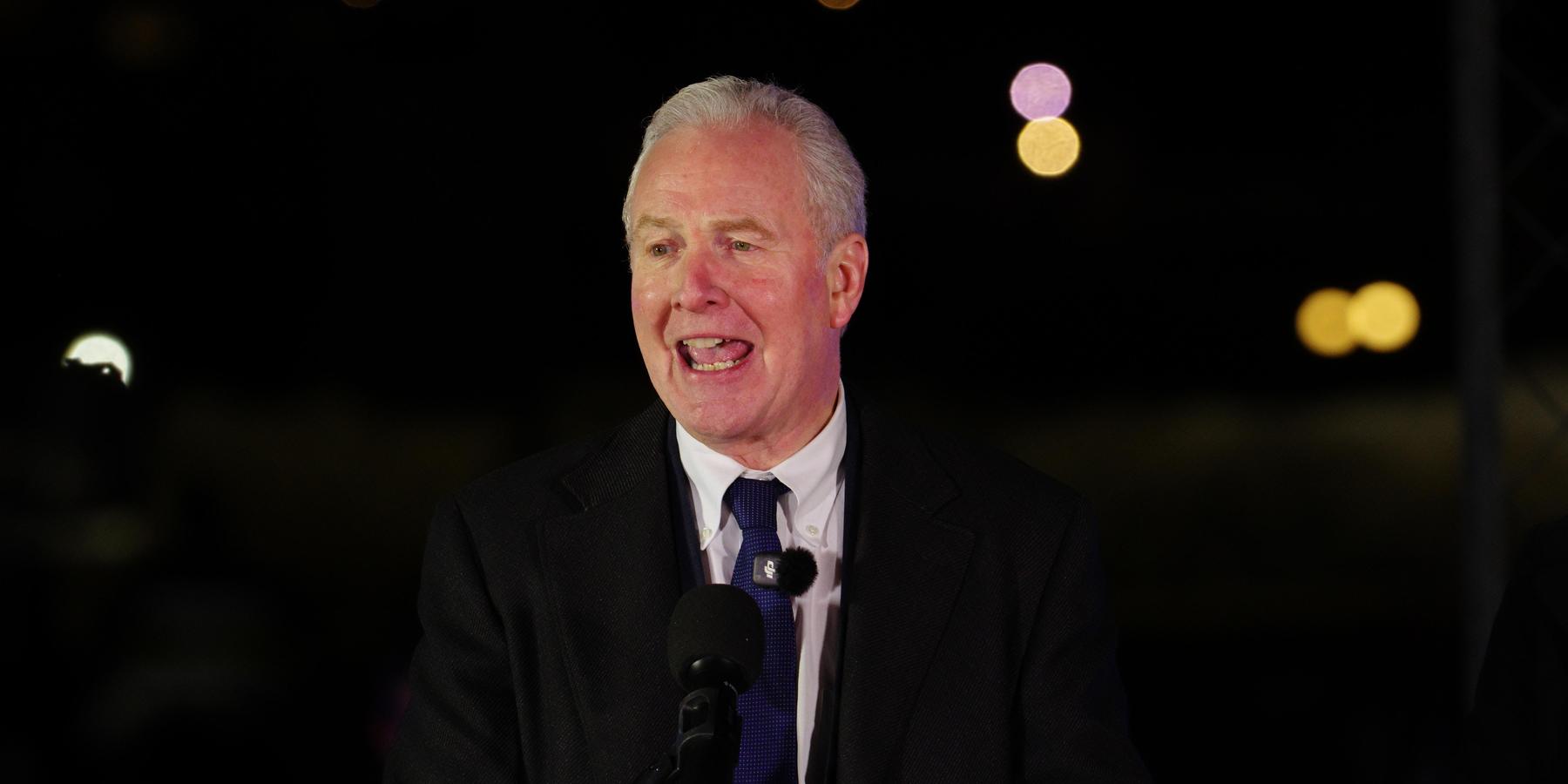
To assess whether there’s a way out of these dismal situations, Responsible Statecraft spoke to Sen. Chris Van Hollen (D-Md.), a potential 2028 presidential candidate who is known for being one of the Senate’s most vocal critics of Israeli conduct and of AIPAC’s influence on the Congress.
This is a partial transcript of Van Hollen’s podcast interview with Martin Di Caro, edited for length and clarity. You can listen to the full conversation on the History As It Happens podcast here.
Martin Di Caro: Let's begin with the Iran war. In June, the House and Senate passed a concurrent War Powers resolution. It directed the president to remove U.S. forces from hostilities. The administration says it does not have to abide by the vote because of the ceasefire, which it says reset the 60-day withdrawal clock.
Is the War Powers Act of 1973 irreparably broken?
Sen. Van Hollen: Well, it's very damaged. Donald Trump has really shredded its provisions and done so with the complicity of Senate Republicans. Our constitutional framers believed that, by setting up a separate branch of government with its own powers, including the power to declare war, that as an institution Congress would protect its prerogatives. But now we have a Republican Party that is just a rubber stamp for Donald Trump… It's my strong view that this was an illegal war when Donald Trump started it and it is an illegal war now as he continues it in violation of the concurrent War Powers resolution.
Di Caro: What other means does Congress have at its disposal to stop an unnecessary war?
Van Hollen: Ultimately, Congress has to use its power of the purse. I've been very clear: not one penny for this illegal war. As you know, the administration has asked for a supplemental of around $70 billion. My view is Congress should not appropriate those funds because by doing so, we'd be giving consent and approval to an illegal war retroactively. So it's very important that we hold the line and not provide that funding. We're also expending munitions at a tremendous and expensive rate. That's another constraint potentially on the administration's continuation of the war, at least at the [prior] intensity level.
Di Caro: One more question about the War Powers Act and Congress's failure going back decades to restrain the executive. For example, the Libya intervention under Barack Obama in 2011. The United Nations did authorize NATO intervention there to protect civilians, but when Congress challenged President Obama about the 60-day withdrawal clock — this was in June 2011 — Harold Koh, a legal adviser at the State Department, testified on Capitol Hill.
He said, “As everyone recognizes, the legal trigger for the automatic pullout clock — hostilities — is an ambiguous term of art that is defined nowhere in the statute. The legislative history which we cite makes clear there is no agreed upon view of exactly what the term hostilities would encompass. Nor has that standard ever been defined by any court or by Congress itself.”
I have a two-part question. What do you make of that statement 15 years on? And do you regret voting in support of the Obama intervention in Libya?
Van Hollen: No, to [answer your] second point, and here's why. I recognize this is a very gray area in certain instances. And the Libya circumstances were a gray area. Iran is not a gray area. Not one bit. We've obviously lost 18 service members. There's no question about whether or not we're engaged in hostilities in Iran.
In the case of Libya, as you know, in addition to the U.N. resolution and NATO's involvement, the Arab League also urged the United States to support the effort as part of a coalition to prevent what was viewed as an imminent massacre of hundreds of thousands of people. And it was exclusively air power. So I do recognize that it was a murky area, but my view was that for the limited period that the Obama administration was engaged in that action, with the support of both the U.N. and the Arab League, the administration's argument was sound. At least it wasn't frivolous. Let's put it that way. Whereas in the case of the Iran situation, the Trump administration's argument is plainly frivolous.
Di Caro: In Libya, it started with good intentions, but there was mission creep and it ended up a regime change operation after President Obama had said he would not [seek that outcome] militarily. And ultimately Libya became a failed state. Maybe it would have been a failed state without U.S. intervention, but I think Libya is an important example in this long story of how we got here today.
Van Hollen: I agree that it resulted in mission creep. No doubt about it. You asked me about the original justification, but if you're looking at the results, on the one hand, it was successful at preventing a mass slaughter, and I think that's obviously a good thing. On the other hand, as you say, the mission did seem to evolve and resulted in the toppling of Gaddafi, and Libya became a failed state. So, I'm not suggesting the Libya operation was an ultimate success. I do think it was a limited success with respect to its original purpose.
Di Caro: Let's move on to Israel now. You wrote an op-ed in the New York Times calling on Democrats to reckon with their failure to use U.S. leverage to restrain Israel's conduct. Some former members of the Biden administration have recently come under intense public scrutiny for not conditioning aid to Israel as it was destroying Gaza. Yet today, U.S. weapons and U.S. manufactured bulldozers keep flowing to Israel. Why is that?
Van Hollen: It's because we still haven't mustered enough votes to stop it. We've made gains. I remember in the March-April period of 2025 when there was a full blockade of all food and humanitarian assistance into Gaza that lasted almost 80 days. We had about 17 votes or thereabouts in the Senate to prevent the transfer of U.S. weapons to the Israeli government. In a more recent vote, we were able to secure 40 Democratic senators to block weapons and bulldozers. So, the trend is in the right direction, at least on the Democratic side. Now, on the Republican side, you have a continued blank check to the Netanyahu government regardless of the conduct of Israel, whether in Gaza or the West Bank.
So I guess the answer to your question is there's growing sentiment that United States taxpayers should stop providing a blank check to Israel. My view is that any offensive weapons should also be conditioned on withdrawal of the Israeli occupation in the West Bank, according to an agreed upon timetable.
Di Caro: You've been one of the more vocal senators criticizing Israel. I often wonder if privately your colleagues in the Senate voice those same opinions, but they're afraid to say them publicly.
Van Hollen: The short answer is yes, that is very true. Mine was a lonely position a number of years ago. In fact, before the war in Gaza, I was very focused on trying to end the Israeli occupation of the West Bank and to use [U.S.] leverage to do so. I had colleagues even then who agreed with me privately, but it was politically inconvenient for them to agree openly.
And then with the war in Gaza, people have witnessed the horrendous destruction, what human rights organizations, historian Omer Bartov, and others have concluded is genocide. They have the right analysis. So, more and more of [my] colleagues are finally waking up to the idea that providing a blank check to the Netanyahu government is undermining our security in the region and undermining our position around the world.
Di Caro: It's not unusual for Congress to trail public opinion. That was the case during the Vietnam War. The public turned against the war before a majority in Congress did. But across the political spectrum now, especially among younger voters — left, center, and right — they have soured on U.S. support for Israel. Why are some of your Senate colleagues still afraid to vote against Israel? Is it as simple as AIPAC or is there more to it?
Van Hollen: The number one driver is politics here in the United States. It’s AIPAC. AIPAC has traditionally been a very strong political player. They weigh into elections. Look, we've just witnessed them putting $30 million into the race against Abdul El-Sayed [in the Michigan Senate race]. They’re involved in many other races. They've shown a willingness to use their political muscle to defeat any candidate that doesn't support unconditional aid to Israel. Now, their position is obviously weakening among Democrats. And there are a lot of other groups in this space, including other prominent Jewish political organizations like J Street, that take a very different position. But AIPAC has been the biggest player, and that is why Congress remains largely in a bubble on this issue, although the bubble is being pierced here and there.
Di Caro: Is U.S. hegemony waning and is that such a bad thing for the rest of the world?
Van Hollen: I would say two things are happening. One is that complete U.S. dominance is certainly waning. We've seen the ongoing rise of other powers, China being the biggest one.
Di Caro: Primacy. You're referring to primacy?
Van Hollen: Yes, I'm talking about the U.S. being an unchallenged leader. What it means, though, is other countries do need to take on more responsibility for their collective defense. I will say that the Trump administration has completely shredded and destroyed U.S. credibility. We used to be a champion for international law and the rules-based order — I would say a very imperfect one. I'm well aware of that, and the Biden administration did a lot of damage in that regard, with respect to not applying international law in the case of Gaza, for example. The Trump administration has just abandoned [international law] altogether. It’s in the United States interests to again work to adhere to a rules-based order internationally. There's a lot of repair work to be done there.
Di Caro: To me, this often comes down to the ability to recognize the limits of power... To those of us who’ve been arguing for a more restrained U.S. foreign policy, the primacists don't understand the limits of power — even though we're seeing it everywhere today, and not just with the United States.
Van Hollen: Well, I think you're right. I think your analysis is spot on. What we're witnessing in Iran is Exhibit A of the limits of power. Donald Trump thought he could go into Venezuela, grab Maduro, and in a short period of time he can do whatever he wants anywhere in the world. Obviously that's just not true. So we need to reassess the huge military footprint we have around the world.
- Israelis don't pay for the weapons we 'sell' to them — US taxpayers do ›
- Did the US only attack Iran because of Israel? ›
- How Congress gave up its power over war and peace ›