

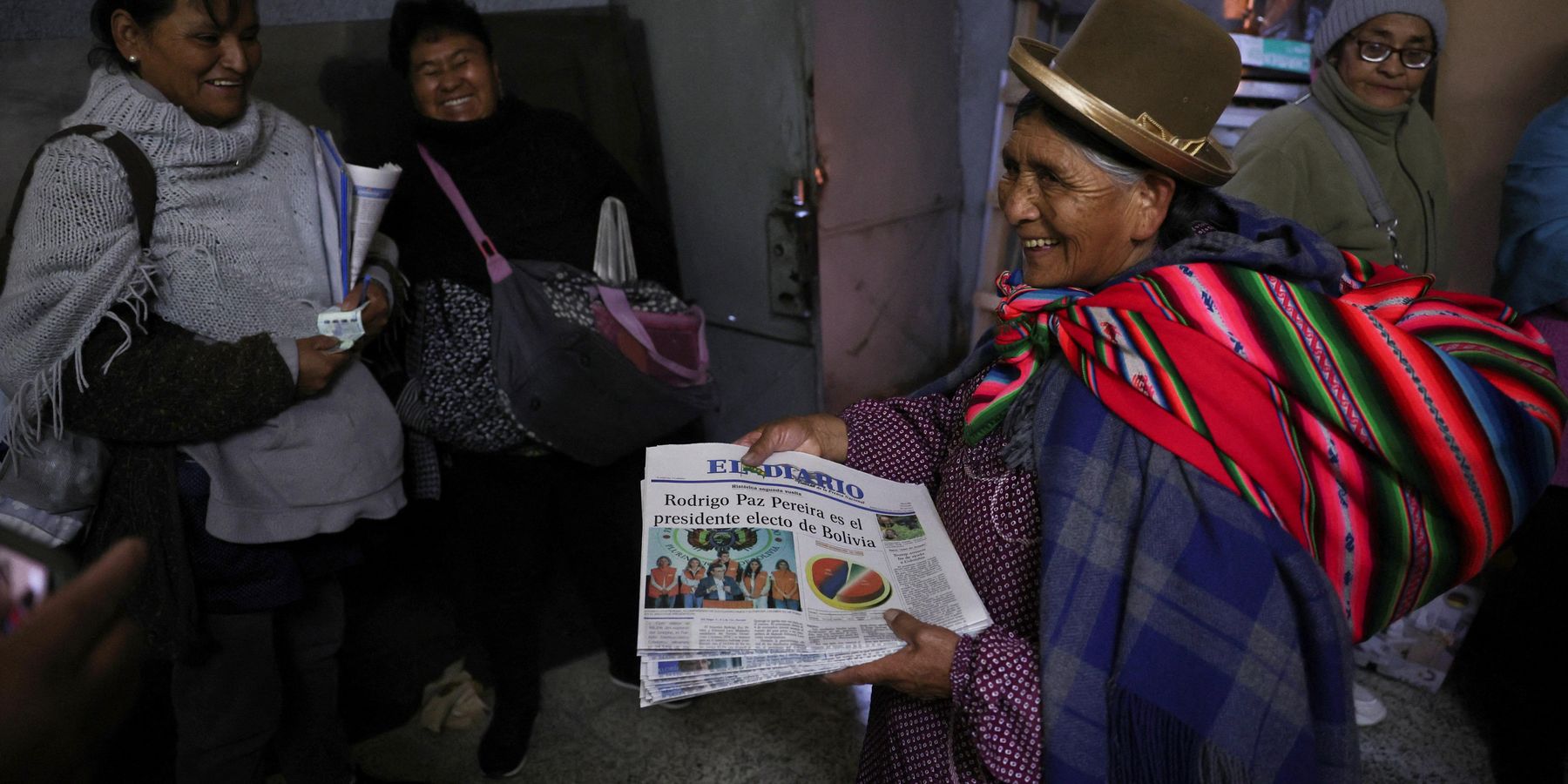
Bolivia has elected centrist Rodrigo Paz as its new president, marking the country’s most significant political shift in nearly two decades.
After a runoff on Sunday, Paz won 54.5 percent of the vote, ending the long dominance of the left-wing Movimiento al Socialismo (MAS) and signaling a return to pragmatic diplomacy after years of ideological polarization.
Paz’s victory was an immense shock even in Bolivia. Until the first round, he had been polling at around seven percent and was dismissed by nearly all analysts as a minor, unknown candidate. I also did not include him in my pre-first-round analysis in August. Yet, when ballots were counted, he captured roughly a third of the vote, entering first place and heading to the runoff.
That upset exposed a chronic weakness in Bolivian polling; surveys rarely capture sentiment in poor rural areas where data collection is difficult. Unlike his rivals, Paz focused his campaign on those overlooked communities, especially Indigenous groups disenchanted with MAS’s unfulfilled promises. He promised “capitalism for all” at a time of historic monetary, economic, and energy crises, and it paid off.
Many voters, fearful that deep subsidy cuts would follow a right-wing victory, saw Paz as a centrist capable of combining market openness with social stability. His opponent, former president Tuto Quiroga, campaigned on “chainsaw, machete, and scissors” austerity, closeness with the West, and vowed to “eliminate socialism once and for all,” a message that seemed to alienate lower-income and more progressive voters.
Since 2006, Bolivia’s relations with the United States had deteriorated under successive socialist governments. Evo Morales expelled the U.S. ambassador and the Drug Enforcement Administration in 2008, as well as USAID in 2013, accusing them of “conspiring” against his government. Also in 2013, Western countries forced Morales’s presidential plane to reroute and land on suspicion that U.S. intelligence whistleblower Edward Snowden was on board.
Those actions marked a definitive break with Washington and a pivot toward China, Russia, and Iran, which filled the void through energy, infrastructure, and security partnerships. They have been key partners for La Paz since.
A brief exception came during the interim rule of Jeanine Áñez in 2019-2020, following what many called a coup. Backed by the Trump administration, Áñez restored ties with the U.S. and Israel, reopened cooperation with Israeli defense contractors and intelligence, and adopted a fiercely anti-communist posture. Her government, however, was marred by allegations of police repression and extrajudicial killings of protesters. She is now in jail for orchestrating a coup in 2019, and was charged with genocide, terrorism, and crimes against humanity.
When MAS returned to power under Luis Arce, Bolivia once again froze U.S. relations. Arce’s term was defined by inflation, fuel shortages, and mounting corruption scandals; he ultimately declined to seek re-election, clearing the path for Paz’s rise.
Paz studied at American universities, spoke at Johns Hopkins SAIS, Harvard’s Kennedy School, and the Wilson Center, and attended a U.S. lithium industry conference earlier this year during his campaign. Paz also met with officials from the IMF, IDB, and World Bank during his campaign. Bolivia currently has multi-billion-dollar lithium exploitation deals with China and Russia, as well as pilot projects with American company EnergyX, all of which have been marred by controversy and lagging progress.
During his visits, he met with several prominent Bolivian academics and policy experts living in the United States, including Diego von Vacano, a former lithium advisor to both Evo Morales and Luis Arce, now a Professor at Texas A&M University and a Global Fellow at the Wilson Center. Von Vacano, who has long advocated for transparent and nationally beneficial lithium policies, has expressed optimism about Paz’s government and its early signals of balancing economic modernization with social inclusion.
Such meetings have reassured segments of the Bolivian diaspora and academic community that Paz’s presidency may represent a pragmatic break from ideological polarization without a return to neoliberal excesses.
His father, Jaime Paz Zamora, governed from 1989 to 1993 and maintained close relations with Washington, extraditing former interior minister Luis Arce Gómez (not related to the current Bolivian president) to the U.S., introducing privatization laws, and pursuing free-trade policies unprecedented in Bolivian history. The elder Paz was also a rival of General Hugo Banzer, the 1971 dictator installed with CIA support under the “Banzer Plan” to protect U.S. interests and “Christian civilization” during the Cold War.
Rodrigo Paz has pledged to rebuild ties with the United States based on “equality, not dependency.” His vice president-elect, Edmand Lara (better known as Capitán Lara due to his background as a former police officer fighting corruption), has called for “Bukele-style” efforts against narcotrafficking, while Paz has proposed legalizing marijuana and refocusing enforcement on large-scale trafficking and money-laundering.
Early signals suggest he may restore cooperation with the DEA, reopen technical discussions with the IMF, and gradually reform the energy sector. Facing crippling fuel shortages and unsustainable subsidies, he is expected to invite foreign, particularly U.S., investment into Bolivia’s oil, gas, and lithium industries, and privatize those sectors.
The previous government’s deals with Russian and Chinese companies may be reviewed amid threats of secondary U.S. sanctions, and plans to import Venezuelan oil and gas will likely be scrapped. The new president’s biggest challenge will be managing this realignment without alienating key partners in the Global South.
China is now Bolivia’s second-largest trading partner after Brazil, accounting for four times the export volume and double the imports of the U.S. Paz will likely maintain economic cooperation with Beijing and participation in BRICS projects, even as he re-opens channels with Washington.
He also faces decisions on sensitive foreign policy fronts, whether to restore diplomatic relations with Israel and distance Bolivia from Iran, with which the previous administration signed cooperation agreements. Israel’s Foreign Minister has already called for a renewed relationship.
Still, both Paz and his advisers insist Bolivia will pursue “pragmatic multipolarity”, a term now gaining currency across the region. Paz will also have to navigate persisting fears of U.S. interference, dating from the Cold War and reignited with the 2019 election, while pursuing his foreign policy goal of increasing pragmatic cooperation with the U.S.
His philosophy resonates with a new model for Latin America in which the United States is included as an equal partner but no longer as the dominant force able to dictate terms or bully its way into influence. This vision accepts that Latin American nations can simultaneously cooperate with Washington, Beijing, and other partners without ideological alignment to any one camp.
The U.S. State Department has already congratulated Paz and expressed optimism about renewed cooperation in “ending illegal immigration, improving market access for bilateral investment, and combating transnational criminal organizations to strengthen regional security.”
For Bolivia, this is an opportunity to stabilize its economy and re-enter global markets while maintaining autonomy. Whether Paz can navigate this delicate foreign policy remains to be seen, but he faces critical tests as he awaits inauguration on November 8.
- Venezuela regime change means invasion, chaos, and heavy losses ›
- Bolivia elections could signal final break with Evo Morales era ›