

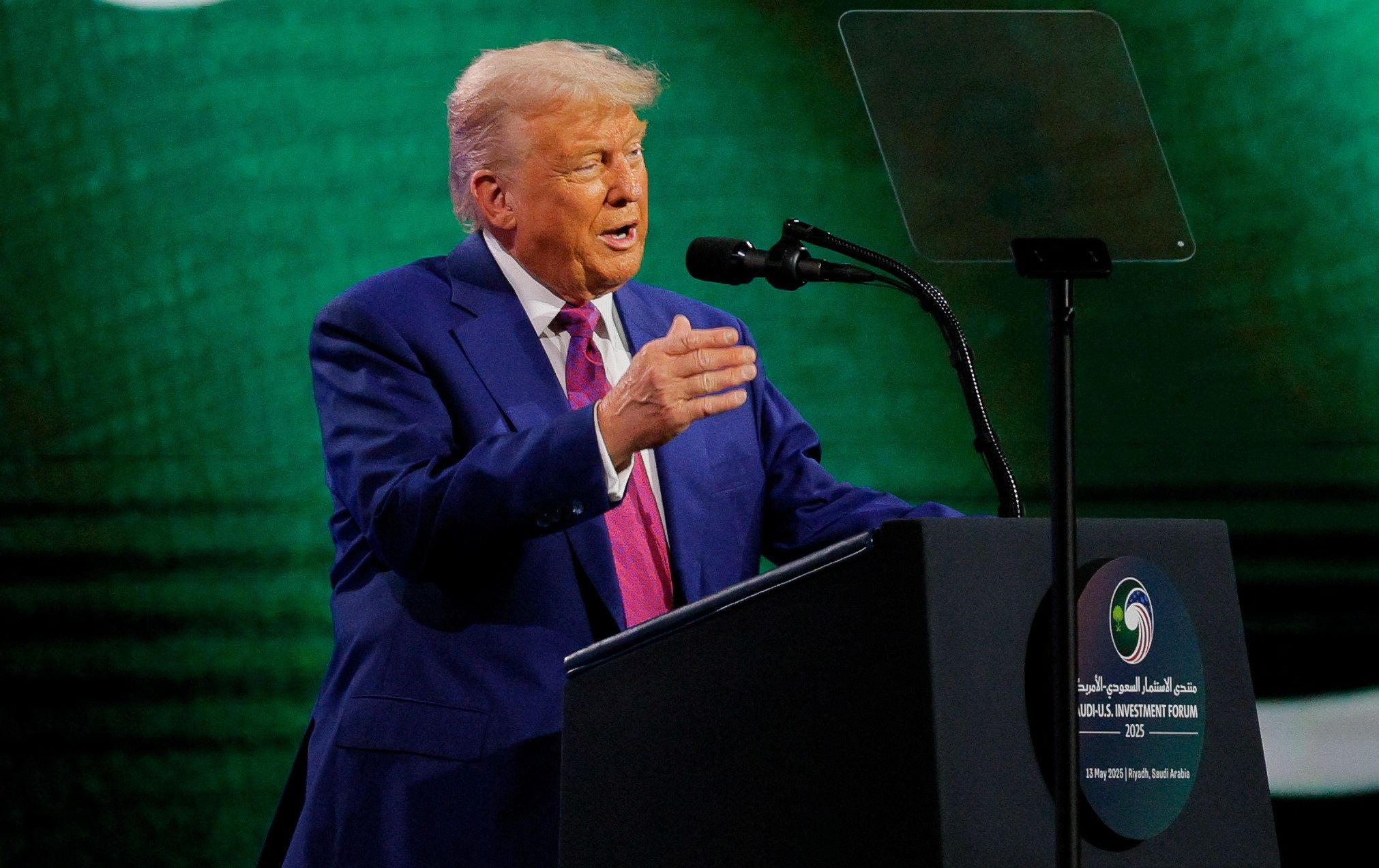
President Trump kicked off his Gulf tour this week in Saudi Arabia by delivering a speech at the Saudi Arabia Investment Forum on Tuesday, in which he announced the lifting of U.S. sanctions on Syria.
Then on Wednesday morning, local time, he met briefly with Syria's President Ahmed al-Sharaa on the sidelines of the regional summit — the first such meeting of Syrian and American leaders in 25 years.
"After discussing the situation in Syria with the Crown Prince [Mohammed bin Salman (MbS)] and also with President [Recep Tayyip] Erdogan of Turkey, who called me the other day and asked for a very similar thing ... I will be ordering the cessation of sanctions against Syria in order to give them a chance at greatness," declared Trump on Tuesday to his audience, which responded with a standing ovation.
Describing the U.S. sanctions as “brutal and crippling,” Trump went on to say that now is the time for the Syrians “to shine” and he wished the war-torn country “good luck.”
Implemented in mid-2020, the Caesar Syrian Civilian Protection Act (a.k.a. the Caesar Act) constitutes the most stringent U.S. sanctions ever imposed on Syria. These derivative sanctions have been strangling the Syrian economy, both before and after Bashar al-Assad’s fall. The lifting of U.S. sanctions marks a significant shift in Washington’s approach to Syria a little more than five months into the post-Assad era.
Trump's meeting with Sharaa — described in papers Wednesday as an "encounter" — took place after the new Syrian leader paid his first trip to Bahrain since Assad’s ouster. The last time the presidents of the U.S. and Syria met in person was in 2000, when Bill Clinton and Hafez al-Assad were in Switzerland discussing efforts to broker an Israeli-Syrian peace deal.
“This indicates that Trump is willing to break with the precedent that has been set by the U.S. since the fall of the regime and introduction of [Hay’at Tahrir al-Sham (HTS)] leadership, entertaining not only direct engagement, but a monumental shift in U.S. Syria policy through sanctions relief,” Caroline Rose, a director at New Lines Institute, told RS.
Even if just a "hello" to Sharaa, who remains on Washington’s “Specially Designated Global Terrorist” list, this illustrates how “Trump is open to pragmatism when there’s a regional consensus,” according to Francesco Salesio Schiavi, an Italian analyst and Middle East expert, who spoke to RS.
“It reflects a shift from doctrinal isolation to transactional engagement, especially if Sharaa is seen as a potential bulwark against Iran and a vehicle for stabilizing post-conflict Syria,” he added.
“While this is far from formal recognition, I think it plants the seeds for a phased normalization process, starting with limited contact and possibly leading to re-engagement on counterterrorism, reconstruction, and border security, provided Sharaa can credibly distance himself from his militant past,” commented Schiavi.
This move on Trump’s part speaks to the extent to which Turkey and Gulf Cooperation Council (GCC) states have significant influence with the current U.S. administration. Notably, Israel, which is extremely skeptical of the Sunni Islamist leadership in Damascus that took power late last year, has been lobbying the Trump administration to avoid moves that could legitimize Syria’s new government or ease the pressure that it is currently under. Thus, Trump’s decision to disregard Israeli interests on this issue fits into a trend that has been emerging whereby Trump is increasingly sidelining Prime Minister Benjamin Netanyahu’s government to align U.S. foreign policy more closely with Ankara, Doha, and Riyadh.
The administration’s approach to diplomacy with Iran, the pact with the Houthis, the de-linking of possible U.S. support for Saudi Arabia’s nuclear ambitions and a Washington-Riyadh defense treaty from Israeli normalization, and the securing of Edan Alexander’s release through direct U.S.-Hamas talks all underscored this overall pivot away from an Israel-centered Middle East foreign policy.
“After almost six months of hard resistance against sanctions relief and direct engagement from cabinet members, congressional voices, and advisors, the fact that this policy shift occurred within less than 24 hours when Trump touched down in Riyadh signals the large weight that the Crown Prince MbS wields over Trump’s decision-making in the Middle East,” explained Rose.
“MbS was successful in encouraging Trump to open the ‘flood gates’ of relief efforts and allow both Saudi Arabia and Qatar to lead these initiatives for reconstruction — efforts that were blocked by U.S. sanctions and non-engagement,” she added.
The fact that the driving force was ultimately MbS — alongside the influence of advisers like Steve Witkoff, pressure from President Erdoğan, and some competition on the part of France whose president hosted Sharaa last week — highlights the extent of Trump’s flexibility on Middle East policy.
Trump has signaled his desire to offer Syria an opportunity to begin its long journey of reconstruction and redevelopment, which will require luring a massive amount of foreign investment. Nonetheless, because many elected officials in Washington remain extremely suspicious toward the HTS-dominated government in Damascus, certain aspects of sanctions relief which require congressional approval might not necessarily move ahead as quickly as Trump and his friends in Turkey and the Gulf would like.
Regardless of how sanctions relief plays out in practice, Trump making this bold announcement and meeting Sharaa in Riyadh are major wins for the Saudi leadership, which has proven to be an effective bridge between post-Assad Syria and the U.S. With Saudi Arabia taking the lead within the GCC when it comes to outreach to the new Syrian government, the Kingdom has demonstrated its ability to use its influence to advance interests shared by all the Gulf Arab monarchies amid a period of regional crises and intensified geopolitical instability worldwide.
“The Trump-Sharaa meeting in Riyadh reflects Saudi Arabia’s capacity to align U.S. policy with shared strategic goals, notably containing Iran and managing the risks posed by HTS. For Trump, the Saudi setting offers political cover, framing the engagement as part of a broader Arab-led initiative rather than a unilateral move,” Schiavi told RS.
Trump’s decision to lift U.S. sanctions on Syria marks a bold reset. Originally designed to isolate and squeeze Syria’s Ba’athist government, the argument in favor of maintaining the Assad-era sanctions following the change of regime late last year has grown unconvincing. Trump now extends not just economic relief but a political overture — offering Syria’s Sunni Islamist leadership a chance to gain greater recognition and legitimacy in the eyes of Western leaders and statesmen, reflecting Trump’s characteristically transactional foreign policy approach.
If Sharaa, in this upcoming period, delivers on access to resources, economic openings, and regional stability, Trump may come to find the former militant as a leader whom he can make many deals with. This factor is particularly important within the context of a possible complete withdrawal of American military forces from Syria. Under that scenario, the White House would have greater incentive to foster positive relations with whichever government holds power in Damascus given that the U.S. would lack any presence on the ground.
In a wider context, great power competition probably played a significant role in Trump’s decision. Continuing to strangle Syria with U.S. sanctions would only open the door to China and Russia to gain greater clout in the country, particularly in the domains of defense and reconstruction.
Ultimately, although certain voices in the U.S. will inevitably find Trump’s move controversial and reckless while pointing to Sharaa’s extremist past, Trump is, to his credit, choosing to be pragmatic above all else.
- Can Trump cool Turkey-Israel tensions over Syria? ›
- Stars are aligned for Trump's troop withdrawal from Syria ›
- Trump: 'We're not involved in Syria, they got their own mess' ›
- Lifting sanctions on Syria exposes their cruel intent | Responsible Statecraft ›
- Syria's new leader sheds terror past at UN | Responsible Statecraft ›
- Trump welcomes controversial Syrian leader to White House | Responsible Statecraft ›