

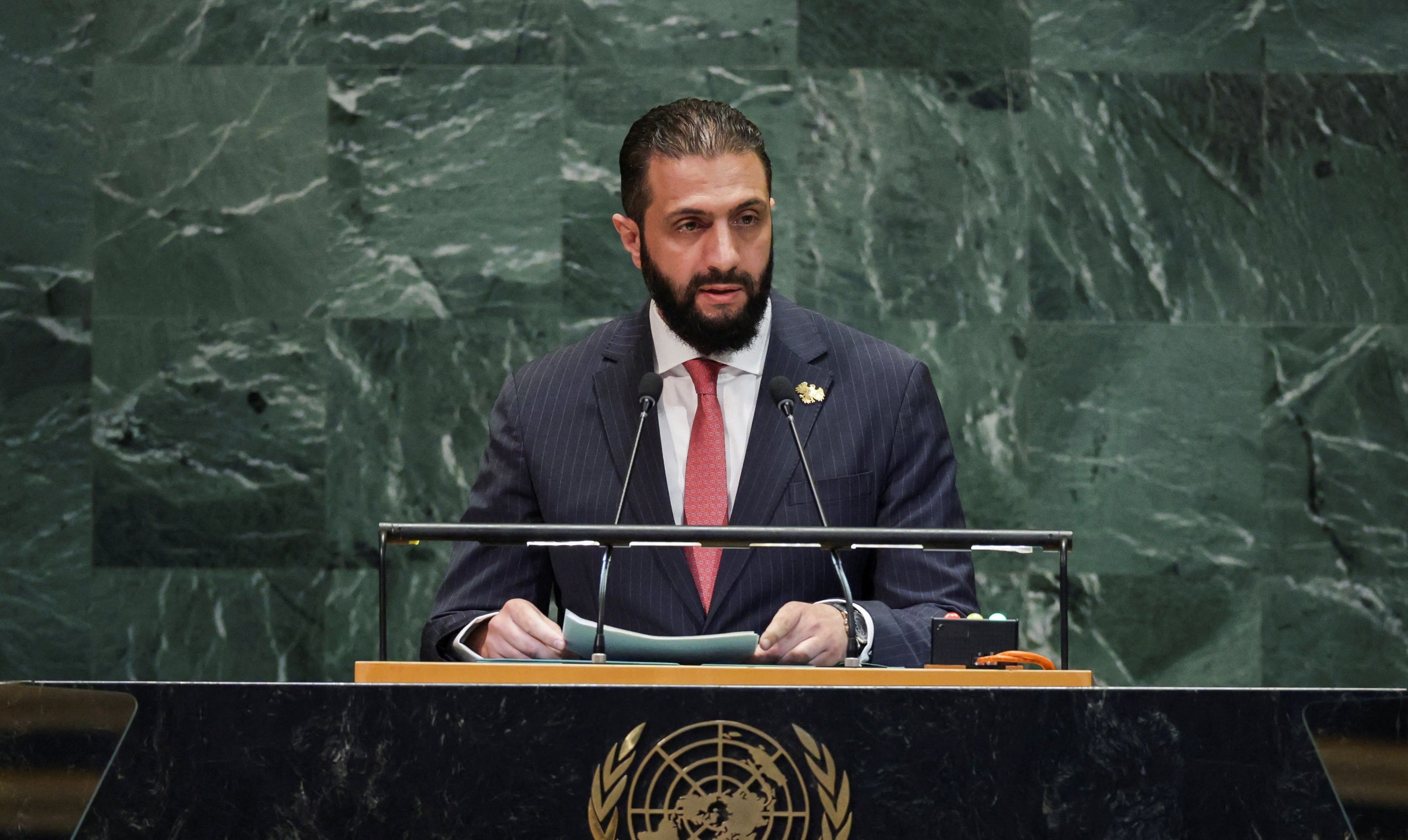
Syria’s President Ahmed al-Sharaa addressed the U.N. General Assembly on Wednesday — the first Syrian leader to do so since 1967. He gave a triumphant speech about Syrians overcoming the murderous Assad regime, vowing to bring those who wronged Syria to justice, and rebuilding anew.
Sharaa has also shuttled around New York City to various engagements. He even sat down with former CIA director David Petraeus, a remarkable moment given that not long ago Washington had a $10 million bounty on his head. At this point, every profile dutifully referencing his past ties to proscribed terrorist groups feels almost a cliche; yet his trajectory — and Syria’s rapid reintegration into the international community — is so extraordinary that it still demands mention.
As I wrote in Foreign Policy in June, the West’s embrace of Syria’s new leadership stands in sharp contrast to its cold rejection of Taliban-ruled Afghanistan. Al-Sharaa, once an al-Qaeda affiliate, now poses for photo ops with Western heads of state, raises Syria’s flag at the U.N., and earns praise from President Trump.
Optics play a role. Al-Sharaa’s rebranding has been welcomed by a Syrian diaspora eager for engagement — as reflected when he addressed Syrian Americans in New York — with minority groups such as Jewish Syrian Americans sitting prominently in attendance. But the deeper reason is strategic: Syria borders Israel, Turkey, and the Mediterranean, and its new government is hostile towards Iran and skeptical of Russia — positive factors from a U.S. and European perspective.
It is still staggering to see Petraeus interview and praise Ahmed al-Sharaa. Yet this transformation did not happen overnight. Al-Sharaa and his group, Hayat Tahrir al-Sham (HTS), had already proven useful in the fight against ISIS and al-Qaeda years before his takeover of Damascus last December. While he once led Jabhat al-Nusra, al-Qaeda’s Syrian affiliate, he was never part of al-Qaeda’s central leadership and eventually broke with Nusra to form HTS. Over time, he has also emerged as a figure capable of galvanizing many Syrians after years of civil war–no small feat.
But the praise lavished on al-Sharaa in New York conference rooms obscures serious problems at home. As QI’s Steven Simon and I recently argued in Foreign Affairs, his insistence on rigid centralization has fueled sectarian violence. Attacks on Alawites and Druze, often carried out with the help of Bedouin fighters, as well as his exerting pressure on the Kurds to disarm, have deepened mistrust among Syria’s minorities. Israel has already intervened militarily to halt massacres of Druze communities, and the Kurdish-led Syrian Democratic Forces now view al-Sharaa’s government as a threat rather than a partner. In addition, while al-Sharaa’s new government has pledged to bring war criminals from the Assad regime to justice, that process has been delayed. The desire for some form of transitional justice may also be fueling sectarian violence in the country.
Once the glamor of the annual gathering of the U.N. General Assembly fades, al-Sharaa will face hard choices in Damascus. Some form of power-sharing is essential to prevent renewed conflict. Allowing minorities autonomy in local governance while keeping foreign policy, defense, and fiscal authority in Damascus could reduce sectarian tensions. Yet al-Sharaa’s coalition resists such reforms, fearing they would dilute Sunni dominance and HTS’s control. For U.S. policymakers, the challenge is to press al-Sharaa toward stability and compromise, not simply applaud his reinvention.
- UAE may need al-Sharaa as much as he needs it. Here's why. ›
- Trump's wise, bold Syria reset ›
- Israel is the main source of instability in the Middle East | Responsible Statecraft ›
- Syria’s ticking time bomb | Responsible Statecraft ›
- Trump welcomes controversial Syrian leader to White House | Responsible Statecraft ›