

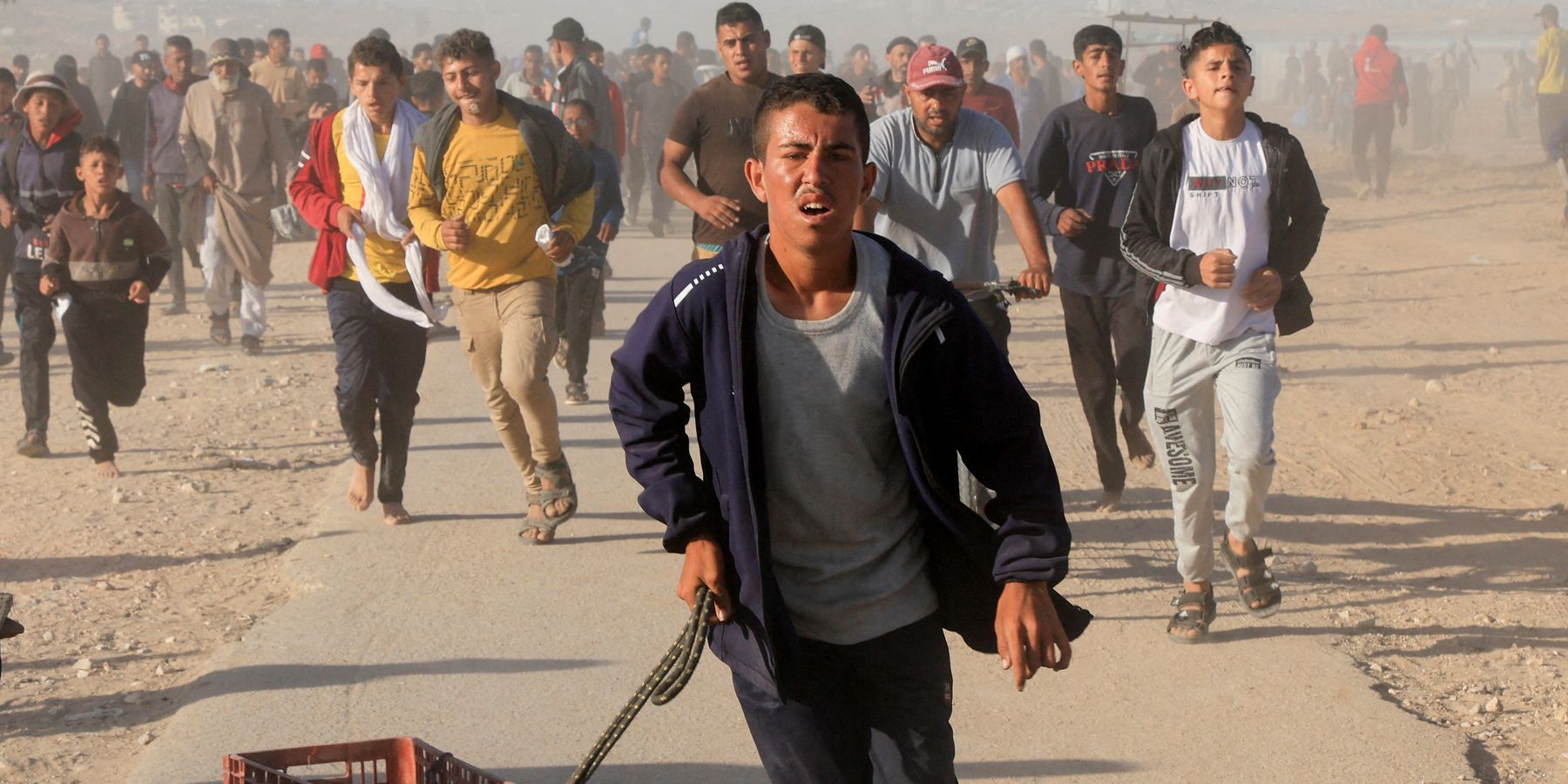
Many human rights organizations say it should shut down. The Israeli Defense Forces (IDF) have killed hundreds of Palestinians at or around its aid centers. And yet, the U.S. has committed no less than $30 million toward the controversial, Israel-backed Gaza Humanitarian Foundation (GHF).
As famine-like conditions grip Gaza, the GHF says it has given over 50 million meals to Palestinians at its four aid centers in central and southern Gaza Strip since late May. These centers are operated by armed U.S. private contractors, and secured by IDF forces present at or near them.
Through almost-daily email campaigns and X posts, the Gaza Humanitarian Foundation contends its work provides critical aid to Palestinians. But these assertions ring hollow when juxtaposed against the disastrous, widely condemned state of its Gaza operations, where IDF soldiers have reportedly been instructed to shoot Palestinians at or around their centers almost every dayGHF's peculiar media strategy
The GHF passes itself off as an independent humanitarian group. In fact, it was conceived by Israeli officials at the beginning of the war, with buy-in from Israeli tech investors and venture capitalists, as well as staff from Israel’s state-aid coordinators, or COGAT (Coordination of Government Activities in the Territories). Israeli opposition lawmakers allege that Mossad, Israel’s intelligence agency, has funded the GHF. Meanwhile, former CIA officer Paul Reilly was allegedly in on the ground floor of the scheme and founded Safe Reach Solutions, one of the two U.S.-based private contracting firms managing the aid hubs. A former U.S. Special Forces soldier heads the other.
For their part, Israeli officials say the GHF is the only safe way to get direct aid to the Palestinians inside. The World Food Programme has found it nearly impossible to operate in Gaza due to the security situation, often halting its operations, while Israel banned the UN program UNRWA, which was the predominant source of aid for Palestinians there, in January.
Eager to depict itself as a force for good, the Gaza Humanitarian Foundation inundates reporters with near-daily communications boasting of the number of meals provided to Gazans, and frequently featuring photos of smiling Palestinians, especially children, receiving aid. Its X account and new, flashy website employ similar messaging and photos.
The GHF has even recruited Shahar Segal, the prominent restaurateur and business partner of celebrity Israeli chef Eyal Shan, as its spokesperson. Segal arguably isn’t the GHF’s only flack: State Department spokespersons Tammy Bruce and Tommy Pigott have repeatedly gushed over GHF aid operations at recent press briefings.
GHF’s other communications efforts are markedly less glamorous. Its Facebook page, for example, often posts announcements in Arabic about upcoming aid distributions. Often, the GHF posts that it’s distributing aid in a given location, only to announce minutes later it’s already handed out all the supplies.
The GHF routinely denounces Hamas in its communications. Like the Israeli government, it says Hamas has fabricated the narrative of Palestinians being harmed or killed by the IDF at their aid sites, even though the killings have been widely reported by numerous mainstream outlets, including Haaretz, Reuters and Al Jazeera.
“There is a growing pattern of violent events being misreported as occurring near our sites, when they involve UN convoys or areas far outside our operations,” the GHF said in a June 17 email. “We’re also concerned by the role of the Hamas-run Gaza Health Ministry, certain UN officials, and Al Jazeera in promoting these false narratives.”
Repeating a common Israeli claim that Hamas diverts humanitarian aid in Gaza to its own ends, Segal insisted that the GHF “is the only right and possible way to deliver food to Gazans without feeding Hamas' terror machine.” But Cindy McCain, the head of the U.N.’s World Food Program, said in late May that there was no evidence Hamas was stealing aid.
Despite credible media reports, GHF insists that IDF soldiers have not killed or injured hundreds of Palestinians seeking aid at their sites. As of June 29, at least 583 Palestinians have been reported killed at or near GHF-run aid sites since May 27, when they started operations.
“It is not surprising that the Gaza Humanitarian Foundation uses social media to portray itself as assisting Palestinians in Gaza,” Annelle Sheline, research fellow at the Quincy Institute’s Middle East program, told RS. “It has to try to overcome the overwhelming evidence that its aid distribution sites are in fact primarily responsible for killing Palestinians rather than saving them.”
Helping Israel dodge accountability
Concerned that GHF’s unconventional operations jeopardize Palestinian lives, many humanitarian organizations condemn its work.
In an open letter released June 23, a group of 15 international human rights organizations, including the International Commission of Journalists, the Palestinian Center for Human Rights, and the New York-based Center for Constitutional Rights, slammed the GHF’s operations, including involving private mercenaries and the IDF.
The GHF’s “new model of privatized, militarized aid distribution constitutes a radical and dangerous shift away from established international humanitarian relief operations,” they wrote.
In another letter from July 1, over 170 humanitarian NGOs, including Doctors Without Borders, Amnesty International, and Save the Children, said the GHF should cease operations. "Today, Palestinians in Gaza face an impossible choice: starve or risk being shot while trying desperately to reach food to feed their families," they wrote.
Alexander Smith, a former USAID contractor who resigned after his work on Gaza was censored by the Biden administration, told RS that the GHF is not behaving like a genuine aid organization. For example, forcing Palestinians to travel to a select few aid centers violated established humanitarian norms. “You don't want sick and injured people having to move, and you don't want them moving across a war zone,” he said. “You get the aid to them.”
Observers contend GHF operations assist Israel’s political goals for the region. Environmental researcher Yaakov Garb found that GHF’s aid structures were designed and located in ways “predominantly responsive to Israeli military strategy and tactics rather than…a broad humanitarian relief intervention.” And the GHF only deploys aid sites in the center and south of Gaza, suggesting the operations aim to force Palestinians out of northern Gaza — where Israel has now banned aid altogether.
"The placement of those three aid distribution hubs in [Gaza’s] extreme south are obviously meant to draw people to the south, near the Egyptian border... to draw people away from the north,” Smith said. “Israeli officials, from Netanyahu to Smotrich, have been very frank about their intention to simply take and resettle that land.”
Sheline said that GHF’s operations and communications help Israel skirt accountability for the humanitarian crisis it has created in Gaza, where Israel has killed more than 56,000 Palestinians since October 7, 2023.
“The IDF only allowed the GHF to begin operating to dispel the impression that Israel is deliberately starving the population of Gaza to death by allowing in almost no food since March 2, and still preventing any medicine, fuel or water from entering the territory,” Sheline said. “The GHF is not intended to help Palestinians, it is intended to dispel negative media coverage.”
When RS asked the State Department about its decision to directly fund the GHF, it was referred to a June 26 press briefing in which Pigott announced the $30 million donation. When reporters at that briefing repeatedly asked about the IDF killing Palestinians at GHF aid centers, Pigott simply said Hamas was solely responsible for starting the war.
“I think everyone in the State Department…and probably within the Trump administration, understands that GHF is not an effective way to deliver aid,” Smith said of the State Department’s $30 million contribution toward GHF operations. “They're choosing to double down on GHF because it's more politically expedient.”
The GHF did not return a request for comment. The IDF says it is investigating the shootings at and around GHF aid hubs as possible war crimes, and plans to reorganize its presence around the aid hubs, adding fences, signs and checkpoints around them, and marked routes to them to minimize “friction with the population.”
- Surprise: CIA link to sketchy Israeli aid scheme ›
- US contractors lose control amid meltdown at new aid center in Gaza ›
- Charges of US contractor abuse in Gaza recalls ugly Blackwater era | Responsible Statecraft ›
- Former Green Beret: The IDF is the GHF’s ‘client’ | Responsible Statecraft ›
- Admin asked if US approves Gaza annex plan, says go ask Israel | Responsible Statecraft ›
- $21.7 billion in US military aid has fueled Israel's war on Gaza | Responsible Statecraft ›
- Are private American guards surging into new Gaza aid sites? | Responsible Statecraft ›