

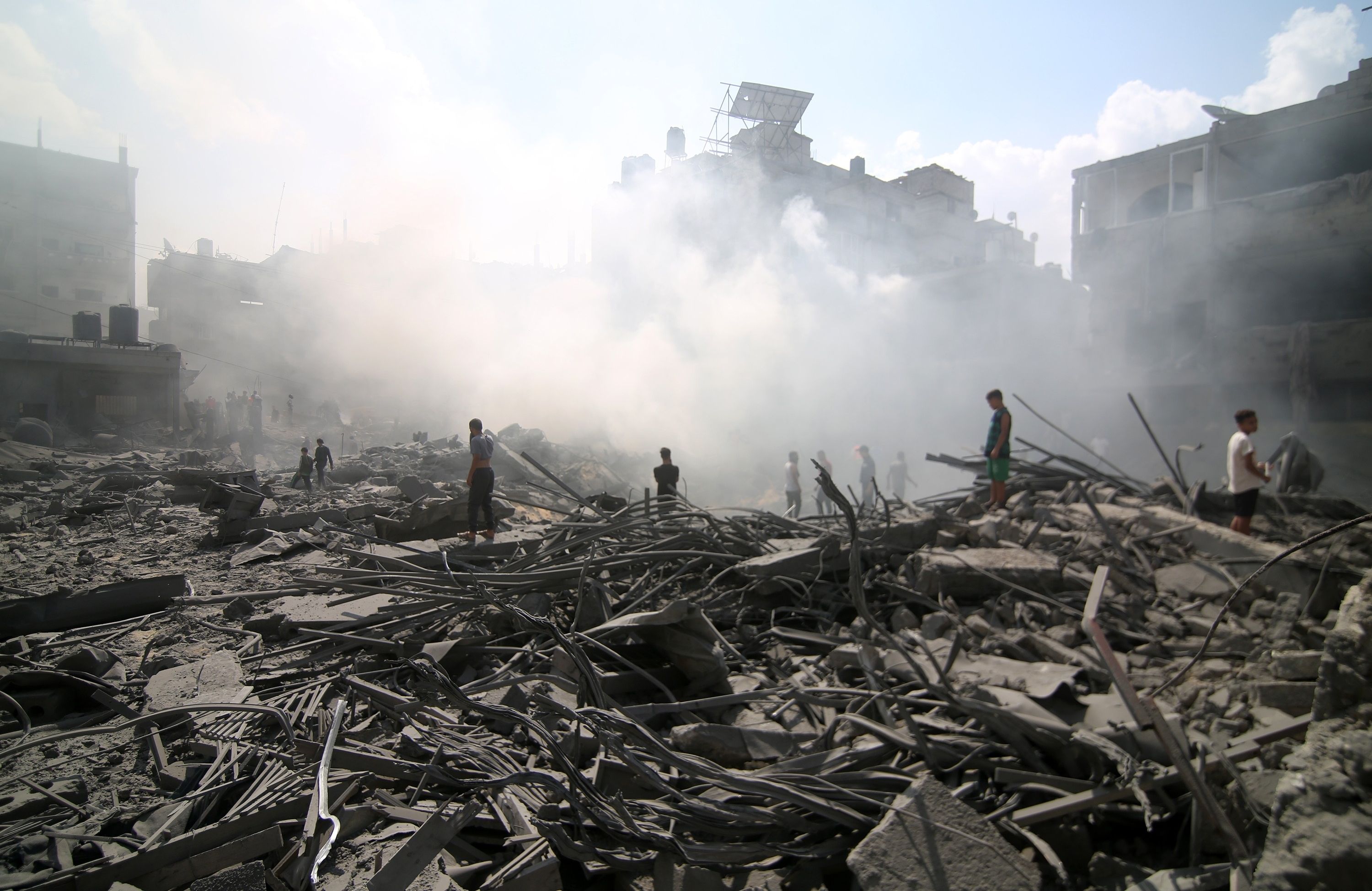
A report released today by the Quincy Institute and the Costs of War Project at Brown University found that the U.S. has supplied $21.7 billion in military aid to Israel since the war in Gaza was triggered by Hamas’October 7, 2023 attack that killed 1,200 people in Israel, mostly civilians. The Israeli response, which has killed tens of thousands of Palestinians, has been described as a genocide by a series of independent experts.
But whether one calls Israel’s actions a genocide, or a series of egregious violations of the laws of war, or merely surveys the human toll, one thing has remained consistent: U.S. military and financial support for the Israeli war effort. The $21.7 billion in U.S.military aid supplied to Israel in the past few years is nearly three times the amount that nation would have received during an average year, based on a 10-year $38 billion commitment negotiated by the Obama administration.
Israel could not have wreaked the level of destruction it has inflicted on Gaza without U.S. weapons and financing, and its ability to widen the war to the broader region would be severely undermined. While some of the weapons slated to be paid for with U.S. aid may not arrive for months or years, over $4 billion worth of weapons transferred from U.S. stocks arrived in short order.
Israel would also have been hard pressed to conduct the war at the pace it did without U.S. assistance with maintenance and spare parts. That’s because Israel’s entire inventory of combat aircraft is composed of U.S.-supplied F-15s, F-16s, and F-35s, as are most of its attack helicopters.
In short, the United States could substantially undermine Israel’s ability to wage war if it cut off weapons, financing and spare parts. But neither the Biden nor Trump administrations have chosen to do so.
And, as another new Costs of War paper by Harvard University economist Linda Bilmes demonstrates, military aid is far from the only economic cost of U.S. support for Israel’s war in Gaza. U.S. military operations in the region — including doing battle with Houthi forces in Yemen and bombing Iran — have cost somewhere between $9.6 billion and $12.7 billion since the start of the Gaza war.
All of this U.S. support has enabled Israel to engage in mass slaughter, with devastating human consequences. Another new Costs of War paper, by Neta Crawford at the University of Oxford and the project’s co-founder, estimates that over 236,000 Gaza residents have been killed or injured during the war, an astounding 10 percent of the territory’s population. And in the fourth paper in the newly published Costs of War series, anthropologist David Vine found that since October 7, 2023, over 5 million people had been displaced by the war in Gaza and the fighting in the wider region.
The humanitarian costs of the Gaza war are unconscionable, but unfortunately they are not the end of the story. Continuing to support Israel’s war efforts in Gaza and beyond could draw the United States into a direct, prolonged conflict in the region, as almost happened when the Trump administration ordered air strikes on Iran in June of this year. Meanwhile, America’s unwavering support for Israel’s brutal war will make it considerably harder for U.S. diplomats to press other nations on human rights issues or speak credibly about a “rules-based international order.”
There are no upsides to supporting Israel’s war on Gaza or its escalation of the conflict to the broader region. When will a U.S. president have the courage to abandon the policy of “Israel right or wrong” and use America’s leverage to stop the killing?
- Is the US now funding the bloodbath at Gaza aid centers? ›
- Gaza breakdown: 20 times Israel used US arms in likely war crimes ›
- Israel to use US military contractors in new Gaza aid scheme ›
- Trump Gaza Deal will work: If he keeps pressure on Israel | Responsible Statecraft ›
- US to build major new base near Gaza: Israeli media | Responsible Statecraft ›
- Plurality of Republicans say end US aid to Israel: poll ›
- Four major dynamics in Gaza War that will impact 2026 | Responsible Statecraft ›
- Congress quietly moves to integrate US and Israeli militaries | Responsible Statecraft ›
- The US wants to end aid to Israel but replace it with something worse ›