

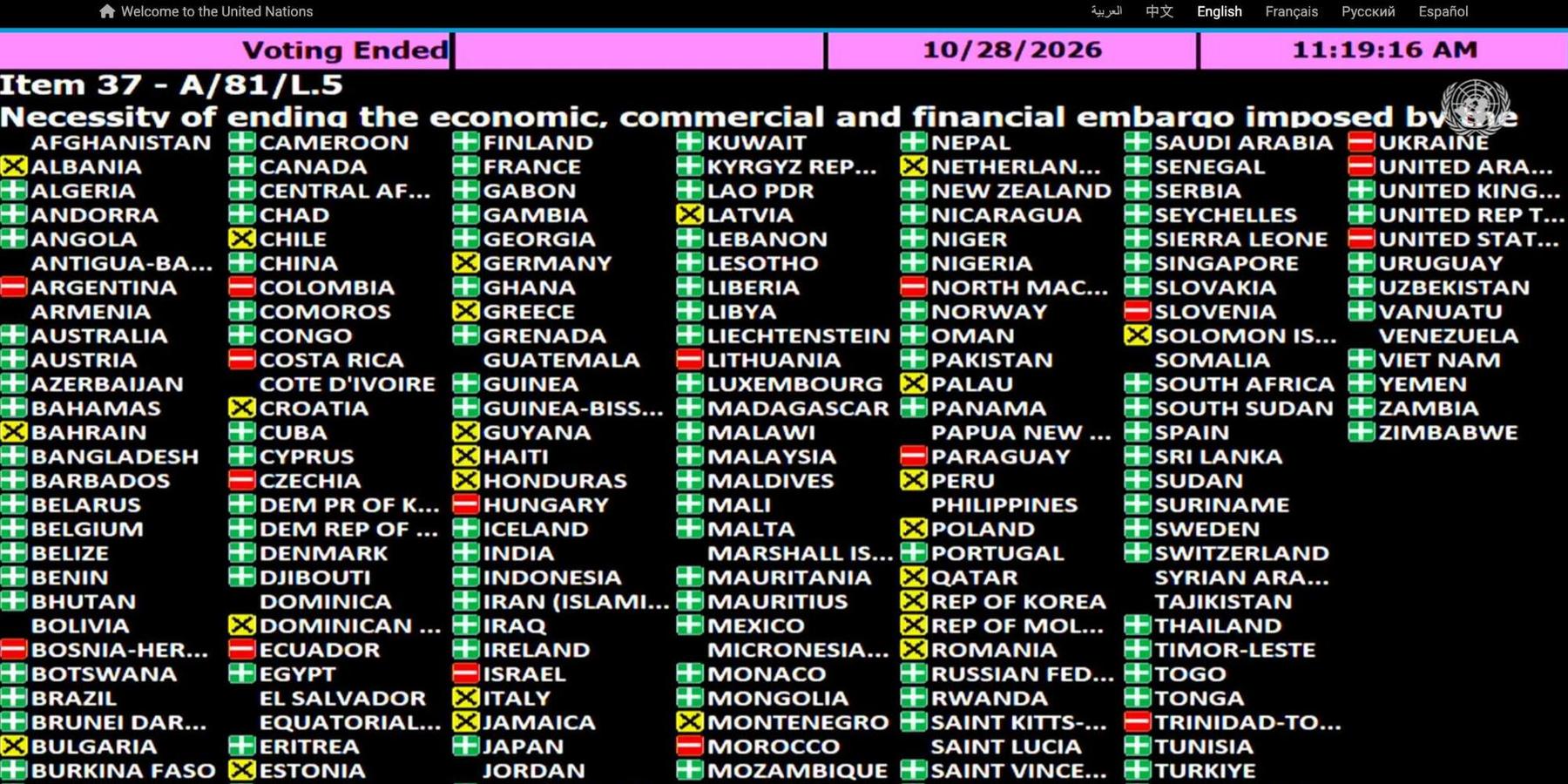
Despite an aggressive U.S. pressure campaign, the United Nations General Assembly voted for the 34th time on Wednesday to condemn the U.S. embargo on Cuba, with 130 nations voting in favor of the resolution, 25 abstaining, and 17 countries, including the U.S. and Israel, voting against.
The Trump administration’s diplomatic push against the annual resolution — spearheaded by U.S. Ambassador to the U.N. Mike Waltz — has been even more intense than last year’s. It also came on the heels of similarly unsuccessful efforts this summer by Secretary of State Marco Rubio to shut down a July 7 General Assembly debate on the escalating U.S. economic sanctions against Havana and the humanitarian catastrophe it has precipitated.
While the pressure failed to defeat the measure, it created a notable shift in the vote tally. Compared to last year, an additional 10 states voted against the measure, and an additional 13 states abstained, particularly countries in Latin America and the Caribbean.
Last week, in anticipation of the vote, Waltz hosted a small group of U.S.-backed Cuban dissidents and researchers for an invite-only event making the case against the resolution, citing the island’s political prisoners, foreign medical brigades, corruption, inequality and the military-run monopoly, GAESA. The same day, Waltz hosted a press conference with the CEO of Freedom House titled, “Holding the Cuban Regime Accountable for its Human Rights Abuses,” where he urged other countries’ ambassadors to consider these issues before casting their votes.
In a press conference days before the U.S. media blitz, Cuba’s ambassador to the U.N., Ernesto Soberón, called Waltz’s event the result of Rubio’s “unhealthy obsession with Cuba,” and staged a protest against Waltz and the event panelists along with his colleagues from Cuba’s U.N. mission.
Cuban Foreign Minister Bruno Rodríguez Parilla went a step further the following day in Havana, alleging that U.S. officials had threatened tariffs, visa denials for foreign officials and their families, and the suspension of U.S. assistance to countries that did not vote with the United States on Wednesday.
Rodríguez presented no concrete evidence for the claims, but in recent weeks, Rubio publicly pressed Salvadoran president Nayib Bukele, whose country did not participate in last year’s vote, to “join the United States and like-minded partners in advancing shared priorities at the United Nations,” stressing that Cuba’s government “will not make the reforms the Cuban people deserve while it believes the international community is on its side.”
Rubio also recently spoke with the presidents of Panama, Argentina and Colombia — all close allies of the Trump administration — about “regional,” “hemispheric” and U.N.-related issues, though it’s not immediately clear whether the Cuba vote was specifically addressed.
Similar to last year’s push, Waltz invoked the presence of Cubans fighting for Russia in Ukraine to lobby European capitals against supporting Cuba’s U.N. resolution.
In a recent statement, the Cuban government again reiterated its “zero-tolerance policy” against mercenarism, saying that “none of the Cuban citizens who have participated or are participating in any of the parties to this conflict have the encouragement, support, or consent of any Cuban state or government institution.” Authorities say investigations into the recruitment of Cuban citizens abroad to fight in Ukraine have resulted in 43 people being brought before Cuban courts in 12 distinct proceedings, with prosecutors seeking sentences ranging from 5 to 16 years.
Boiling tensions between the longtime adversaries spilled out into the open during the first day of debate this week when Rodríguez Parilla interrupted and approached Ambassador Waltz as he showed images of alleged corruption by Cuban leadership, calling for a point of order.
“He’s not going to intimidate me in the United States of America like he tries to intimidate political prisoners,” Waltz shot back at Rodríguez.
“You are a liar,” Rodríguez retorted.
After a Cuban diplomat tried to prevent one of Waltz’s staffers from filming him as he asked U.N. employees to cut Waltz’s microphone, Waltz told Fox News that Rubio had signed off on the Cuban diplomat’s expulsion from the United States.
While this year’s non-binding vote picked up marginally more support for the U.S. position than in past years, it nonetheless reflected the limits of the administration’s diplomatic arm-twisting — and its null impact on remedying the plight of the Cuban people.
But the State Department’s ratcheted up pressure did not fall flat with everybody. In Europe and the Middle East, Lithuania, Slovenia and the United Arab Emirates broke from their historic position by voting against the resolution, while in Latin America and the Caribbean, Costa Rica, Colombia, Trinidad and Tobago, Honduras and Chile — which have traditionally backed Cuba’s efforts — opposed the resolution or abstained.
Nevertheless, other U.S. allies that have criticized Cuba’s political and economic systems maintained their firm position against the decades-long system of unilateral coercive measures, which, they claim, indiscriminately punishes the Cuban people, violates international law, and discourages reforms related to human rights or the economic system on the island.
“Mexico maintains that the use of unilateral measures as a means of exerting external pressure to influence internal decisions within a sovereign state is incompatible with the principles enshrined in the charter of this organization,” Mexico’s U.N. ambassador Hector Vasconcelos said during the debate.
“The restrictions on fuel exports to Cuba have aggravated the country’s ongoing energy crisis. The shortages have disrupted essential services, including healthcare, education, water supplies, food distribution and transportation,” added India’s representative to the U.N. “India hopes that the embargo will be lifted at the earliest, to help create an environment that would enable the people of Cuba…to pursue their legitimate development aspirations.”
Earlier this year, Cuba presented a report, submitted alongside the draft U.N. resolution, on the impacts of U.S. sanctions on the country’s economy, claiming over $8 billion in losses and damages stemming from maximum pressure U.S. sanctions under the Trump administration.
So far this year, the U.S. has threatened imposing 30% tariffs against countries sending fuel to Cuba, created a new secondary sanctions regime targeting foreign firms operating on the island, and issued dozens of new sanctions and visa restrictions against Cuban officials, ministries, joint ventures, state-owned companies and the country’s fledgling private sector.
The unprecedented squeeze comes amid threats of military and covert action on the island to force regime compliance alongside direct talks between senior U.S. defense, intelligence and policy officials and their Cuban counterparts, as well as reports of back-channel deals and posturing to assume control of Cuba’s key economic assets.
Most recently, on Friday, Rubio called on Cuban leaders to enter into a “discrete partnership” with the CIA — a move seen as an effort to frighten Havana with the specter of covert operations — and Trump said on the campaign trail in Florida that U.S. warships returning from the Middle East could stop over in Cuba on their way back from the war in Iran.
“What we're going to do with Cuba is we're going to come back from Iran. Those beautiful ships will pass Cuba. We'll have one of them stop about 50 yards off the coast. They'll raise up their hands. And then we're going to send Marco Rubio in to finish up the deal," Trump said, reiterating a pledge he made five months earlier.
Editor's note: This breaking story was last updated at 11:56 a.m. U.S. Eastern time.
- 65 yrs after first one, Trump's 'Bay of Pigs' may take many forms ›
- Trump and 14 Lat Am leaders ignite new drug-terror war at UN ›
- How years of US policy put Cubans on a path to Gitmo ›