

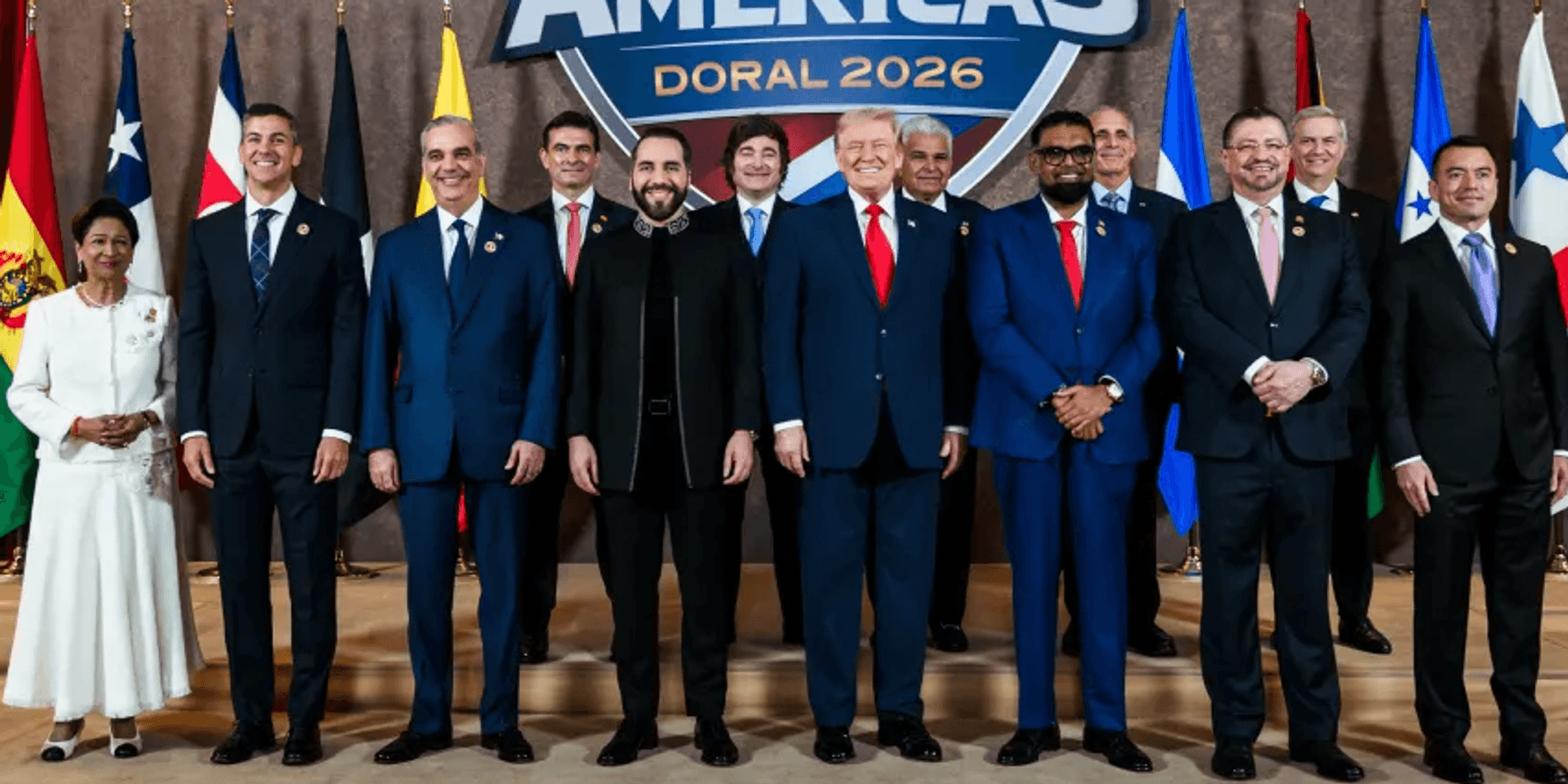
On the sidelines of the United Nations General Assembly (UNGA) in New York on Tuesday, 14 Latin American and Caribbean countries followed the Trump administration’s lead by designating 24 cartels, prison gangs, and drug trafficking groups as foreign terrorist organizations (FTOs), laying the groundwork for potential U.S. military involvement in operations across the Western Hemisphere.
The announcement came from the majority of the member-states of the Shield of the Americas, a loosely-formed coalition of 19 right-leaning regional governments — including Colombia, Argentina, Chile and Peru — which in March committed to use lethal military force against criminal groups alleged of drug trafficking to the United States.
The Shield members that — for reasons not immediately clear — did not sign Tuesday’s statement include Guatemala, Jamaica, Belize and Bahamas. Other hemispheric governments led by nominally left-of-center leaders, such as Mexico, Brazil, Canada, Venezuela, Uruguay, Nicaragua, Cuba and several Caribbean nations — some of which are regional epicenters for organized crime — have not been invited to join the ad-hoc coalition.
The joint declaration, which invoked the 1947 mutual defense pact known as the Rio Treaty, came just hours after President Trump told world leaders that “the cartels are the ISIS of the Western Hemisphere.” As such he was previewing what many believe may signal the acceleration of open-ended, ill-defined, and unauthorized U.S. military deployments across wide swaths of Latin America and Caribbean in a fusion of the war on drugs with the war on terror.
“For years, the cartels have waged war against the people of this hemisphere. Now, we’re waging war on them,” Trump told several heads of state, including Ecuadorean President Daniel Noboa, Honduran President Nasry Asfura, and Bolivian President Rodrigo Paz, at the gathering of the consortium being led by ousted Homeland Security Secretary Kristi Noem.
Tuesday’s announcement followed statements last month by Secretary of Defense Pete Hegseth at a Panama gathering of the Americas Counter-Cartel Coalition (AC3), the Shield's operational wing, that five countries — Ecuador, Colombia, Honduras, Jamaica and Guatemala — had authorized U.S. forces to conduct joint military operations against armed groups in their national territory. Since March, Ecuador has been hosting U.S. special forces in joint operations near the border with Colombia, which has agreed to host the organization’s regional headquarters in Medellín. Colombia also plans to borrow three U.S. MQ-9A reaper drones to carry-out precision strikes against high-value targets and is slated to receive $1 billion in fresh U.S. security assistance over an undefined period of time.
While Tuesday’s joint declaration also highlighted plans to boost economic cooperation and multilateral coordination, the coalition’s principal objective is “to do bad things to bad people,” Hegseth told the senior military leaders assembled in Panama, warning them of the alleged threats also posed by irregular migration and extrahemispheric actors like China.
Tuesday’s meeting came a week after U.S. officials announced that $52 million in foreign military financing would be redirected from African and European countries to Ecuador, Colombia, Peru and Panama. More recently, defense officials speaking with CNN said that “most” of the Pentagon’s high-powered drones operating in Africa will likely be transferred to South America in anticipation of escalating, land-based counternarcotics and counter-terrorism operations.
While most, if not all, of the region’s leaders understand the acute challenges to their societies posed by organized crime, experts and former officials say that coercive pressure must act in concert with law enforcement-led solutions and economic development, as well strengthening the rule of law, combatting public corruption, and disrupting illicit financial flows, if security strategies are to prove durable over time.
“Criminal organizations are not terrorist organizations,” Todd Robinson, a top Biden administration official for international narcotics and law enforcement, told the New York Times. Weakening these groups requires bolstering a “civilian security apparatus that is trained to go after these organizations — to go after their money, to collect evidence, to indict and prosecute and to, under the rule of law, bring these people to justice.”