

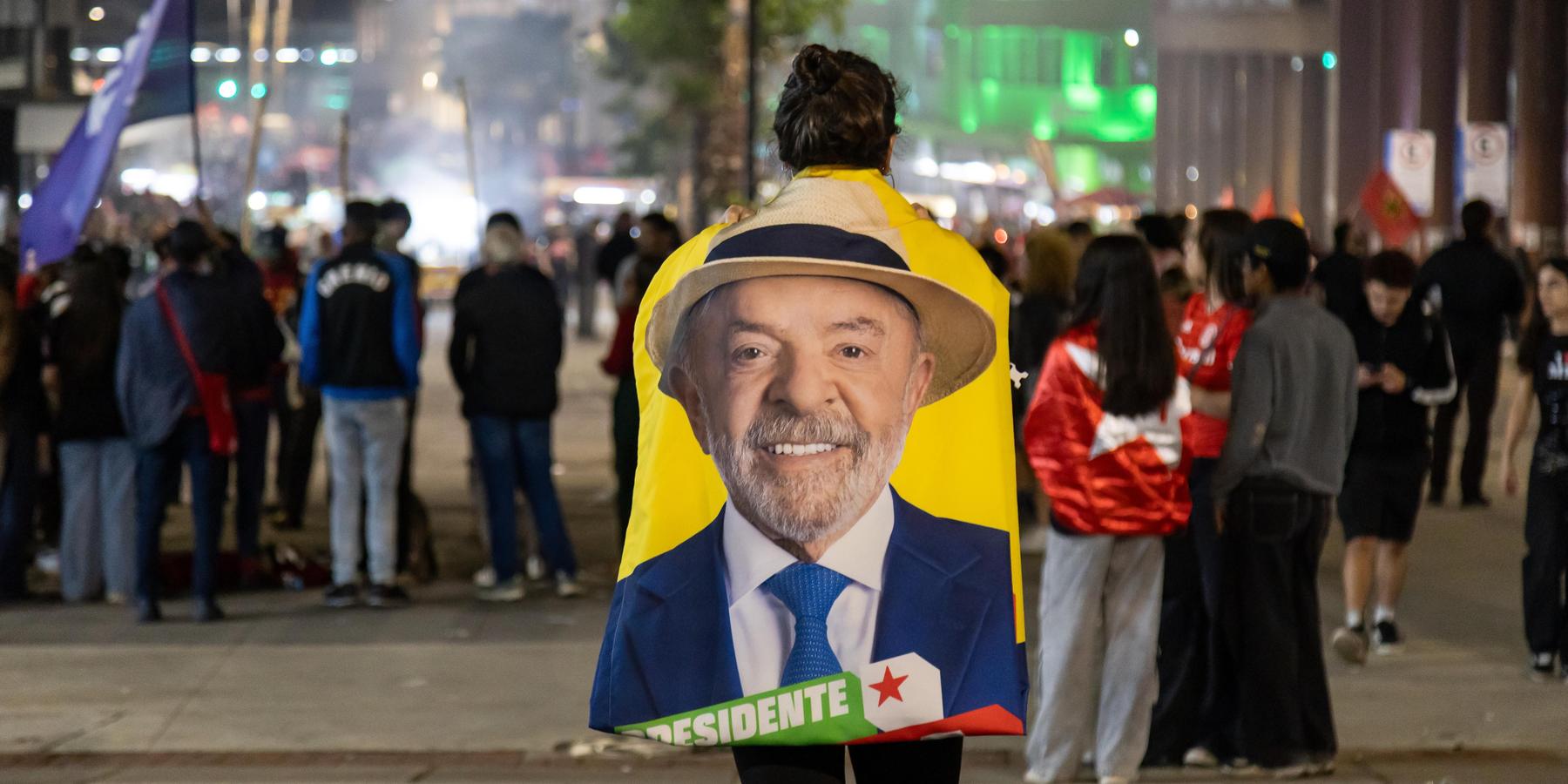
Luiz Inacio Lula da Silva’s come-from-behind victory in the Brazilian election, to borrow a phrase, is not the end of the Donroe Doctrine, but it marks the end of the Donroe Doctrine’s beginning.
For the first time since the second Trump administration began, Washington’s preferred election outcome in a Latin American country has not come to pass. Lula’s victory comes despite a determined U.S. government effort to shape the result in favor of Flavio Bolsonaro, the son of former Brazilian President Jair Bolsonaro, who fled Brazil after the vote and is now in exile in the United States. President Donald Trump’s interference also let Lula present his candidacy as a defense of Brazil’s sovereignty. Now Lula, having won re-election, can rightly claim that he has punctured the myth of the Donroe Doctrine’s invincibility.
Yet the most significant damage the Donroe Doctrine sustained Sunday was not inflicted by Lula. Instead, the most telling sign of the Donroe Doctrine’s weakening hold on Latin America was the decision of just about every right-wing Latin American government, except Argentina and El Salvador, to publicly accept the result and congratulate Lula on his re-election.
Paraguay got there first, with its president, Santiago Peña, posting a congratulatory message by 9:31 pm on election night, Brasilia time. Under Peña, Paraguay has largely followed the U.S. lead, even designating the Iranian Islamic Revolutionary Guards Corps a terrorist organization at Washington’s request.
Within 10 minutes, at 9:38 pm Brasilia time, Bolivian President Rodrigo Paz posted his own congratulations. Paz’s government earlier this year barely survived an intense crisis of large-scale protests, during which Paz received significant public support from the United States.
At 10:18 pm Brasilia time, Chilean President Jose Antonio Kast upped the ante by announcing he had spoken by phone with Lula to congratulate him personally. Despite Kast’s right-wing credentials, Chile’s relationship with Washington has grown testy as a result of U.S. pressure on Kast to cancel a project to lay an undersea data cable connecting Valparaiso with Hong Kong. Most recently, the U.S. ambassador to Chile, former Border Patrol officer Brandon Judd, added to the ill will by threatening Chile’s sovereignty over the Strait of Magellan if the country failed to align itself more closely with Washington.
Ecuadorian President Daniel Noboa’s congratulatory post came at 10:50 pm Brasilia time. Noboa, who sought Trump’s support during his 2025 presidential campaign, has directly invited U.S. troops into Ecuador to help fight various criminal groups. The U.S. intervention in Ecuador’s drug war has already resulted in controversial incidents, including an attack on a dairy farm.
Peru’s newly-elected president, Keiko Fujimori, who has provided symbolic support for the U.S. war with Iran, capped off the night with her own congratulatory post just before 11:00 pm Brasilia time. The following morning, at 10:21 am Brasilia time, came the congratulatory social media post by Costa Rica’s right-wing president, Laura Fernandez Delgado, followed at 2 pm Brasilia time by a post from Honduran President Nasry Asfura, who Trump actively supported during his very narrow election last November.
The most interesting congratulations the next morning came from Colombia’s newly-elected right-wing president, Abelardo De La Espriella, who openly acknowledged that he had supported Lula’s opponent. De La Espriella got to brass tacks, writing on X: “Brazil and Colombia need each other. No consideration can stand above the interests of our nations.” That apparently includes consideration of what Washington will think.
Paraguay, Bolivia, Chile, Ecuador, Peru, Costa Rica, Honduras, Colombia – all of these states have signed up to Trump’s new “Shield of the Americas,” which aims to institutionalize the Donroe Doctrine as a regional security architecture. Yet here they all are, recognizing Lula’s victory.
Tellingly, all of these Latin American recognitions of Lula’s victory came before any official reaction from the Trump administration. In his first public comments on the election, issued almost a day later, Trump said the election looked “terrible” and “like another rigged election,” while also claiming falsely that he “didn’t take sides.”
Washington is no doubt displeased with Lula’s win. With Flavio Bolsonaro now having fled the country to the United States, the option certainly exists for the U.S. government to escalate its interference in Brazilian affairs and seek to undermine Lula’s government with Bolsonaro as figurehead. Yet the reaction of Latin America’s right-wing governments suggests that such blatant U.S. interference in Brazil’s domestic politics would not enjoy much regional support.
We have thus discovered the limits to the Donroe Doctrine. Yes, right-wing elites in various Latin American countries, Brazil included, are happy to benefit from U.S. electoral interference to bring them to power. Yes, right-wing regional governments appreciate U.S. financial and military assistance, as well as the U.S. looking the other way from the growing authoritarianism, corruption, or human rights abuses of these same governments. In return, these governments are also happy to symbolically join U.S.-led projects such as lending diplomatic support to the U.S. blockade of Cuba at forums like the UN. They are especially eager to bring U.S. power to bear against their own criminals or domestic opponents – and to blur the line between the two.
Yet, risking economic ties with Brazil is a much bigger ask. Take Paraguay, which was the first Shield of the Americas signatory to publicly congratulate Lula. Brazil is already the number one destination of Paraguayan exports, making the relationship with Brazil one no Paraguayan President can afford to put at risk. The U.S. cannot hope to overtake Brazil in importance as a trading partner for Paraguay, especially not with a populist U.S. electorate ready to punish politicians for actions that harm domestic U.S. production, such as the importation of Argentine beef. In time, this logic will likely prevail in Argentina, where, despite Milei’s erratic leadership, the significance of Brazil as a trading partner cannot be ignored.
The Latin American right’s geopolitical alignment with the United States ends where national economic interests begin. As many have long noted, this is the exact dynamic that also holds true in regard to Latin America’s relationship with China. Weak and destitute Cuba is easy to cut ties with; wealthy and powerful China is another matter entirely. Brazil has proved to be in China’s category, not Cuba’s. Brazil might simply be “Too Big to Coup.”
This raises an uncomfortable thought: rather than expanding Washington’s influence and control over the hemisphere, the Donroe Doctrine may actually represent how the U.S. is being used by Latin America’s right wing elites. Washington’s policymaking is sadly no stranger to capture by foreign elites with money to spend and diasporas to mobilize. Multiple right-wing Latin American presidents are now actively intervening in domestic U.S. politics, such as by endorsing Miami Republican Maria Elvira Salazar, who is among those governments’ most effective advocates in Washington.
Through such political allies and sympathetic diasporas in the United States, Latin America’s right-wing leaders have thus convinced the Trump administration to foot the bill for economic bailouts and security cooperation. In exchange, Washington has received little more than killing alleged drug traffickers and symbolic gestures from these right-wing governments, such as moving their embassies to Jerusalem or cutting ties with Cuba and Iran, all while these governments continue to benefit from close economic ties with China.
Forget choosing between Washington and Beijing. The Latin American right has proven unwilling even to choose between Washington and Brasilia!
The Donroe Doctrine is thus exposed for what it is: reducing the United States to a piggy bank and a provider of mercenaries for Latin American elites who are pursuing their own profits and domestic agendas regardless of Washington’s preferences. “Americas First” and “America First” are proving incompatible.
- What Brazil's president did instead of joining Trump's 'Board of Peace' ›
- Trump's 'Shield of the Americas' is more fragile than it seems ›